Coin Value Contents Table
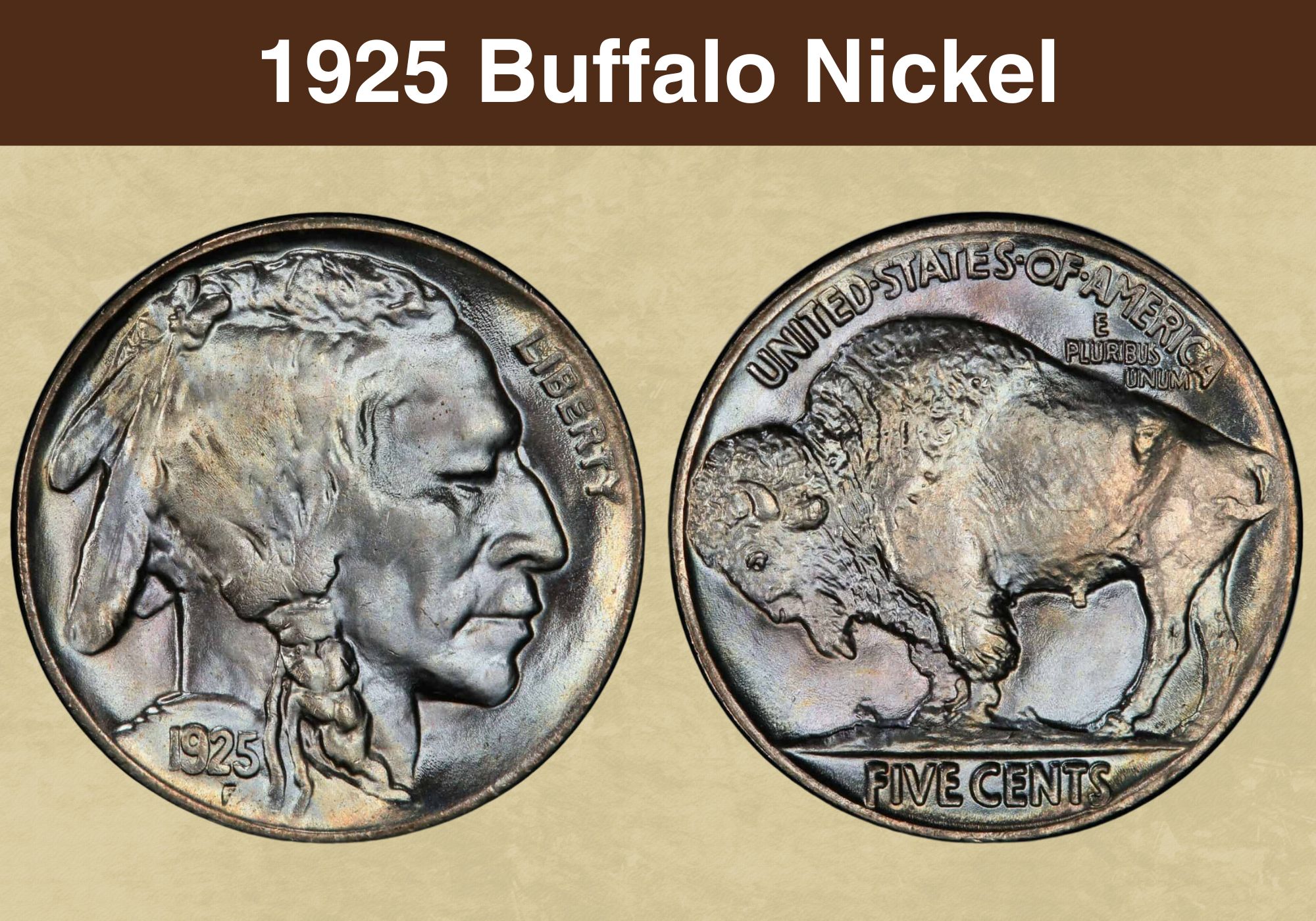
For those who appreciate the artistry of vintage coins, the 1925 Buffalo Nickel is a true masterpiece. This stunning coin showcases exquisite design and embodies a rich history that makes it a desirable piece for any serious collector.
If you’re curious about the value of this vintage treasure, then you won’t want to miss our comprehensive guide. This article covers everything you need to know about the 1925 Buffalo Nickel value.
We’ll go over all the important aspects of this iconic coin, from its design to its historical significance. So, let’s cut to the chase and dive right in!
1925 Buffalo Nickel Value Chart |
||||
| Mint Mark | Good | Fine | Extremely Fine | Uncirculated |
| 1925 No Mint Mark Buffalo Nickel Value | $3 | $7.50 | $25 | As high as $17,500 |
| 1925 “D” Buffalo Nickel Value | $20 | $45 | $195 | As high as $12,000 |
| 1925 “S” Buffalo Nickel Value | $7.50 | $35 | $200 | As high as $50,000 |
1925 Buffalo Nickel Grading
Grading is a crucial part of evaluating the value and authenticity of a 1925 Buffalo Nickel. The coin’s condition plays a crucial role in determining its grade, which can range from Poor to Mint State.
Professional coin grading services, such as the Professional Coin Grading Service (PCGS) and the Numismatic Guaranty Corporation (NGC), use a standardized system to grade coins based on their wear, luster, and overall appearance.
It is important for collectors to understand the grading system to assess their coins’ value accurately. For more information on coin grading.
| # | Grade |
|---|---|
| 1 | Basal State-1 |
| 2 | Fair |
| 3 | Very Fair |
| 4, 5, 6 | Good |
| 7, 8, 10 | Very Good |
| 12, 15 | Fine |
| 20, 30 | Very Fine |
| 40 | Extremely Fine |
| 50 | About Uncirculated |
| 60 | Mint State |
| 65 | Mint State |
| 70 | Mint State |
Please check our grading guides to know your coin scale, It’s the necessary step to know the exact value of your coin.
Check out now: How to Grade Buffalo Nickel?
1925 No Mint Mark Buffalo Nickel Value
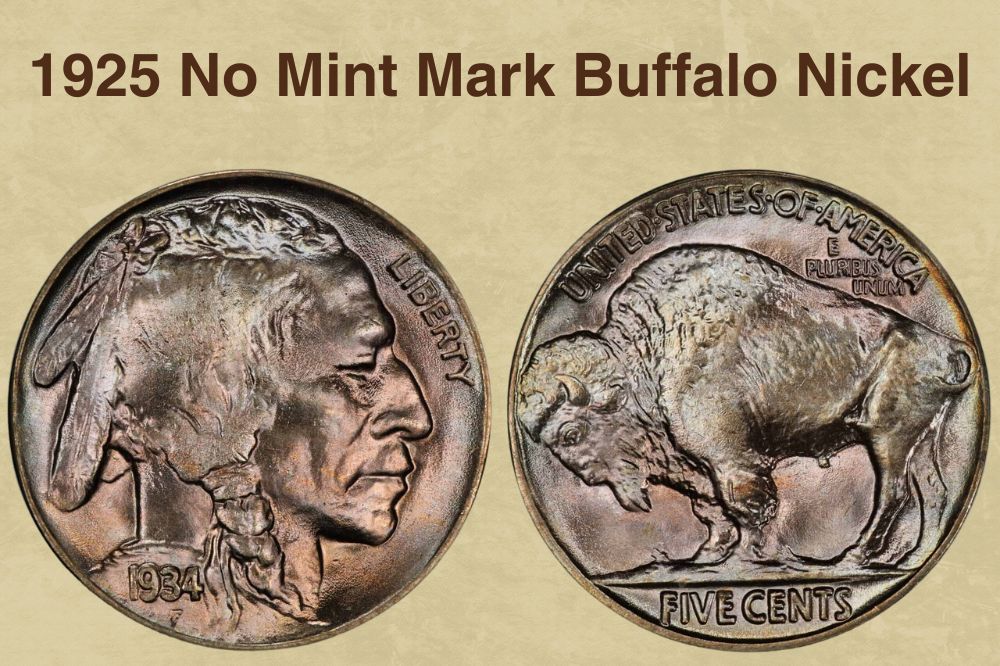
The Buffalo Nickel, often known as the Indian Head Nickel, was created by James Earle Fraser and was initially struck in 1913. It was produced until 1938. Due to its rarity and distinctive design, the 1925 Buffalo Nickel without a mint mark is especially valued.
The obverse side of the coin depicts the portrait of a Native American chief, which Fraser fashioned after three different people: Chief Iron Tail of the Lakota Sioux, Chief Two Moons of the Cheyenne, and Chief John Big Tree of the Seneca.
The reverse side of the coin depicts an American bison, which is thought to be based on a bison named Black Diamond that once roamed in New York City’s Central Park Zoo.
James Earle Fraser, the Buffalo Nickel’s creator, was a student of Augustus Saint-Gaudens, one of the most notable American sculptors of the late nineteenth and early twentieth century.
The coin’s elaborate design, filled with depth and detail, is a clear example of Fraser’s sculptural background. The Buffalo Nickel is regarded by many as one of the most exquisite coins ever made in the United States.
The 1925 Buffalo Nickel is not only beautiful but also historically significant. The currency was produced during a time when America endured substantial transformation. The Roaring Twenties, or the 1920s, were a prosperous and revolutionary decade.
But at the same time, hostilities were growing between Native People and the federal government, which prompted the Indian Citizenship Act to be passed in 1924.
Minted in Philadelphia, the total mintage of the 1925 Buffalo Nickel without a mint mark was 35,565,100. Due to its distinctive appearance and fascinating history, the 1925 Buffalo Nickel without a mint mark is nevertheless considered a highly collectible coin even though it has a relatively high mintage.
The 1925 Buffalo Nickel is an alloy, also referred to as “cupronickel,” consisting of 75% copper and 25% nickel. The coin weighs 5 grams and has a diameter of 21.2 millimeters.
The 1925 Buffalo Nickel without a mint mark’s value can differ considerably, just like other vintage coins, based on its condition, rarity, and historical relevance.
While a coin in good condition might only be worth $3 to $4, a well-kept, uncirculated 1925 Buffalo Nickel without a mint mark can be worth as much as $17,500.
It’s also interesting to note that the Buffalo Nickel wasn’t immediately well-liked when it was initially released in 1913. The coin’s unusual design drew criticism from people who thought it was too “busy” and challenging to read.
Some people took issue with the coin’s depiction of a Native American, saying it was disrespectful and demeaning. In spite of the criticism, the Buffalo Nickel eventually rose to become one of the most cherished and iconic coins in American history.
1925 “D” Buffalo Nickel Value
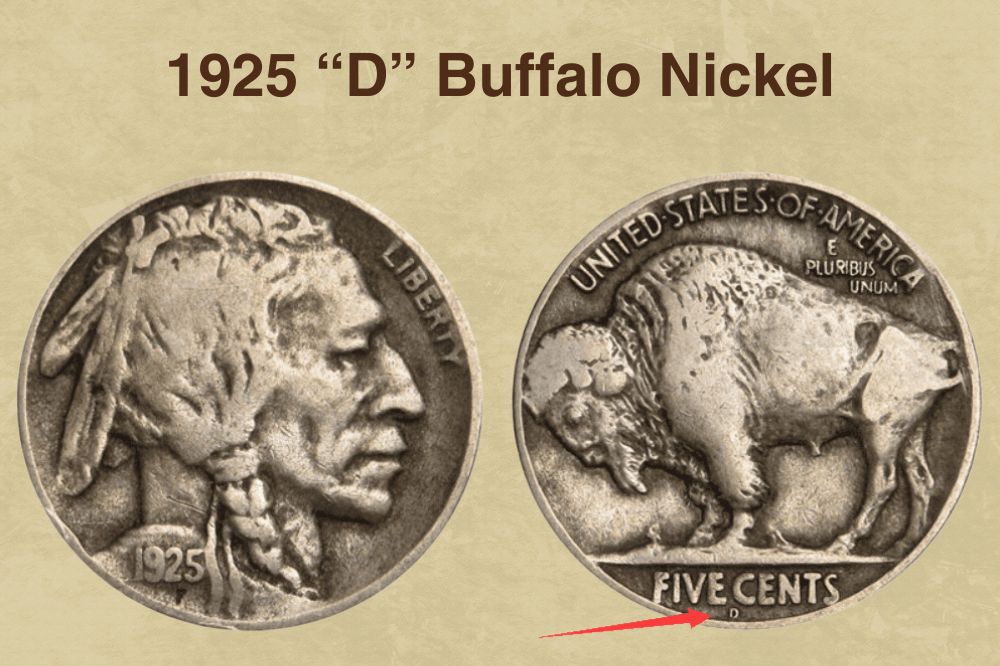
Like its previous variant, the 1925 “D” Buffalo Nickel is not behind in terms of demand and collectability. The coin’s collector value is increased by the “D” on it, which stands for the Denver Mint, where it was made in 1925.
James Earle Fraser also designed this version of the Buffalo Nickel series. The obverse side of the 1925 “D” Buffalo Nickel features the image of a Native American chief, while the reverse side has the image of an American bison.
The reverse design of the 1925 “D” Buffalo Nickel is an intriguing characteristic. The legendary American bison known as “Black Diamond,” who once resided in New York City’s Central Park Zoo, is represented on the coin. Prior to producing the coin’s design, Fraser is rumored to have visited the zoo and seen the animal up close.
The 1925 “D” Buffalo Nickel serves as a physical reminder of a pivotal time in American history. The Native American head and American bison on the back of the coin act as a constant reminder of the nation’s rich natural and cultural heritage.
The 1925 “D” Buffalo Nickel is a rare coin because only 4,450,000 of them were produced. The coin has a diameter of 21.2 millimeters, weighs 5 grams, and is made up of 75% copper and 25% nickel.
The 1925 “D” Buffalo Nickel’s value is greatly enhanced by its scarcity. Its value might vary greatly based on the coin’s condition, variety, and historical importance.
While a coin in lousy condition might only be worth a few dollars, a well-kept 1925 “D” Buffalo Nickel in uncirculated condition can be valued at as high as $12,000.
Some specimens can fetch even higher values at auctions like this rare 1925 “D” Buffalo Nickel. Graded MS66, the coin was sold for an impressive $57,500 at an auction held in 2007.
The location of the mint mark on the 1925 “D” Buffalo Nickel is an intriguing feature. The “D” mint mark appears on the coin’s back side, directly underneath the denomination.
The mint mark was often found on the coin’s obverse side for other Buffalo Nickels made in Denver; thus, the 1925 “D” Buffalo Nickel’s positioning is distinctive.
Also read: Top 17 Most Valuable Buffalo Nickel Worth Money
1925 “S” Buffalo Nickel Value
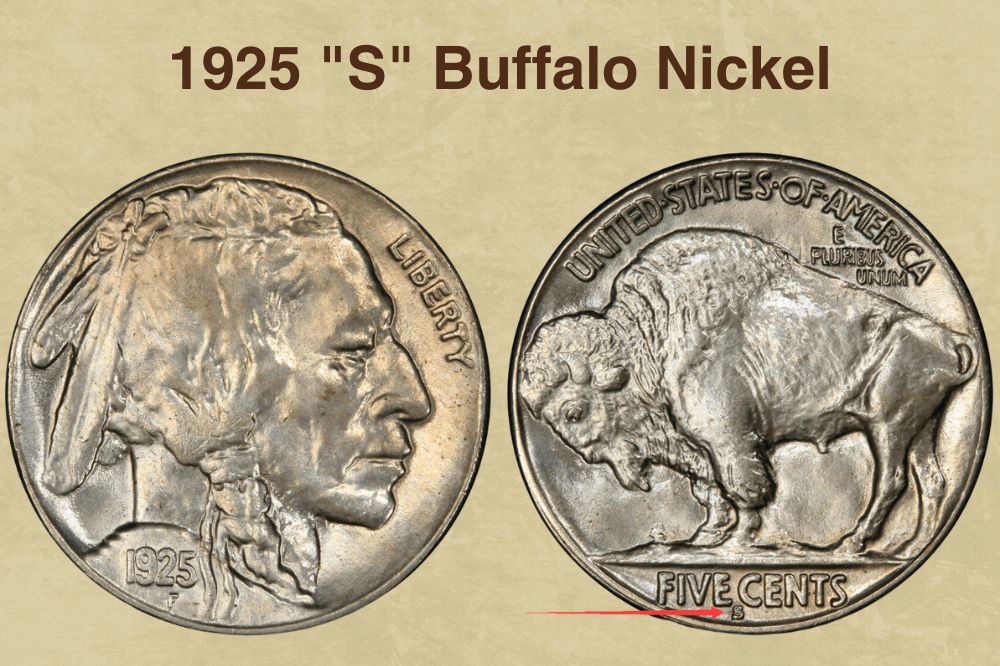
The 1925 “S” Buffalo Nickel is a highly sought-after coin by collectors and enthusiasts because it oozes rarity and beauty. Created in San Francisco, California, the coin is a tribute to American history and design.
The 1925 “S” Buffalo Nickel’s design by James Earle Fraser was a significant change from the prevalent coinage at the time, just like its other variants. The mighty American bison is shown on the back, while the obverse shows a profile of a Native American chief that is thought to be a composite of three different people.
The time when the 1925 “S” Buffalo Nickel was minted holds a special place in American history. The Indian Citizenship Act of 1924 granted Native Americans citizenship but also compelled them to adapt to American society, leading to the collapse of many Native American customs.
The 1925 “S” Buffalo Nickel is a rare treasure and an excellent addition to any portfolio, with a cumulative mintage of just 6,256,000 pieces.
This coin was created by the San Francisco Mint, renowned for its expert craftsmanship and attention to detail. It stands out for its elaborate design and extensive history.
In addition to having a distinctive mint mark positioning, the 1925 “S” Buffalo Nickel differs slightly from Philadelphia and Denver counterparts in terms of appearance. These variances include the thickness of the strike and the curvature of the buffalo’s horn.
This coin is made even more desirable by its distinct design and mint mark, which underscore the special history and significance of the San Francisco Mint in the early 20th century.
Moving on to the value, a 1925 “S” Buffalo Nickel in MS-63 condition that has been ideally kept can be worth about $1375, whereas a coin in a lower grade, like Fine-12, may only be worth about $35.
The coin’s value can also be impacted by elements like shine and strike quality, with coins with Full Steps designation being more desirable. Coins with rust or substantial wear, on the other hand, might only be worth a few bucks or less.
To sum up, the value of a 1925 “S” Buffalo Nickel ultimately depends on a number of variables, thus, it is crucial for investors and collectors to thoroughly inspect the coin before making a buy or sale. A 1925 “S” Buffalo Nickel recently fetched a high price of $3840 at an auction in Feb 2023.
Even though the coin faced several objections for its unconventional design, the Buffalo Nickel evolved to become a renowned representation of American history and culture. The 1925 “S” Buffalo Nickel symbolizes the coin’s enduring heritage because of its rarity and attractive appearance.
Also read: Top 10 Most Valuable Nickels Worth Money
Rare 1925 Buffalo Nickel Errors List
1925 Buffalo Nickel Clipped Planchet Error
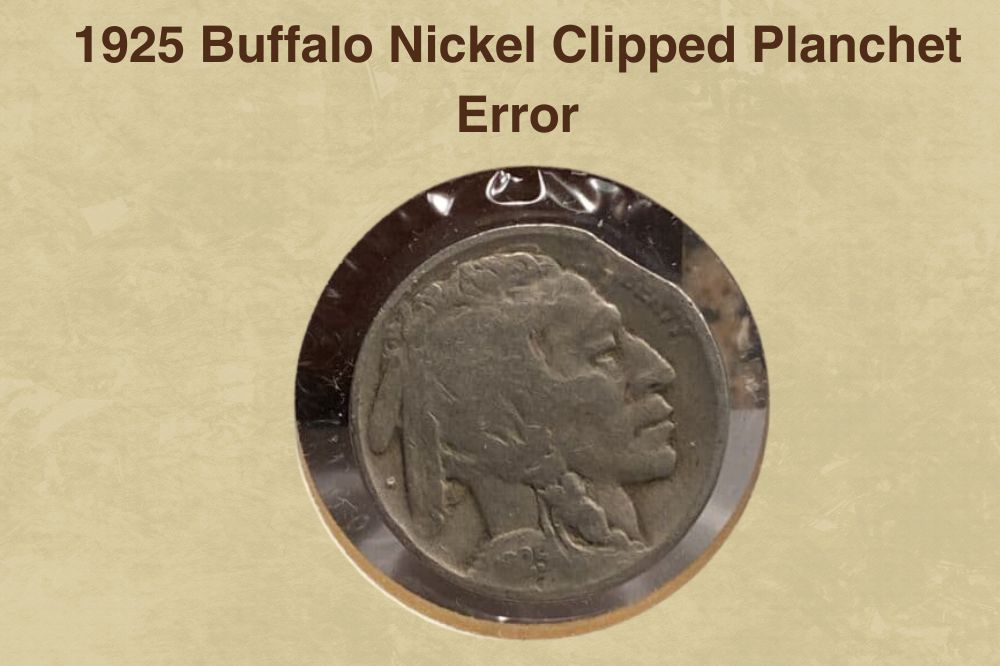
A clipped planchet error is an exciting and one-of-a-kind error during coin production. This mistake happens when a piece of the blank planchet strip used to punch the coins is missing or is not cut properly.
So, when the dies are used to stamp this partial blank sheet, the ensuing coins will have a curved piece of metal missing, resulting in an unusual and noticeable mistake.
The 1925 Buffalo Nickel is a prime illustration of a coin with a clipped planchet error. The inaccuracy can range from a slight clip to a large section of the coin’s edge being removed. These coins are valued dramatically by collectors since they are rare.
A clipped planchet error in a 1925 Buffalo Nickel can add several hundred dollars to its value, depending on the severity of the error.
1925 Buffalo Nickel Off-Center Error
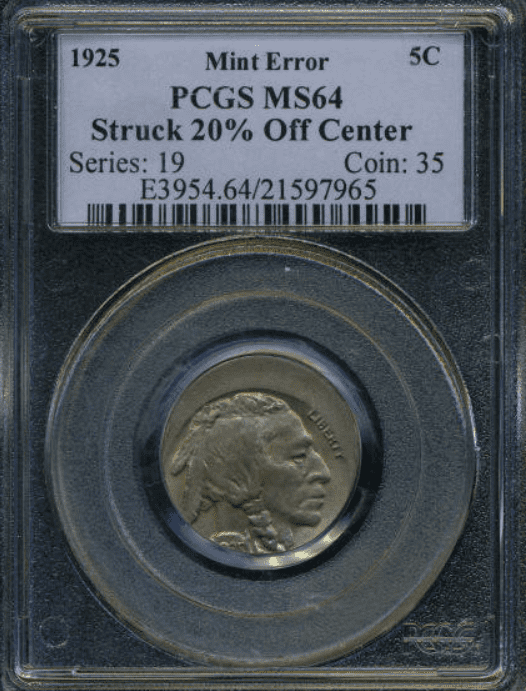
The off-center error is a particular and fascinating error that can happen when coins are being minted. This issue occurred in the 1925 Buffalo Nickel because the minting process’s dies were improperly positioned, which displaced the design out of the center.
1925 Buffalo Nickels’ degree of off-center error can vary greatly, with some coins having only a 5% deviation and others being up to 50% off-center. Generally, a coin’s value to collectors will increase with the degree of off-center error.
Off-center error coins, particularly those with a higher degree of discrepancy, are a great supplement to any coin collector’s set. They add an unusual and intriguing component to the hobby.
1925 Buffalo Nickel Struck On A Ten-Cent Silver Planchet Error
In this error, the 1925 nickel is accidentally struck on a ten-cent silver planchet rather than a five-cent planchet. The outcome is a coin with varied metal content, sheen, and weight.
With only a few examples known to exist, the 1925 Buffalo nickel error struck on a ten-cent silver planchet is highly prized by collectors.
Because of its scarcity, the value of this coin can fluctuate significantly based on elements like the severity of the inaccuracy and the coin’s general condition. A 1925 Buffalo nickel minted on a ten-cent silver planchet can fetch more than $100,000 in pristine condition.
Also read: Top 17 Most Valuable Jefferson Nickels Worth Money
Where to Sell Your 1925 Buffalo Nickel ?
Now that you know the value of your coins, do you know where to sell those coins online easily? Don’t worry, I’ve compiled a list of these sites, including their introduction, pros, and cons.
Check out now: Best Places To Sell Coins Online (Pros & Cons)
1925 Buffalo Nickel FAQs
How do I know if my Buffalo Nickel is valuable?
The condition, rarity, and mint mark of a Buffalo Nickel are only a few of the variables that affect its worth. A coin with minimal wear and exceptional condition will be worth more than one with significant wear or damage.
The coin’s year and mint mark affect how much it is worth. You can ask a coin dealer for their opinion on the Buffalo Nickel’s worth or consult a price guide.
What is a 1925 nickel made of?
The 1925 Buffalo Nickel is made of a composition of 75% copper and 25% nickel. This alloy was used for all Buffalo Nickels produced from 1913 to 1938.
Is a Buffalo Nickel special?
Certainly, many coin collectors and enthusiasts view the Buffalo Nickel as unique. It was created by James Earle Fraser and issued for the first time in 1913. Because of its stunning and distinctive design, it immediately became a classic.
The Buffalo Nickel has a long history and is still a well-liked coin among coin collectors today since it was created at a time when the United States was experiencing rapid expansion and change.
Also read: 14 Most Valuable Nickel Errors Worth Money