Coin Value Contents Table
- 1934 nickel value Chart
- History of the 1934 Buffalo Nickel
- 1934 Buffalo nickel Types
- Features of the 1934 Buffalo Nickel
- 1934 Buffalo Nickel Grading
- 1934 Buffalo Nickel Value Guides
- 1934 No Mint Mark nickel Value
- 1934 D nickel Value
- 1934 (proof) Buffalo nickel Value
- Rare 1934 Buffalo Nickel Errors List
- Where to Sell Your 1934 Buffalo Nickel ?
- FAQ about the 1934 Buffalo Nickel
The US Mint started producing the Buffalo nickels in 1913, and the last pieces appeared in circulation in 1938. Despite poor design quality for minting and relatively low prices in the current market, these coins are significant to collectors.
In 1934, the San Francisco mint was not involved in the nickel minting, so only two mints shared all production duties. Surprisingly, the 1934 Buffalo nickel value is moderate for such old specimens. Since there were no proofs from 1917 to 1935, you can find and buy only regularly struck coins.
1934 nickel value Chart |
||
| Condition | 1934 nickel | 1934 D nickel |
| Good | $3 | $3 |
| Very good | $3 | $3 |
| Fine | $4 | $6 |
| Very fine | $5 | $12 |
| Extra fine | $15 | $30 |
| AU | $30 | $55 |
| MS 60 | $65 | $100 |
| MS 63 | $105 | $200 |
History of the 1934 Buffalo Nickel
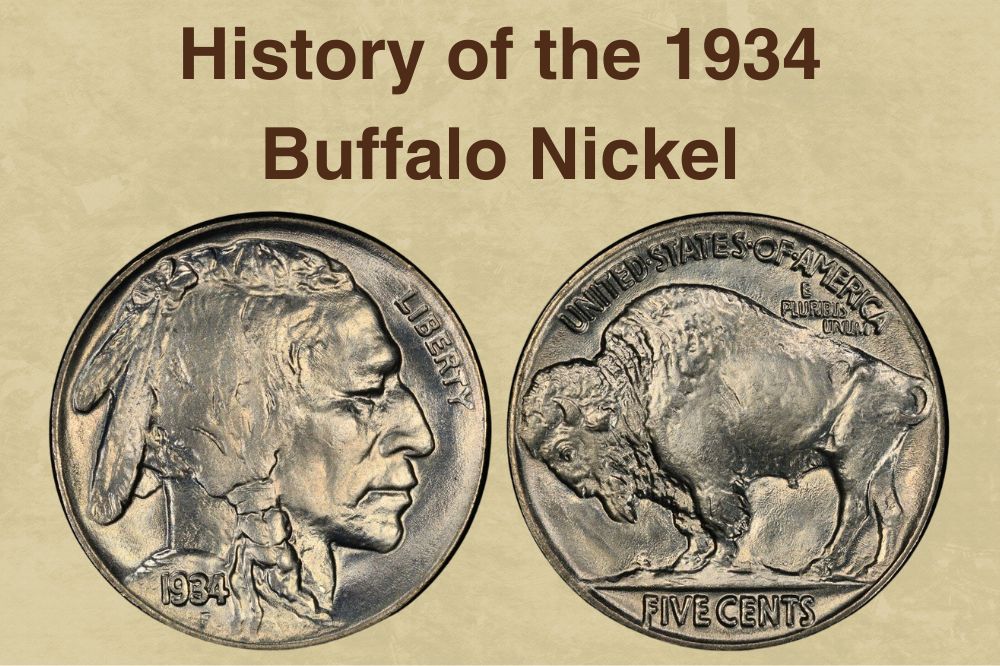
Unlike early American coinage depicting symbolic figures like Lady Liberty, the Buffalo nickels were the first to show the American legacy.
The reason was President Theodore Roosevelt’s belief that the nation deserved more artistic coinage. Nine years needed to pass from his request in 1904 to the moment when the first coins appeared in circulation.
On the reverse, you can see a bison living in the prairies centuries before the white man discovered the New World. The coin obverse is dedicated to Native Americans to pay tribute to the people who suffered so much in their history.
1934 Buffalo nickel Types |
||
| Location | Year | Minted |
| Philadelphia | 1934 nickel | 20,213,003 |
| Denver | 1934 D nickel | 7,480,000 |
| Total | / | 27,693,003 |
The US Mint issued these coins from 1913 to 1938. Unfortunately, such a demanding design caused too many problems with minting, making them impractical and complicated to produce. Nowadays, Buffalo nickels are among the most collectible American coinage ever.
Also read: Top 10 Most Valuable Nickels Worth Money
Features of the 1934 Buffalo Nickel
James Earle Fraser designed Buffalo nickels because then Secretary of the Treasury rejected Laura Gardin Fraser’s conceptual solution for this coin. These standard circulation pieces were minted in a few mints from 1913 to 1938. The 1934 nickels from regular strikes came from two, Denver and Philadelphia.
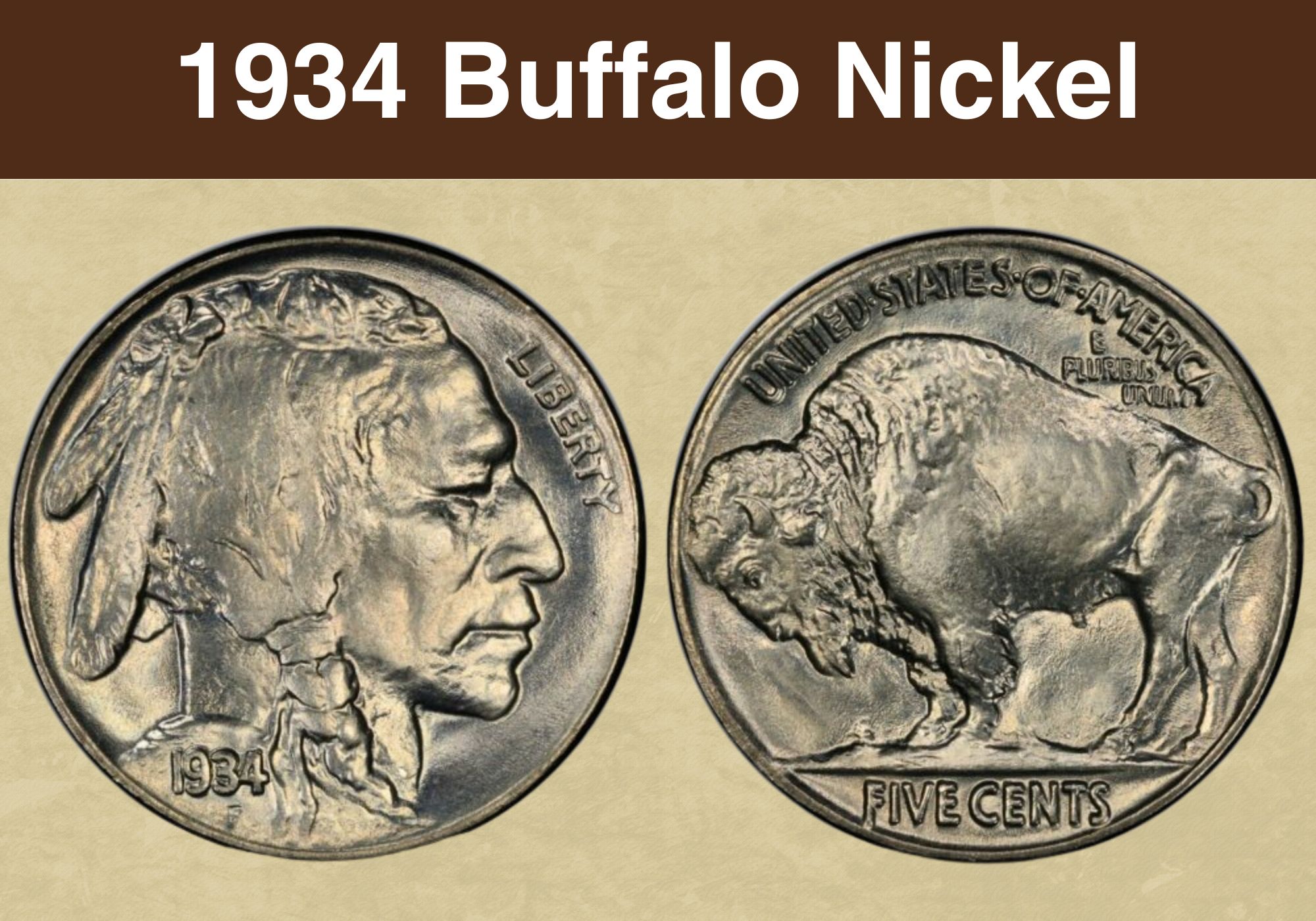
The obverse of the 1934 Buffalo nickel
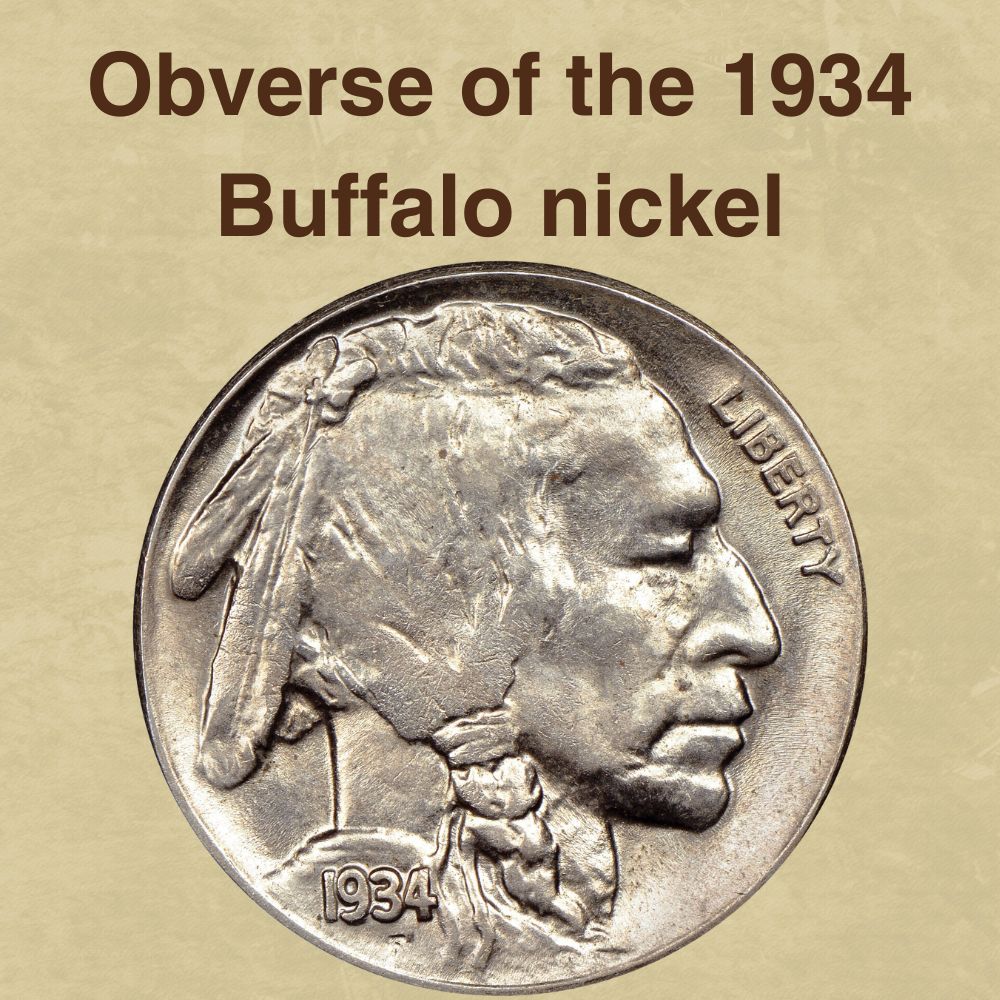
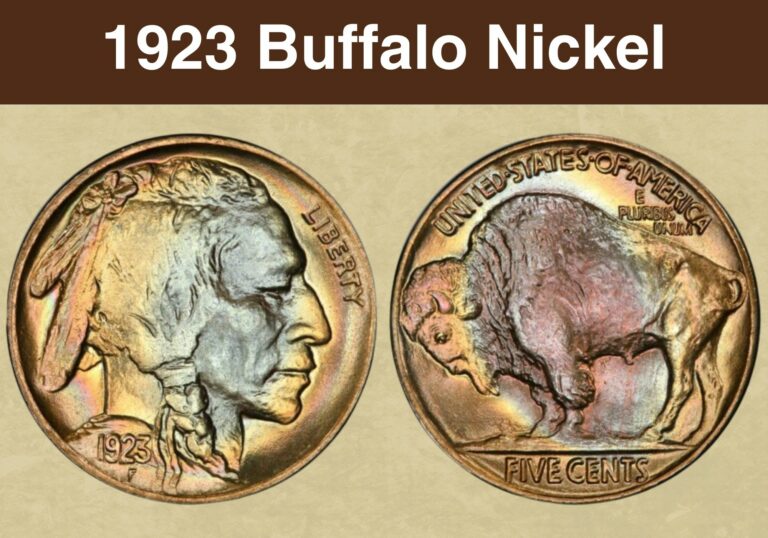
The 1934 Buffalo nickel obverse design shows the composite profile of three Indian chiefs wearing a traditional feather headdress. Besides the central image, there are also the date, the initial F, and the word LIBERTY.
The reverse of the 1934 Buffalo nickel
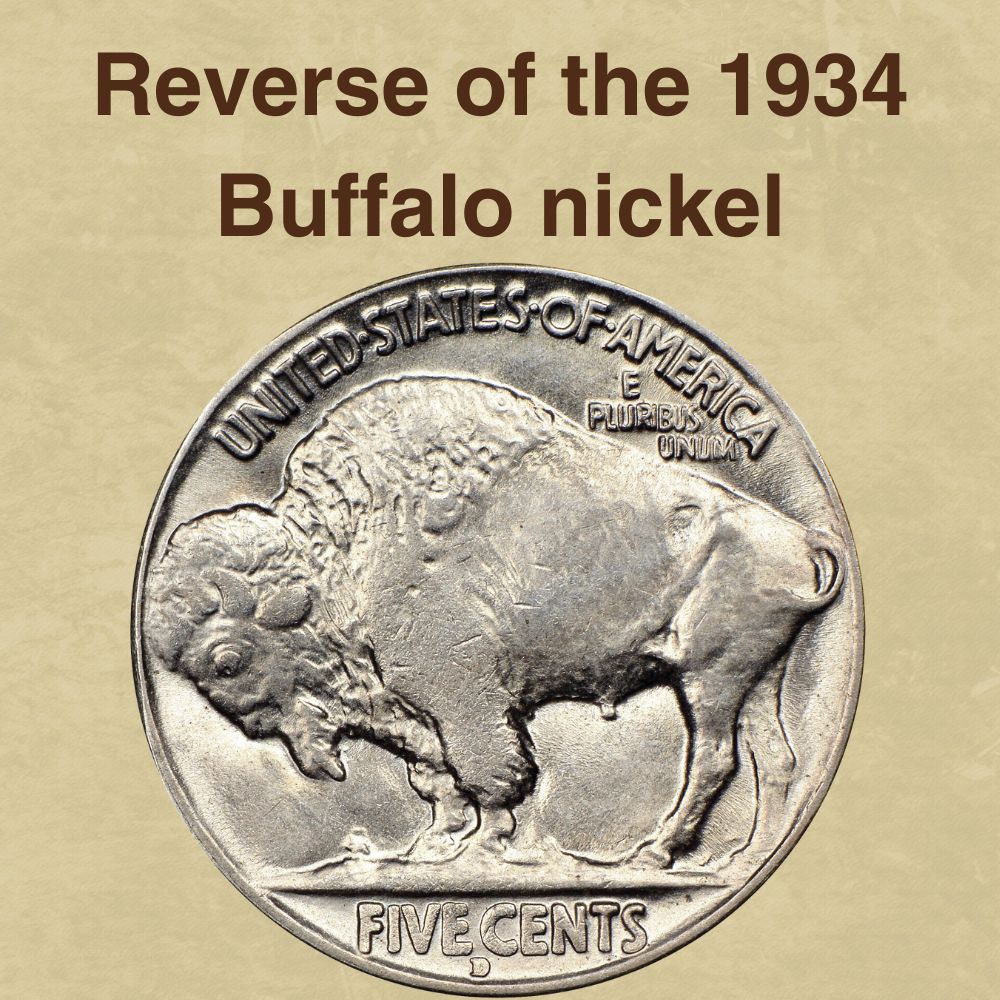
An American bison occupies this nickel’s reverse. The animal stands on the ground with the denomination struck below. The US name stretches along the top coin rim, with the required motto in the upper right corner.
1934 Buffalo nickel Details |
|
| Face value | Five cents ($0.05) |
| Shape | Round |
| Compound | 3/4 copper with 1/4 nickel |
| Coin thickness | 0.07677 inches (1.95 mm) |
| Coin diameter | 0.83504 inches (21.2 mm) |
| Coin weight | 0.17637 ounces (5 g) |
| Edge | Plain |
Other features of the 1934 Buffalo nickel
The standard 1934 Buffalo nickel’s measurements include a weight of 0.17637 ounces (5 g) and a diameter of 0.83504 inches (21.2 mm). Besides, each of the coins minted this year contains two metals, copper and nickel, in the required ratio and is thick 0.07677 inches (1.95 mm).
Also read: Top 17 Most Valuable Buffalo Nickel Worth Money
1934 Buffalo Nickel Grading
Grading the 1934 Buffalo nickel requires the same process as any other coin. You need to follow the precisely listed guidelines when deciding to do the job yourself. Another option is to send your specimen to a professional grading company and let their professionals estimate the piece you have.
Even though professional assessment is preferable because it increases coins’ prices at auctions, it is sometimes an unprofitable option. When you have an inexpensive nickel in low grade, there is no need to pay for their grading since that service cost can be higher than the coin value.
| # | Grade |
|---|---|
| 1 | Basal State-1 |
| 2 | Fair |
| 3 | Very Fair |
| 4, 5, 6 | Good |
| 7, 8, 10 | Very Good |
| 12, 15 | Fine |
| 20, 30 | Very Fine |
| 40 | Extremely Fine |
| 50 | About Uncirculated |
| 60 | Mint State |
| 65 | Mint State |
| 70 | Mint State |
Please check our grading guides to know your coin scale, It’s the necessary step to know the exact value of your coin.
Check out now: How to Grade Buffalo Nickel?
1934 Buffalo Nickel Value Guides
Two mints, from Philadelphia and Denver, produced two types of 27,693,003 regular coins without any proofs. Interestingly, this year has only several variations, while a few error coin types appeared in circulation. Besides the best-quality and rare pieces, most are inexpensive and interesting only as a part of the series.
1934 No Mint Mark nickel Value
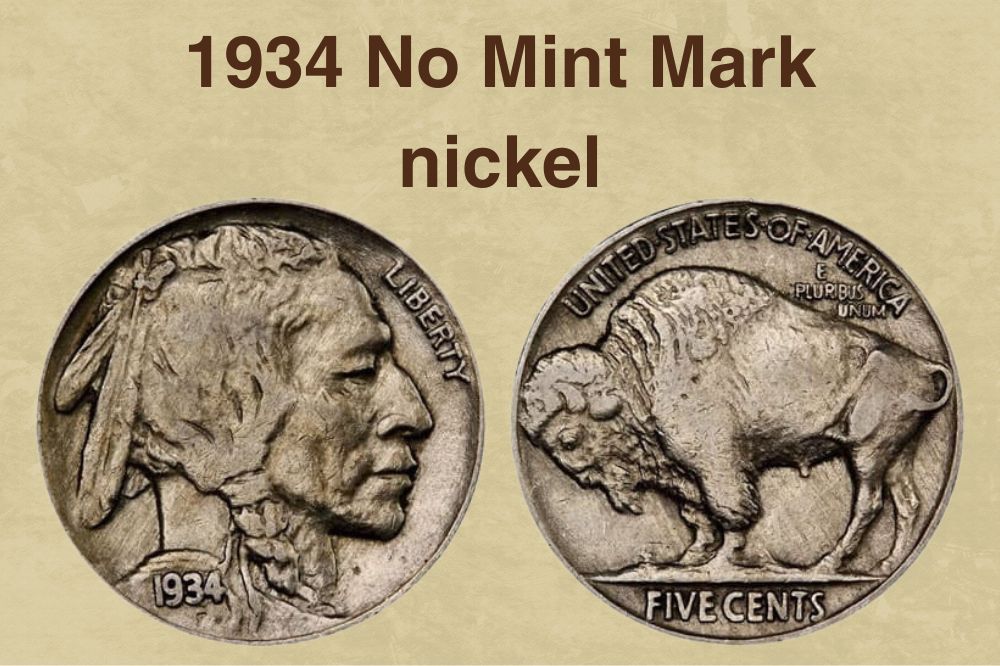
Precisely 20,213,003 nickels came from the Philadelphia mint in 1934, and all these coins came without the mint mark, according to the rules of that time. Even though they are 90 years old, you can expect most to be affordable for collectors, including those with a low budget.
For instance, specimens in circulated condition typically cost $2 to $15, while those in About Uncirculated quality are worth approximately $30. All existing 1934 Buffalo nickels in the mint state are in a range from MS 60 to MS 67.
The less expensive are lower-graded pieces that cost less than $65. Expectedly, better-quality ones cost more, so you should set aside $265 for specimens in the MS 65 rank.
Those rated MS 66 cost about $625, while the highest estimated prices are reserved for MS 67 nickels. Their assessed value is an impressive $4,200.
The rarest, thus the most expensive 1934 nickel, is the one in MS 67+ grade. This lovely coin won an auction record of $12,000 at an auction held on October 24, 2019.
1934 D nickel Value
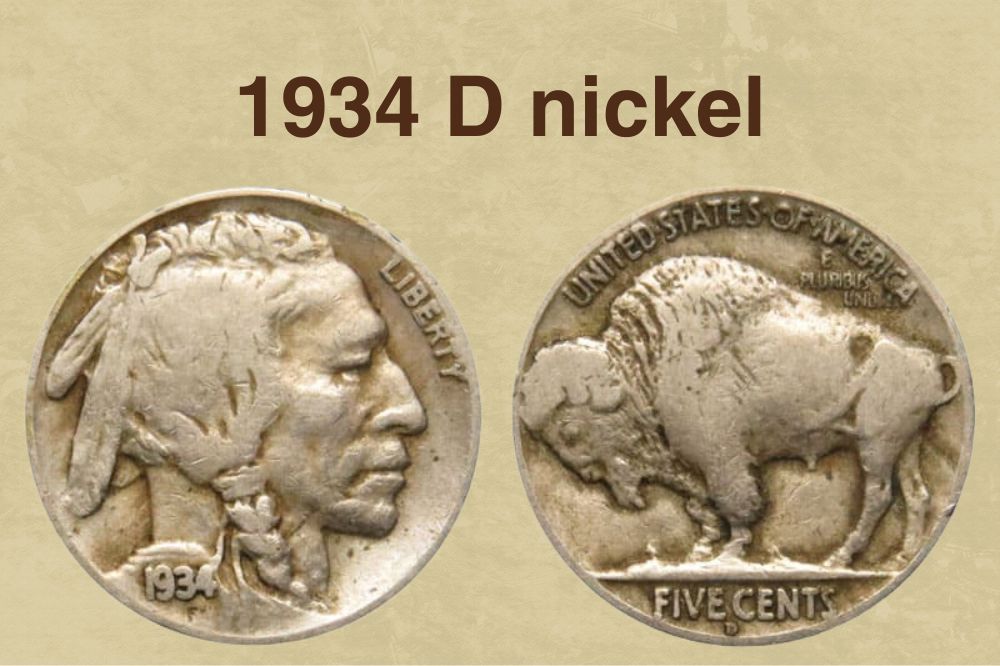
Unlike 1934 Buffalo nickels struck in Philadelphia, all 7,480,000 pieces minted in the Denver mint came with the mint mark. The letter D was struck under the denomination on the coin reverse.
Despite a significant difference in mintage, coins spending years in circulation have similar value to those from another mint. You can buy one piece from GOOD to EXTRA FINE condition for $3 to $30.
Those rated AU are more expensive, with an average price range from $36 to $55. Expectedly, you need to set aside the highest sum of money for specimens in the mint state.
Their value directly depends on their preservation, beauty, and condition. Besides, such coins never have traces of wear and tear or even the tiniest damage. The only difference in quality appears because of inadequate saving or potential rubbing against the coin packing bag.
With all that in mind, you can expect different prices depending on each coin’s grading. For instance, the estimated value for uncirculated nickels is approximately:
- $100 for pieces in MS 60 grade
- $110 for pieces in MS 61 grade
- $125 for pieces in MS 62 grade
- $200 for pieces in MS 63 grade
- $250 for pieces in MS 64 grade
- $575 for pieces in MS 65 grade
As always, the most expensive are nickels in the highest grades. In this case, it is MS 66, and such coins are assessed to be $2,250.
One of the scarce 1934 D MS 66+ nickels appeared at Legend Rare Coin Auctions on January 30, 2020, winning the auction record of $23,500. As you can see, it is a far higher price than expected, probably because only a few coins in this rank still exist.
1934 (proof) Buffalo nickel Value
The US Mint stopped minting Buffalo nickels intended for collectors in 1917. Since the first proofs after that year appeared again in 1936, you can’t expect to find one of these excellently looking specimens on the market.
In fact, the entire series includes only proofs minted in seven years, including:
- 1913 – 1,520 proofs Type 1
- 1913 – 1,514 proofs Type 2
- 1914 – 1,275 proofs
- 1915 – 1,050 proofs
- 1916 – 600 proofs
- 1936 – 4,420 proofs
- 1937 – 5,769 proofs
Also read: Top 17 Most Valuable Jefferson Nickels Worth Money
Rare 1934 Buffalo Nickel Errors List
The list of 1934 Buffalo nickel errors is mainly limited to four well-known types. These imperfections resulted from issues during minting, often improper aligning or old, worn out, or dirty equipment. Sometimes, workers replace planchets by accident and use the wrong size inadequate for nickel. Let’s take a look.
Three-legged buffalo
Excessive reverse die polishing causes this favorite Buffalo nickel error. It includes a partially or wholly erased bison’s front right leg. In 1934, this kind of coin appeared in the Denver mint, and experts estimate that up to 40,000 pieces were realized into circulation.
They are sought-after collectibles, but their prices depend on each nickel’s condition. You should set aside a few bucks or several hundred dollars for circulated specimens, while these in the mint state can be worth thousands of dollars.
Off-center
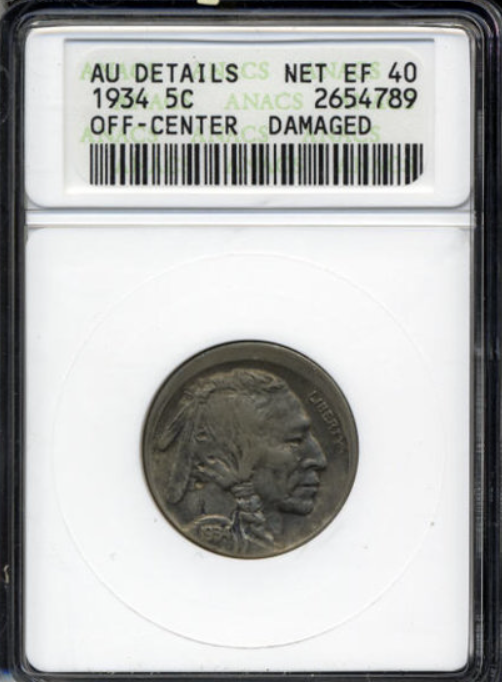
Incorrectly inserted coin between the dies moves during minting. The result is an image struck more or less off-center. Even though the most collectible specimens are those with about 50% off-center, it is impossible to find such coins among nickels minted in 1934.
Some pieces minted in Philadelphia with 10% off-center error have a subtle blank space along the rim. You should pay approximately $550 to $600 for one such coin.
Buffalo nickel struck on the wrong planchet
When a smaller one-cent planchet accidentally ends up inside the coin machine, it cuts off a part of the design. Since its diameter is 0.75 inches (19.05 mm) instead of the 0.83504 inches (21.21 mm) standard for nickels, a part of the date and lettering is missing. Such a copper-colored coin in MS 62 grade has an assessed price of $4,600.
Strike through
This error type results from a foreign object that ends up between the die and the corresponding planchet. Its silhouette becomes visible on the nickel surface after the die strikes it.
You can find this imperfection on the 1934 nickels minted in Denver but be prepared that a highly textured design makes it hard to spot. Such coins are worth about $200.
Also read: 14 Most Valuable Nickel Errors Worth Money
Where to Sell Your 1934 Buffalo Nickel ?
Now that you know the value of your coins, do you know where to sell those coins online easily? Don’t worry, I’ve compiled a list of these sites, including their introduction, pros, and cons.
Check out now: Best Places To Sell Coins Online (Pros & Cons)
FAQ about the 1934 Buffalo Nickel
What makes a 1934 Buffalo nickel rare?
It is pretty easy to find 1934 Buffalo nickels, making these lovely coins common and available in any grade. Be aware that many were in high relief, speeding up their wear and damage over time. That makes pieces in the highest mint states rarer but not exceptionally hard to find.
Which Buffalo nickels minted in 1934 are the most expensive?
The most expensive 1934 D MS 66+ nickel with an Indian chief on the obverse and a Buffalo on the reverse is a coin sold at $23,500. One collector bought this beautiful piece at Legend Rare Coin Auctions organized on January 30, 2020.
The most expensive 1934 MS 67+ nickel with an Indian chief on the obverse and a Buffalo on the reverse is a coin sold at $12,000. One collector bought this beautiful piece at Heritage Auctions organized on October 24, 2019.
How much is the 1934 No Mint mark Buffalo nickel worth?
Nickels minted in Philadelphia in 1934 came without the mint mark, differentiating them from pieces struck in the Denver mint the same year. Despite their age, these 90-year-old coins are affordable for most collectors.
You should pay about $0.45 to $34 for specimens in circulated condition, while unused ones come with a wide price range. While most cost $36 to $480, those rated MS 67 have an impressive estimated value of $2,650 to $3,180.
What is the priciest nickel from a Buffalo series?
The costliest Buffalo nickel is an error coin. One collector set aside a fantastic $350,750 on August 16, 2006, to get the 1918/7 D MS 65 nickel.
The most expensive nickel from the San Francisco mint was the 1926 S MS 66 specimen sold at Bowers & Merena on April 1, 2008. Its auction record was $322,000.
The Buffalo nickel from Denver reached a double lower price, $143,750. This Type 2 coin in MS 68 grade, minted in 1913, was sold at Bowers & Merena on January 8, 2008.
The Philadelphia mint came with a few coins that won auction records in their categories. The list includes:
- The costliest Buffalo nickel (proof) Type 1 is the 1913 PR 68 coin sold at $96,937.50 on September 2, 2021 (Legend Rare Coin Auctions)
- The costliest Buffalo nickel (proof) Type 2 is the 1913 PR 68 coin sold at $66,700 on August 12, 2005 (Bowers & Merena)
- The costliest Buffalo nickel (Special Strike) is the 1927 SP 65 coin sold at $47,150 on April 1, 2009 (Heritage Auctions)