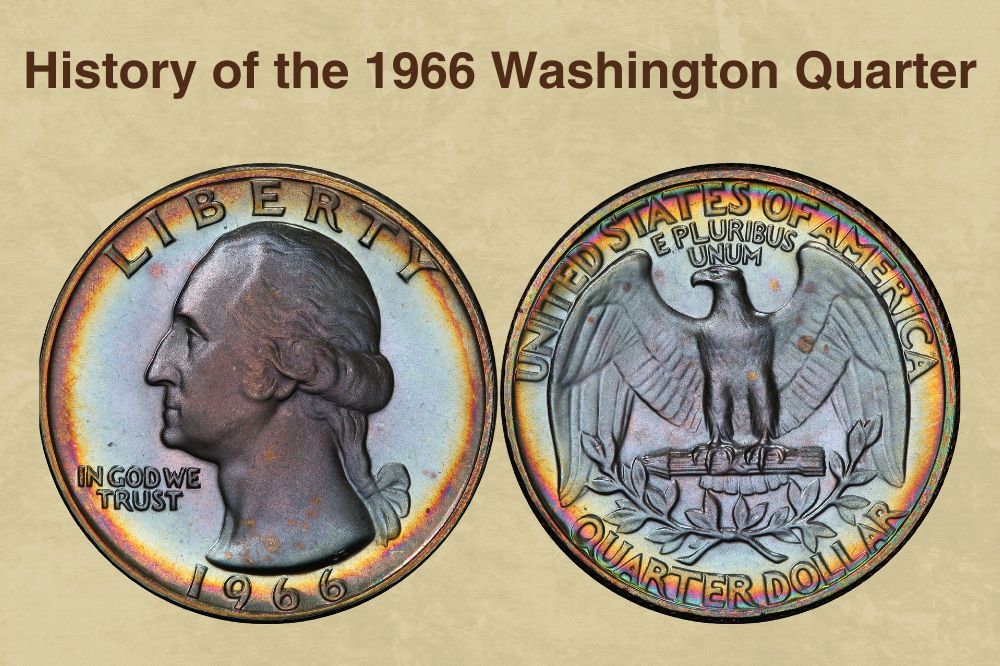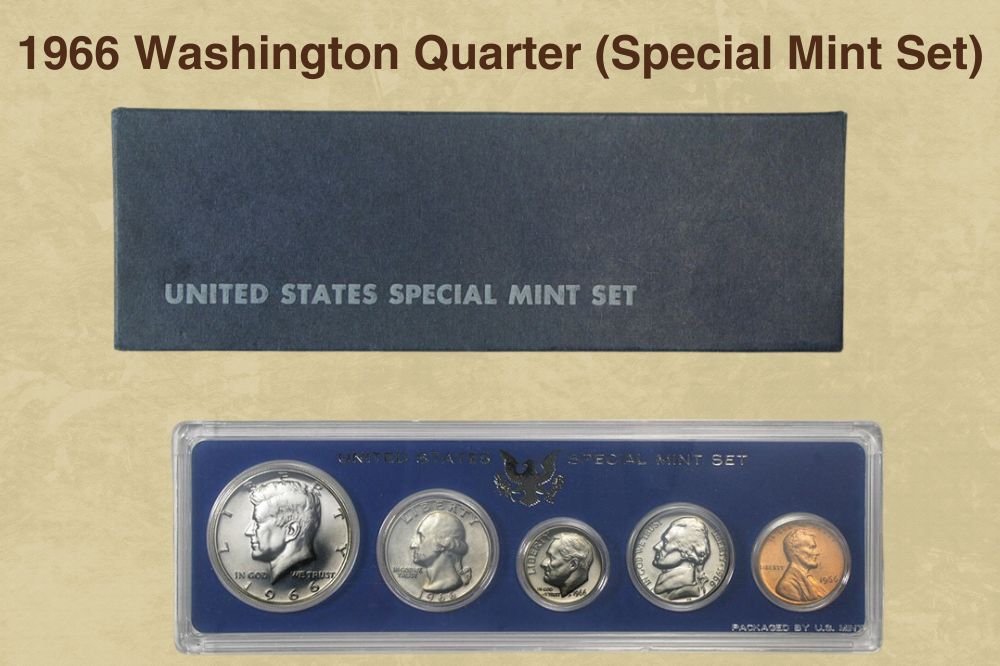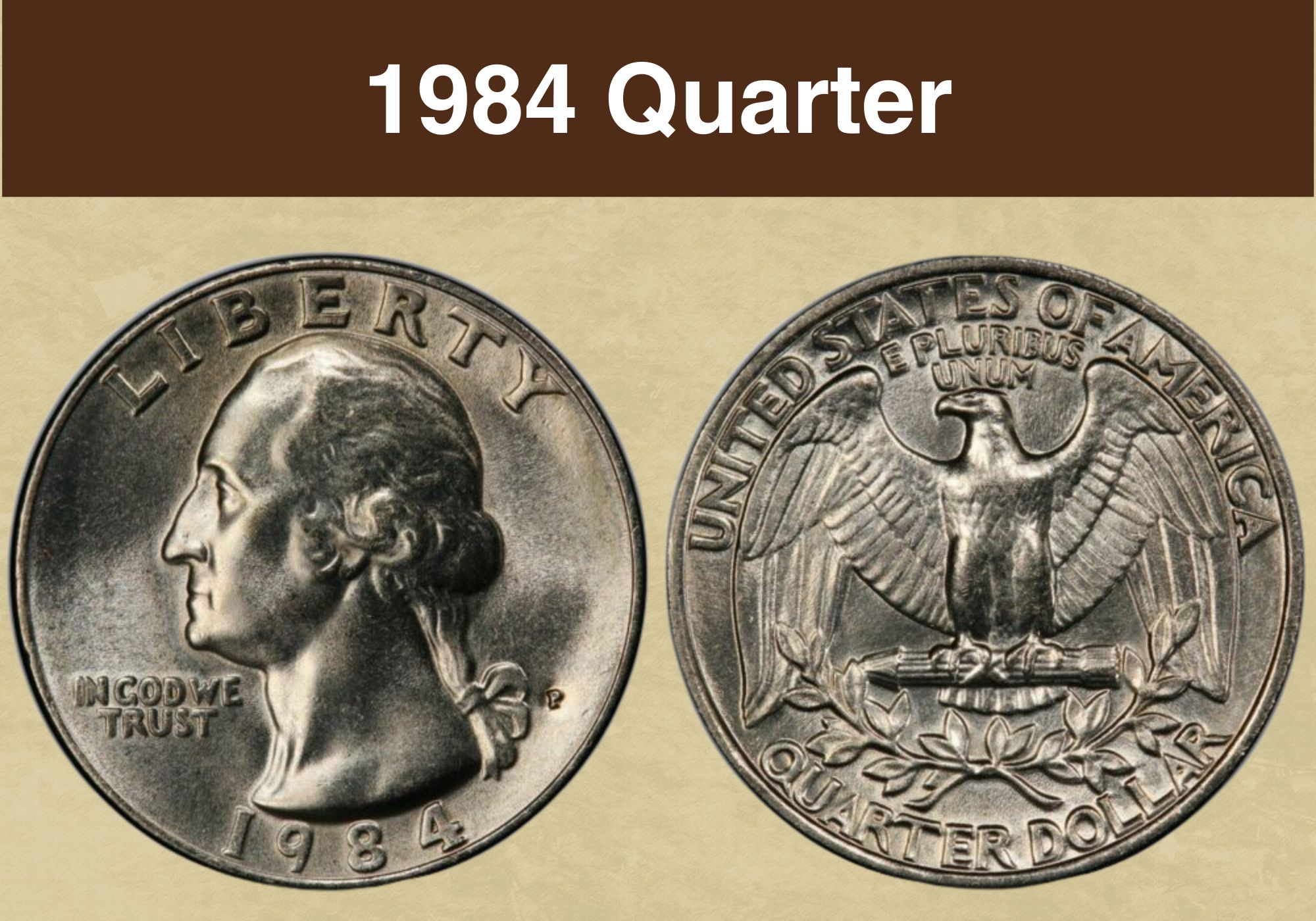
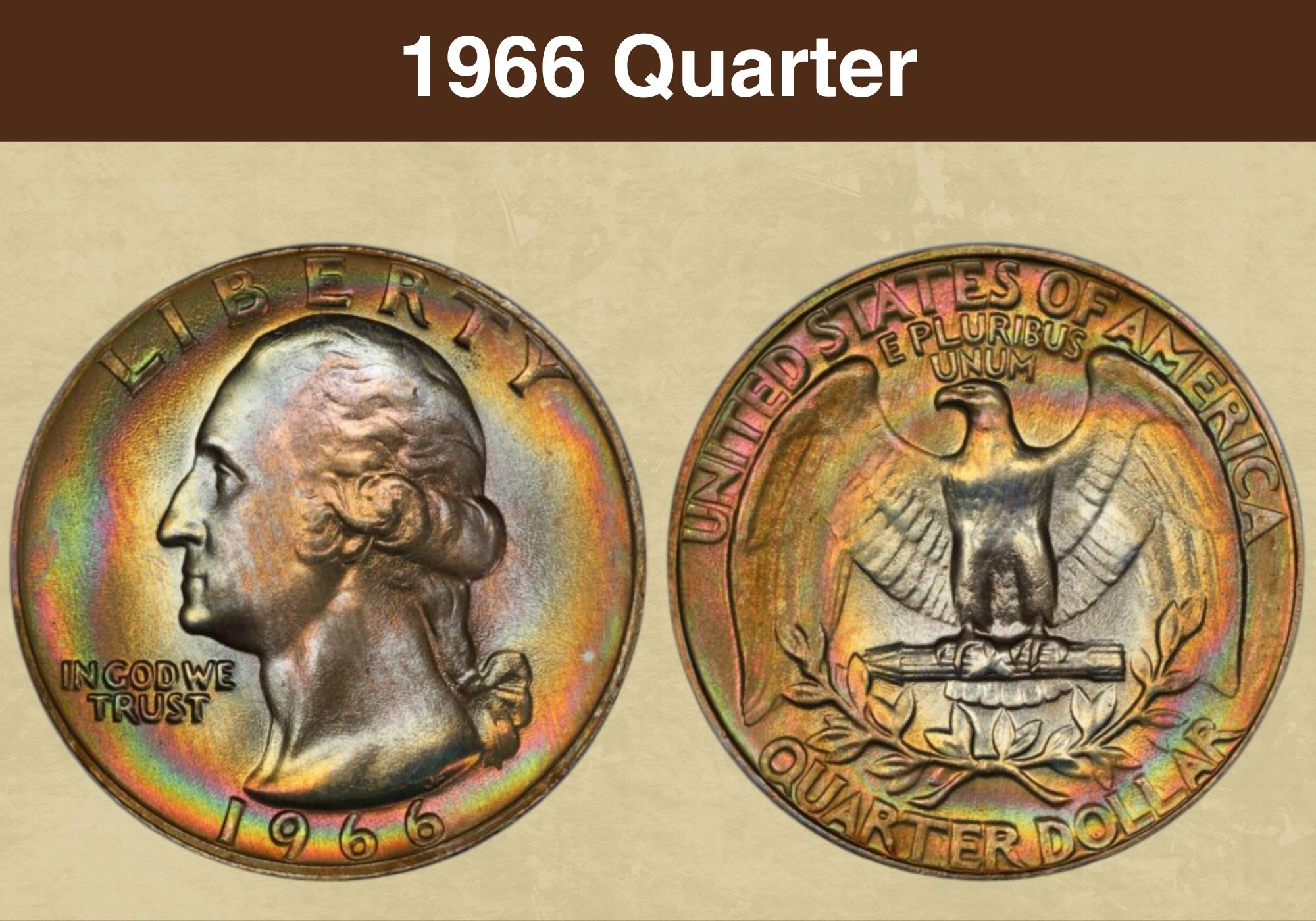
The 1966 Washington Quarter holds a unique spot in American coin history — it was struck during the second year of the copper-nickel clad era, after the historic Coinage Act of 1965 permanently ended silver quarters. With over 821 million coins produced at the Philadelphia Mint alone, most examples are still worth only face value today.
That said, condition changes everything. High-grade mint-state examples can fetch hundreds or even thousands of dollars, and Special Mint Set (SMS) specimens with Deep Cameo contrast have sold for over $3,700 at auction. Even a common-date coin like this one can surprise you.
Coin Value Contents Table
- 1966 Quarter Value By Variety
- 1966 Quarter Value Chart
- Top 10 Most Valuable 1966 Quarter Worth Money
- History of the 1966 Quarter
- Is Your 1966 Quarter Rare?
- Key Features of the 1966 Quarter
- 1966 Quarter Mintage & Survival Data
- 1966 Quarter Mintage & Survival Chart
- The Easy Way to Know Your 1966 Quarter Value
- 1966 Quarter Value Guides
- 1966 No Mint Mark Quarter Value
- 1966 SMS Special Strike Quarter Value
- 1966 SMS Special Strike CAM Quarter Value
- 1966 SMS Special Strike DCAM Quarter Value
- Rare 1966 Washington Quarter Error List and 1966 Quarter Value for Errors
- Where to Sell Your 1966 Quarter?
- 1966 Quarter Market Trend
- FAQ about the 1966 Quarter Value
1966 Quarter Value By Variety
This comprehensive value chart displays the current market prices for different 1966 Quarter varieties across various condition grades, from Good to Mint State, highlighting the significant premium that top-grade specimens and Special Mint Set varieties command in today’s collector market.
If you know the grade of your coin, you can find the exact price below in the Value Guides section.
1966 Quarter Value Chart
| TYPE | GOOD | FINE | AU | MS | PR |
|---|---|---|---|---|---|
| 1966 No Mint Mark Quarter Value | $0.25 | $0.29 | $0.67 | $10.83 | — |
Also Read: Top 100 Most Valuable Modern Quarter Worth Money (1932 – Present)
Top 10 Most Valuable 1966 Quarter Worth Money
Most Valuable 1966 Quarter Chart
2006 - Present
The 1966 Quarter market reveals how dramatically grade and finish drive value for this common-date issue. At the very top, a single MS 68+ business strike sold for $21,000 at Heritage Auctions in May 2023 — a record for this coin that illustrates what perfect preservation can be worth.
SMS varieties also command strong premiums, with the 1966 SMS SP 68 CAM reaching $4,113 and the SMS SP 67 DCAM achieving $3,738, both sold at Heritage Auctions in 2012. A standard SP-67 SMS quarter might sell for around $22, but the same coin with a Deep Cameo (DCAM) designation can jump to $2,650–$3,900 — over 120 times the base value.
This extreme gap reflects a critical fact about SMS coins: the frosted cameo contrast comes only from freshly polished dies, and that frost wears away quickly. Out of 2.26 million SMS quarters struck, only the first few thousand impressions from each die pair would show strong contrast, making true DCAM specimens genuinely rare.
For collectors seeking broader opportunities in Washington quarters, the comprehensive Top 100 Most Valuable Washington Quarter Worth Money (1932 – 1998) provides essential context for this series.
History of the 1966 Quarter
The 1966 Washington Quarter was born out of one of the most dramatic crises in American monetary history. To understand why this coin exists the way it does — clad, without a mint mark, produced only in Philadelphia — you need to go back to the early 1960s.
The Silver Shortage That Changed Everything
Coin shortages had been building since 1959, but by April 1964, Federal Reserve Chairman William McChesney Martin publicly described the situation as a “chronic, serious coin shortage” affecting commerce nationwide. The root cause was simple: the price of silver had climbed so high that the metal inside a silver quarter was worth more than 25 cents.
This triggered mass hoarding under a principle economists call Gresham’s Law — people pulled the “good” (silver) money out of circulation and spent the “bad” (base metal) money instead. Banks received 63% less small change in 1964 compared to 1963. Adding fuel to the fire, the Kennedy half dollar debuted in March 1964 and was immediately hoarded by both silver speculators and people wanting a memento of the assassinated president.
President Lyndon B. Johnson signed the Coinage Act of 1965 (Public Law 89-81) on July 23, 1965, making what he called “the first fundamental change in our coinage in 173 years.” The Act eliminated silver from quarters and dimes entirely, switching to a composition of 91.67% copper and 8.33% nickel over a pure copper core. It also reduced silver in the half dollar from 90% to 40%, a step toward full elimination in 1971.
Why the 1966 Quarter Has No Mint Mark
The Coinage Act of 1965 did something else that directly affects how collectors identify 1966 quarters today: it removed mint marks from all circulating coins. U.S. Mint officials partially blamed coin collectors for contributing to the shortage by hoarding coins with scarce or desirable mint marks. Removing all mint marks made it impossible to distinguish Philadelphia, Denver, or San Francisco strikes — eliminating the collector motivation to pull specific coins from circulation.
Mint marks stayed off coins from 1965 through 1967, returning in 1968. When they came back, they moved from the reverse to the obverse side of coins — a change that remains in place today.
Why 1966 Quarters Didn’t Appear Until August
The composition change caused significant production delays. PCGS CoinFacts notes that 1966-dated clad quarters were struck only from August through December, meaning all 821,101,500 coins were produced in just five months. This compressed schedule explains the enormous single-facility output — it was a genuine emergency production effort.
The SMS Program and the Absent Proof Sets
Normally, the U.S. Mint would sell proof sets to collectors each year. But from 1965 to 1967, all mint resources were directed at producing circulation coinage. Instead, the Mint created Special Mint Sets (SMS) as a substitute. These sets were struck on specially polished planchets using specially prepared dies, creating coins with sharper detail and a semi-reflective satin finish — not a full mirror-like proof surface, but visibly superior to regular business strikes. Each five-coin SMS set was limited to 25 sets per customer. When traditional proof sets and mint sets resumed in 1968, the SMS program ended.
Also Read: Top 30 Most Valuable State Quarter Worth Money (1999 – 2008)
Is Your 1966 Quarter Rare?
1966 No Mint Mark Quarter
Use our CoinValueChecker App to instantly determine which variety type you possess and its current rarity assessment.
Key Features of the 1966 Quarter
The 1966 Washington Quarter uses the same design John Flanagan created in 1932 to mark George Washington’s 200th birthday. The coin’s specifications matter for authentication: it weighs exactly 5.67 grams, measures 24.3 mm in diameter, and has a reeded edge. If a “quarter” you find weighs differently, it may be an error coin or simply not a genuine 1966 issue.
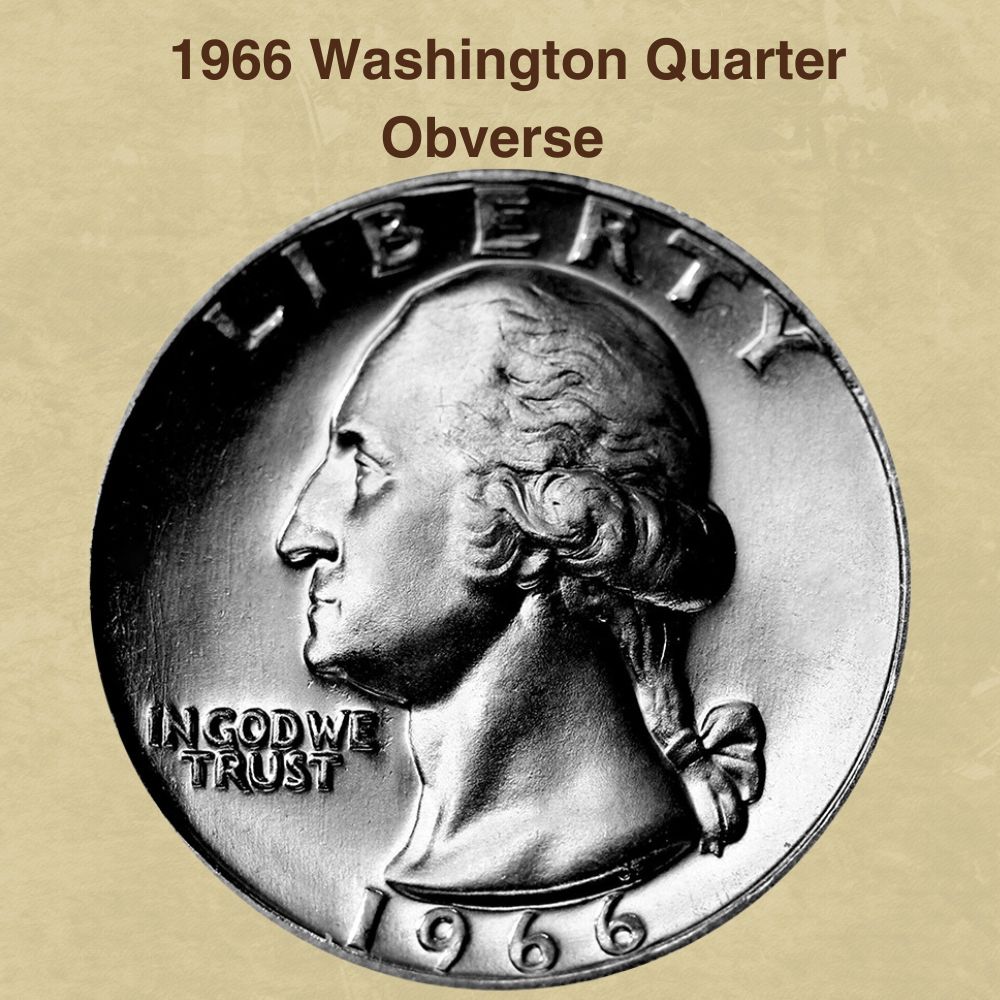
The Obverse of the 1966 Quarter
The obverse shows Washington’s portrait facing left, with LIBERTY arching above his head and the date 1966 beneath his bust. On the left field, aligned with the upper part of Washington’s neck, is the motto IN GOD WE TRUST. The designer’s initials JF (for John Flanagan) appear below the right side of the motto.
Notice that there is no mint mark on this coin. This is normal and expected for 1966 — all quarters struck that year, regardless of facility, were made without a mint mark under the provisions of the Coinage Act of 1965.
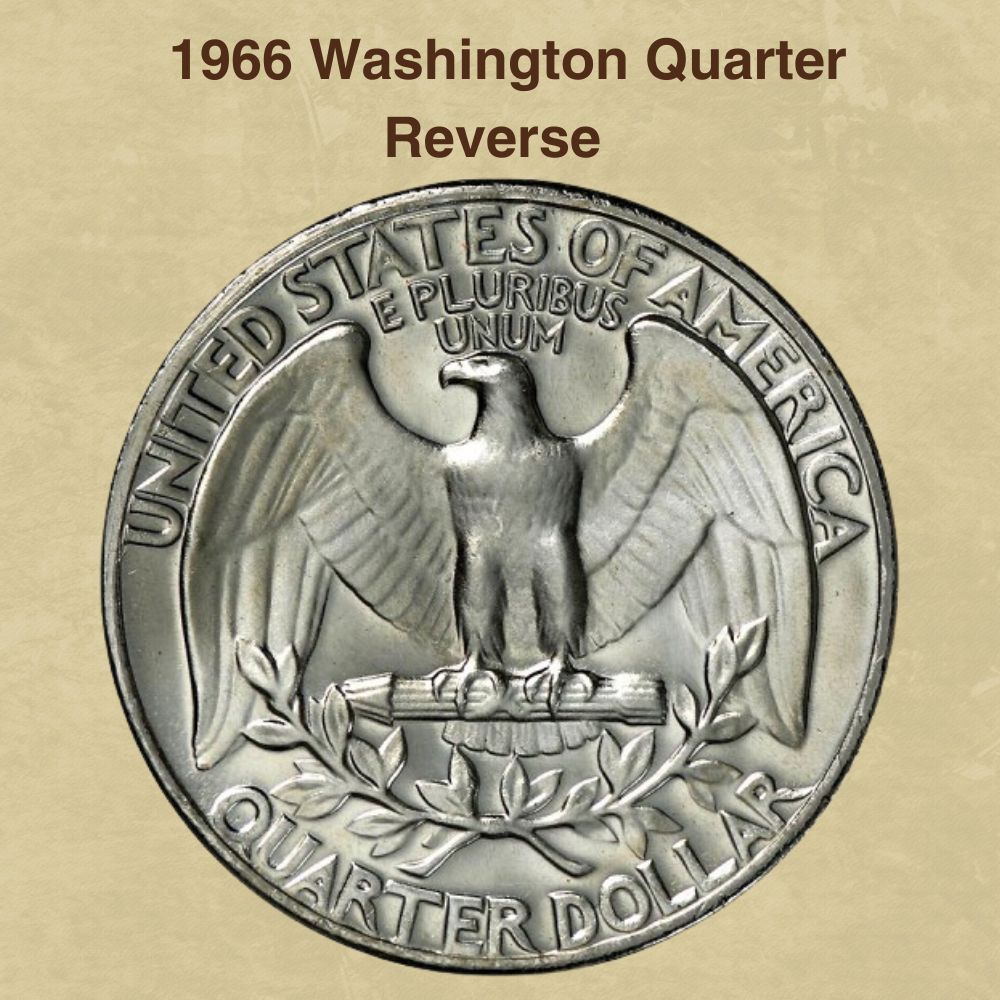
The Reverse of the 1966 Quarter
The reverse displays a heraldic eagle with wings spread wide, clutching a bundle of arrows in its left talon and olive branches in its right. UNITED STATES OF AMERICA frames the upper edge of the coin, and E PLURIBUS UNUM (Latin for “out of many, one”) appears between the eagle and that text. QUARTER DOLLAR runs along the bottom edge, with the two olive branches forming a wreath between the denomination and the eagle.
Each element carries symbolic meaning: the eagle represents national strength and independence, the arrows signal military readiness, and the olive branches represent the country’s preference for peace.
Also Read: Top 20 Most Valuable 1776-1976 Bicentennial Quarter
1966 Quarter Mintage & Survival Data
1966 Quarter Mintage & Survival Chart
Survival Distribution
| Type | Mintage | Survival | Survival Rate |
|---|---|---|---|
| No Mint Mark | 821,101,500 | 205,275,375 | 25% |
| SMS SP | 2,200,000 | unknown | unknown |
The 1966 quarter’s mintage of 821,101,500 is impressive but actually represents less than half the 1.8 billion quarters produced in 1965 — a reminder that 1966’s compressed production window (August through December only) was still not enough to fully catch up on the coin shortage.
The roughly 25% survival rate for circulated business strikes means approximately 205 million examples remain in collectible form today. The vast majority show wear from decades in pocket change. Coins at MS63 or below can still be found in circulation, and even some MS64–MS66 examples occasionally turn up.
The real scarcity kicks in at MS67. According to PCGS CoinFacts numismatist Jaime Hernandez, fewer than one hundred examples have been graded MS67 by PCGS — a stark number against the original 821 million struck. At MS68 and the unique MS68+ example, these coins represent genuine condition rarities that command premium prices.
SMS mintage figures stand at approximately 2,261,583 pieces — a collector-focused issue that was never intended for pocket change. SMS data records remain incomplete at some grade levels, reflecting the specialized nature of how these sets were distributed and preserved.
Also Read: Top 100 Most Valuable Washington Quarter Worth Money (1932 – 1998)
The Easy Way to Know Your 1966 Quarter Value
1966 quarters present unique valuation challenges as America’s second copper-nickel composition year. Without silver content, their worth hinges entirely on preservation quality and production method. Massive 821M circulation strikes typically hold face value unless achieving MS67+ grades (reaching $1,700–$21,000).
The real opportunity lies in Special Mint Sets — replacing traditional proofs during 1965–1968, these 2.26M specimens showcase superior strikes with proof-like surfaces.

Coin Value Checker App
Not sure what your coins are worth? Get Instant Value • Grade • Error Detection with coin identifier and value app (FREE Usage Daily)
Critical assessment factors include surface finish examination (business strike versus SMS characteristics), contrast intensity grading (standard SMS at $10+ versus Cameo/Deep Cameo premiums exceeding $400), and wrong planchet error detection (quarters struck on dime/nickel blanks worth $100–$500+).
CoinValueChecker App transforms complex authentication into instant analysis — upload images to automatically distinguish SMS from business strikes, measure cameo intensity, identify transitional-era errors, and access real-time valuations for this historically significant composition-change quarter.

1966 Quarter Value Guides
- 1966 No Mint Mark Quarter (Philadelphia)
- 1966 SMS Special Strike Quarter
- 1966 SMS Special Strike CAM Quarter
- 1966 SMS Special Strike DCAM Quarter
The 1966 Washington Quarter represents a pivotal moment in U.S. coinage history — the second year of the copper-nickel clad era, with no traditional proof coins and no mint marks. Regular business strikes were produced for circulation, while SMS quarters served as the collector substitute with superior striking quality and finish. Die varieties and errors add numismatic interest, and the coin’s historical connection to the Coinage Act of 1965 gives it a story beyond its composition.
1966 No Mint Mark Quarter Value
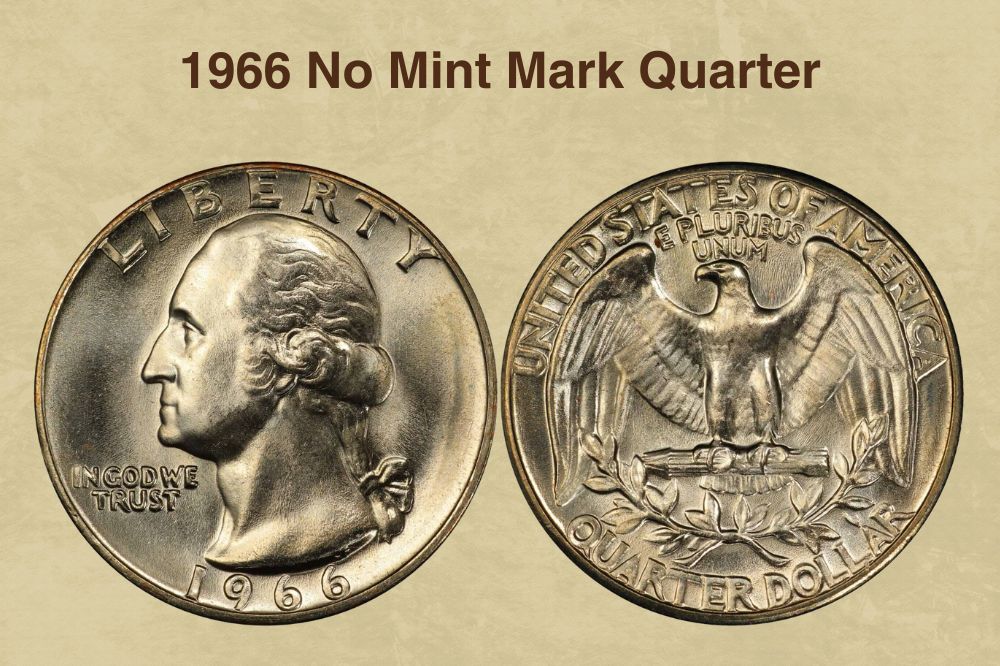
The 1966 No Mint Mark Quarter is the standard business strike produced exclusively at the Philadelphia Mint. All 821,101,500 examples were struck between August and December 1966, during the compressed production window caused by the composition changeover.
The absence of a mint mark is not a variety or an error — it was mandated by the Coinage Act of 1965 for all U.S. coins from 1965 through 1967, regardless of which mint facility produced them. This means you cannot use the lack of a mint mark to identify which city struck any given 1966 quarter.
The coin’s composition is 91.67% copper and 8.33% nickel over a pure copper core, giving it the characteristic copper-colored edge stripe visible when viewed from the side. The standard weight is 5.67 grams. According to PCGS, coins in MS64–MS66 can be purchased inexpensively, while MS67 is scarce with fewer than 100 examples graded by PCGS. Only a handful of coins have been certified at MS68, with just one known at the finest MS68+ grade.
1966 No Mint Mark Quarter Price/Grade Chart
Price by 1-70 Grade (Latest Auction Records Included)
The all-time auction record for this coin is $21,000 for the MS68+ example, sold at Heritage Auctions on May 7, 2023. Six additional MS68-graded examples have sold in recent years for $900 to $11,750, illustrating that even the same numeric grade can produce a wide range of realized prices based on eye appeal and surface quality.
| Date | Platform | Price | Grade |
|---|
Current trading patterns demonstrate ongoing collector interest in securing high-grade examples of this historically significant transitional quarter.
Market activity: 1966 No Mint Mark Quarter
1966 SMS Special Strike Quarter Value
The 1966 SMS Special Strike Quarter (graded SP by PCGS and NGC — “SP” stands for Specimen, meaning a coin struck for collectors rather than circulation) was produced as the U.S. Mint’s substitute for the traditional proof set during the 1965–1967 transitional period.
These 2,261,583 quarters were struck on specially polished planchets using freshly prepared dies, creating sharper detail and a semi-reflective satin finish. They were packaged in hard plastic holders as five-coin sets and were limited to 25 sets per customer due to high collector demand. The resulting coins are visually superior to business strikes but generally lack the deep, watery mirror fields of full proof coins — unless they happen to be the very first strikes from a fresh die, which can show Cameo or Deep Cameo contrast.
The critical distinction to understand about SMS value is this: the numerical grade (SP-65 vs. SP-67) makes minimal difference for standard non-CAM examples. What matters enormously is whether the coin carries a Cameo or Deep Cameo designation. A standard SP-67 SMS quarter is worth roughly $22, while the same coin with a Deep Cameo designation can reach $2,650–$3,900.
1966 SMS Special Strike Quarter Price/Grade Chart
Price by 1-70 Grade (Latest Auction Records Included)
Auction records demonstrate the premium that collectors consistently place on these specially produced transitional specimens over the years.
| Date | Platform | Price | Grade |
|---|
Market activity levels reflect the sustained enthusiasm among numismatists for acquiring these distinctive Special Mint Set quarters.
No valid activity data found
1966 SMS Special Strike CAM Quarter Value
The 1966 SMS Special Strike CAM (Cameo) Quarter features frosted raised design elements contrasting against mirror-like background fields — the same visual effect seen on the finest proof coins, but achieved here through the SMS striking process.
Cameo contrast (CAM) is what’s called a “designation” — it’s an additional quality label assigned by PCGS or NGC on top of the numerical grade, indicating the coin shows a measurable level of frost-versus-mirror contrast. CAM means the contrast is clearly visible; Deep Cameo (DCAM) means the contrast is extreme and dramatic.
This frosting is an unintentional byproduct of freshly polished dies. As dies are used, the frost on the raised design elements wears away rapidly. Out of more than 2 million SMS quarters struck, only the first few thousand impressions from each die pair would show strong Cameo contrast — making CAM and DCAM examples a true condition rarity within the SMS population.
The highest auction record for this variety is $4,113 for an SP 68 CAM, sold at Heritage Auctions on September 4, 2012.
1966 SMS Special Strike CAM Quarter Price/Grade Chart
Price by 1-70 Grade (Latest Auction Records Included)
Historical auction performance data illustrates the premium collector market consistently assigns to these visually striking cameo specimens.
| Date | Platform | Price | Grade |
|---|
Current market dynamics demonstrate the strong and sustained collector demand for these exceptional contrast-effect Special Mint Set quarters.
No valid activity data found
1966 SMS Special Strike DCAM Quarter Value
The 1966 SMS Special Strike DCAM (Deep Cameo) Quarter represents the absolute pinnacle of the Special Mint Set program. DCAM coins show heavily frosted design elements that stand out brilliantly against deeply mirrored fields — the effect is sometimes described as looking three-dimensional, like a cameo jewel on a mirror.
To achieve a DCAM designation, the contrast between frost and mirror field must be extreme and immediately obvious to the eye. These are the very first coins struck from a freshly prepared die, before any die wear softens the contrast. Given the production volumes involved, DCAM examples are exponentially rarer than standard SMS quarters.
This variety is available in only two certified grades — SP 67 and SP 68 — reflecting how few examples survived in suitable condition. The highest auction record is $3,738 for the SP 67 DCAM, sold at Heritage Auctions on October 14, 2012. The Greysheet (CDN Publishing) lists CPG values for this series ranging up to $4,000.
1966 SMS Special Strike DCAM Quarter Price/Grade Chart
Price by 1-70 Grade (Latest Auction Records Included)
Auction records clearly demonstrate the exceptional premium these deep cameo specimens command in the collector marketplace.
| Date | Platform | Price | Grade |
|---|
Market activity reflects the intense competition among advanced collectors pursuing these rare and visually spectacular deep cameo examples.
No valid activity data found
Also Read: What Quarters Are Worth Money
Rare 1966 Washington Quarter Error List and 1966 Quarter Value for Errors
The 1966 quarter was produced during a period of significant change at the U.S. Mint — new planchet composition, compressed production schedules, and retooled processes all created conditions favorable for errors. Here are the documented error types that collectors look for, along with current market values.
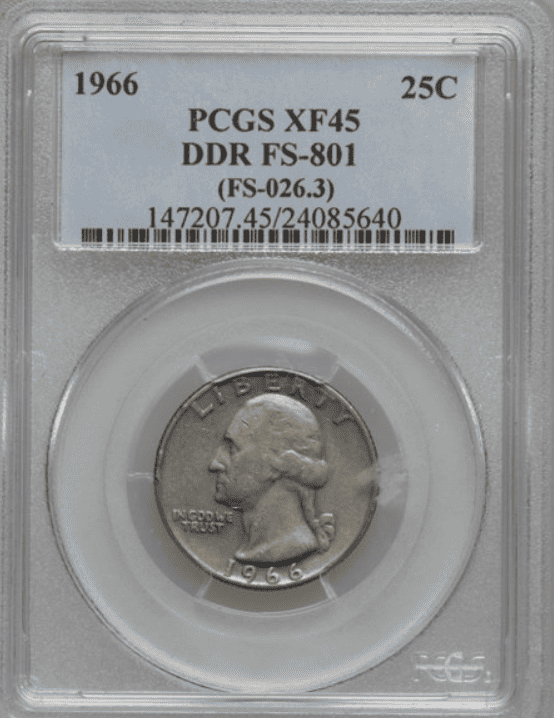
1. DDR — Doubled Die Reverse (FS-801)
The only officially recognized die variety for this year is the 1966 DDR FS-801 (FS stands for “Fivaz-Stanton,” the standard numismatic variety reference guide). This variety shows strong, clearly separated doubling on the reverse lettering, particularly visible in “UNITED STATES OF AMERICA” and “QUARTER DOLLAR.” Identifying it requires 10x to 20x magnification.
What makes this variety exceptionally rare is its certified population. According to data compiled from PCGS and NGC, there are fewer than 10 certified examples across all grades — PCGS has certified 4 examples and NGC has certified 2. This minuscule population makes the FS-801 one of the rarest modern quarter varieties in existence.
The auction record is $920 for an XF 45 graded example, sold at Heritage Auctions on April 18, 2012. Raw, uncertified examples have been offered in the marketplace ranging from $66 to $800. For a theoretically high-grade MS-68 example, the NGC Price Guide lists a value of $5,750 — though no high-grade certified examples have yet come to auction.
2. Quarter Struck on a Dime Planchet
This wrong-planchet error occurs when a quarter-sized die strikes a dime-sized blank by mistake. Because the quarter die is larger than a dime planchet, the finished coin will be missing approximately 20% or more of the design around the edges — you’ll see parts of the inscription cut off.

Coin Value Checker App
Not sure what your coins are worth? Get Instant Value • Grade • Error Detection with coin identifier and value app (FREE Usage Daily)
The coin will weigh approximately 2.27 grams (a dime’s weight) rather than the standard 5.67 grams for a quarter. This weight discrepancy is a quick initial check. Documented examples have sold for an average of around $500 at auction, with values varying based on how much of the design is visible and the overall centering.
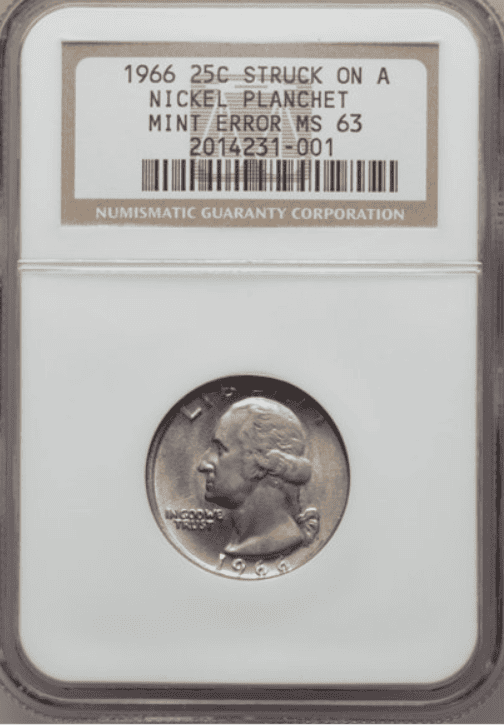
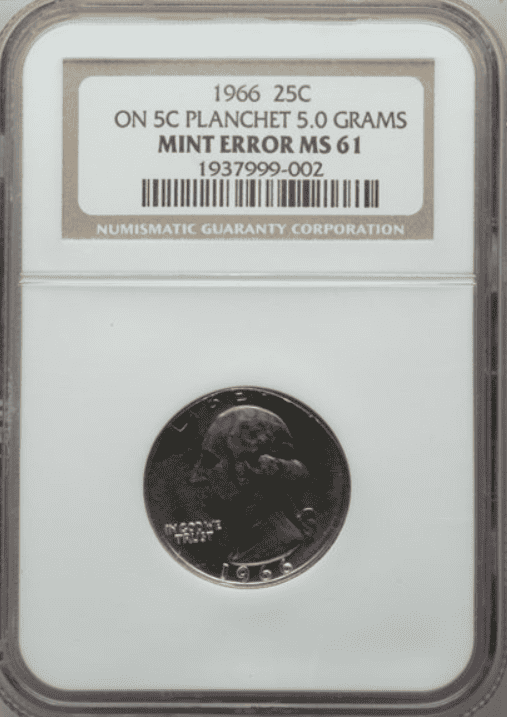
3. Quarter Struck on a Nickel Planchet
When the quarter die strikes a nickel blank, the result is a coin that weighs approximately 5.0 grams (close to a standard nickel’s 5.0 grams) rather than the quarter’s 5.67 grams. Because a nickel planchet is slightly smaller than a quarter, some of the peripheral lettering will be incomplete.
You can typically still identify the date and most of the central design on both sides. Documented examples have sold for an average of approximately $550, with values adjusted for inflation. PCGS and NGC certification is strongly recommended for any wrong-planchet error to establish authenticity.
4. Quarter Struck on a Cent Planchet
This is one of the most dramatic wrong-planchet errors for the 1966 quarter. A cent planchet is much smaller than a quarter die, so the resulting coin is copper-colored (the giveaway that it’s on a cent blank) and is missing large portions of the design — LIBERTY and QUARTER DOLLAR may be partially or fully absent.
These coins weigh approximately 3.11 grams (a cent’s weight). One documented example with an additional off-center strike sold for $1,293 at auction in 2013. Average values for standard examples run around $900, making this one of the most valuable error types for this year.
5. Off-Center Strike
Off-center strikes happen when the coin blank is not properly centered between the dies when the press fires. The degree of misalignment determines value — a 5–15% off-center coin is relatively common and worth $30–$75, while a dramatic 50–70% off-center strike with the full date visible is worth $200–$400. The full date must be visible for maximum value, as collectors need to confirm the year.
6. Clipped Planchet
A clipped planchet error results when the metal strip wasn’t fed correctly through the punching machine, creating a coin with a curved or straight section missing from its edge. Single clips in good condition sell for $100–$300 depending on severity. A triple clipped planchet combined with a broadstrike — a more dramatic example — sold at the August 2024 Stack’s Bowers auction for $85.
Also Read: 20 Rare Washington Quarter Errors Worth Money (Full List with Pictures)
Where to Sell Your 1966 Quarter?
Now that you understand the value potential of your 1966 quarters, selecting the right marketplace is crucial for maximizing your return and ensuring a secure transaction.
Check out now: Best Places To Sell Coins Online (Pros & Cons)
1966 Quarter Market Trend
Market Interest Trend Chart - 1966 Quarter
*Market Trend Chart showing the number of people paying attention to this coin.
FAQ about the 1966 Quarter Value
1. Is the 1966 quarter made of silver?
No. The 1966 quarter contains no silver at all. The Coinage Act of 1965 eliminated silver from quarters and dimes, replacing the old 90% silver composition with a copper-nickel clad alloy (91.67% copper and 8.33% nickel over a pure copper core). You can confirm this by looking at the coin’s edge — you’ll see a visible copper-colored stripe, which silver quarters do not have. The standard 1966 quarter weighs 5.67 grams; a pre-1965 silver quarter weighs 6.25 grams.
2. How much is a 1966 quarter worth with no mint mark?
A circulated 1966 no-mint-mark quarter is worth face value ($0.25). In uncirculated mint-state grades: MS63–MS65 examples are worth $1–$16 according to the PCGS Price Guide; MS66 grades at about $30; MS67 is scarce and worth roughly $285–$1,350; MS68 examples have sold for $900–$11,750; and the single MS68+ coin sold for $21,000 at Heritage Auctions in May 2023.
3. What is the 1966 DDR FS-801 variety and how do I identify it?
The 1966 DDR FS-801 is a Doubled Die Reverse variety — the only officially recognized die variety for this year. It shows clearly separated doubling on reverse lettering, especially “UNITED STATES OF AMERICA” and “QUARTER DOLLAR.” You need 10x to 20x magnification to see it clearly. This is an extremely rare variety with fewer than 10 certified examples between PCGS (4 examples) and NGC (2 examples). The auction record is $920 for an XF 45 coin sold at Heritage Auctions in April 2012, and a theoretical MS-68 is valued at $5,750 by the NGC Price Guide.
4. What makes a 1966 SMS quarter different from a regular 1966 quarter?
SMS stands for Special Mint Set. Unlike regular business strikes made for pocket change, SMS quarters were struck on specially polished planchets using freshly prepared dies, producing sharper detail and a semi-reflective satin finish. They came packaged in hard plastic holders as five-coin sets, limited to 25 sets per customer. The 2,261,583 SMS quarters made in 1966 are noticeably different in appearance from circulation strikes — the surfaces look more refined and the design details are crisper.
5. What is Cameo (CAM) and Deep Cameo (DCAM) on a 1966 quarter?
CAM (Cameo) and DCAM (Deep Cameo) are quality designations assigned by grading services like PCGS and NGC. They indicate the level of contrast between the frosted raised design elements and the mirror-like background fields of an SMS coin. CAM means the contrast is clearly visible; DCAM means it is dramatic and immediately striking. This frost comes from freshly polished dies and wears away with use — making CAM and DCAM coins much rarer than standard SMS examples. A standard SP-67 SMS quarter is worth about $22, while the same coin with a DCAM designation can be worth $2,650–$3,900.
6. Which 1966 quarters are the most valuable at auction?
The top five verified auction sales for 1966 quarters are: (1) 1966 MS 68+ at $21,000, Heritage Auctions, May 7, 2023; (2) 1966 SMS SP 68 CAM at $4,113, Heritage Auctions, September 4, 2012; (3) 1966 SMS SP 67 DCAM at $3,738, Heritage Auctions, October 14, 2012; (4) 1966 PCGS MS-68 (toned) at $3,836.25, GreatCollections; (5) 1966 DDR FS-801 XF 45 at $920, Heritage Auctions, April 18, 2012.
7. Can a 1966 quarter be worth $1,000 or more?
Yes, but only in specific circumstances. Regular business strikes must reach MS67 ($285+) or higher, with MS68 examples having sold for $900–$11,750 and the unique MS68+ at $21,000. SMS quarters with CAM or DCAM designations at SP67–SP68 can reach $3,700+. The extremely rare DDR FS-801 variety can exceed $1,000 in high grades. Certified wrong-planchet errors (especially cent-planchet strikes) have sold above $1,000. For any coin you suspect may be in this range, professional certification by PCGS or NGC is essential.
8. Why did the U.S. Mint remove mint marks from 1966 quarters?
The Coinage Act of 1965 directed the U.S. Mint to remove mint marks from all circulating coins for a period intended to be five years (Congress ultimately restored them in 1968). The reasoning was that collectors had been selectively pulling coins with scarce or desirable mint marks from circulation, contributing to the nationwide coin shortage. By making all coins identical regardless of mint facility, the government hoped to eliminate the collector motivation to hoard specific issues. Mint marks returned in 1968 and moved from the reverse to the obverse, where they remain today.
9. How do I store a 1966 quarter to preserve its value?
Use only PVC-free holders such as PCGS or NGC slabs, hard plastic coin capsules, or archival 2×2 flips with Mylar windows. Avoid soft plastic flips, which contain PVC that can damage coin surfaces over time. Store coins in a stable environment with low humidity (30–40%) and moderate temperature (60–70°F). Never clean your coins — even gentle cleaning removes surface metal and destroys originality, often reducing a coin’s value by 50% or more. For any coin you believe may be worth more than $50, consider submitting it to PCGS or NGC for professional grading.
10. What are the most valuable Washington quarters across the entire series?
The highest-valued Washington quarters include: the 1932-D at MS 66 grade (silver) for $143,750 at auction in 2008; the 1932-S at MS 66 grade for $45,500 in 2020; the 1949-D at MS 68 for $43,475 in 2019; the 1948 quarter at MS 68 for $43,200 in 2021; the 1964-D at MS 68 for $38,400 in 2021; and the 1947 quarter at MS 68 for $32,400 in 2021. The 1932-D and 1932-S are the key dates of the series, minted in low numbers during the Great Depression.