Coin Value Contents Table
Are you an Abraham Lincoln enthusiast and are interested in collecting coins featuring this iconic United States president?
Lincoln pennies can be a great addition to your collection, especially if you have rare error coins; these can be worth hundreds of dollars!
In this article, you will learn everything you need to about the 1999 penny value. You will discover how much your Lincoln Memorial cent is worth in circulated and circulated condition as well as errors to pay attention to that can earn you a fortune.
Let’s jump in and get started!
1999 Penny Value Chart |
||||
| Mint Mark | Good | Fine | Extremely Fine | Uncirculated |
| 1999 No-Mint Mark Penny Value | $0.05 | $0.05 | $0.05 | $0.34 |
| 1999-D Penny Value | $0.05 | $0.05 | $0.05 | $7.50 |
| 1999- S Proof Penny Value | – | – | – | $15 |
History of the 1999 Penny
The Lincoln penny was firsts struck in 1909 to commemorate the 100th birth anniversary of President Abraham Lincoln. This was the first time in U.S. coinage history that a real human was depicted on the obverse of a coin; coins traditionally featured the fictional Lady Liberty.
President Theodore Roosevelt played a key role in the creation of a Lincoln penny. In 1908, Roosevelt interacted with sculptor Victor David Brenner for the creation of a Roosevelt medal for the Panama Canal Commission.
The president admired a Lincoln plaque Brenner had designed in 1907 and it is believed he requested mint director Frank Leach to consider Brenner as a designer for the new Lincoln coin. Indeed, Leach reached out to Brenner and commission him to design the Lincoln wheat penny.
After a lot of public anticipation, the new Lincoln penny was released in August 1909. The coin’s obverse featured a right-facing portrait of Abe Lincoln; the obverse design has remained more or less the same over the years.
The reverse has changed severally since the coin was first struck. Initially, the reverse depicted two wheat leaves, giving the coin the name Lincoln Wheat Penny. This design changed in 1958 to feature Frank Gasparro’s impression of the historical Lincoln Memorial and remained that way until 2008, after which it was changed again.
In 1999, the Denver, Philadelphia, and San Francisco mints struck Lincoln coins for circulation and for collectors. In the next section will explore the unique features to pay attention to in a 1999 Lincoln Memorial penny worth money.
Also read: 12 Most Valuable Lincoln Penny Worth Money
Features of the 1999 Penny
Let’s look at the physical attributes of the 1999 penny. Knowing what to look for in your penny can help you spot one that is worth money.
The Obverse of the 1999 Penny
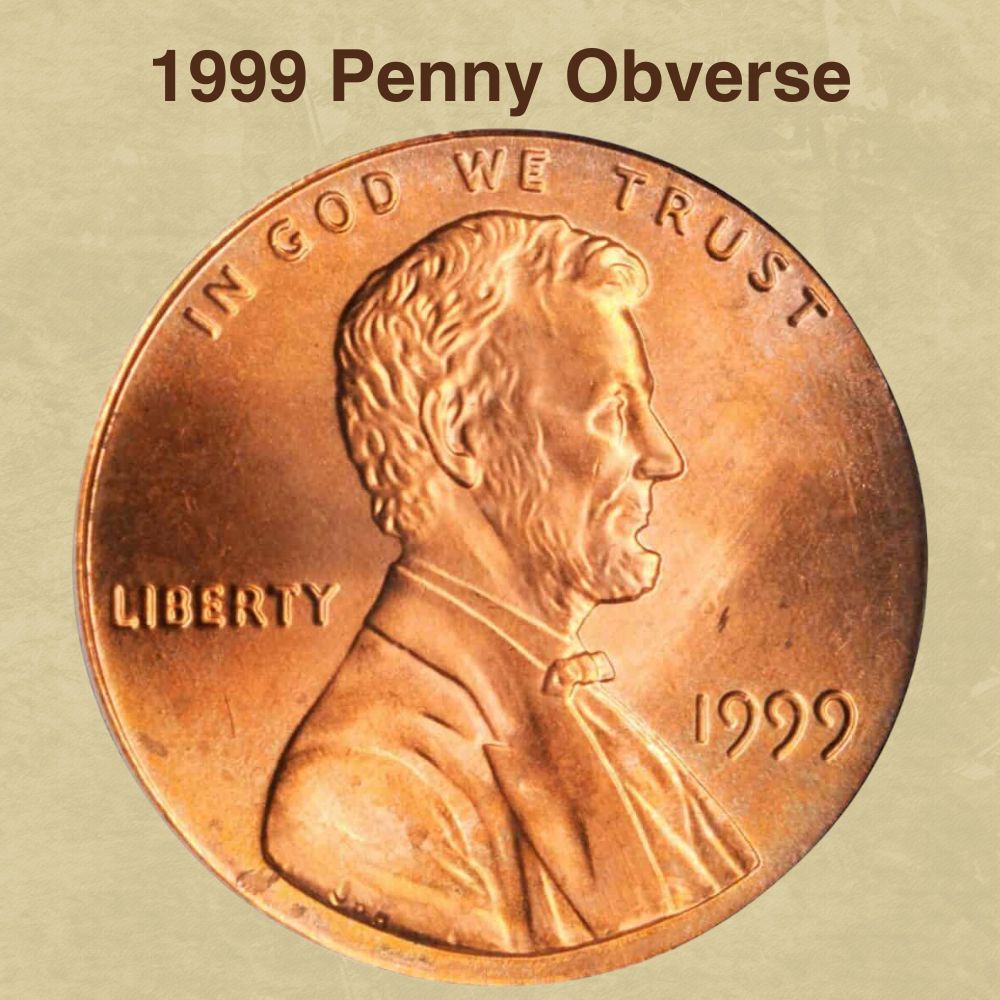
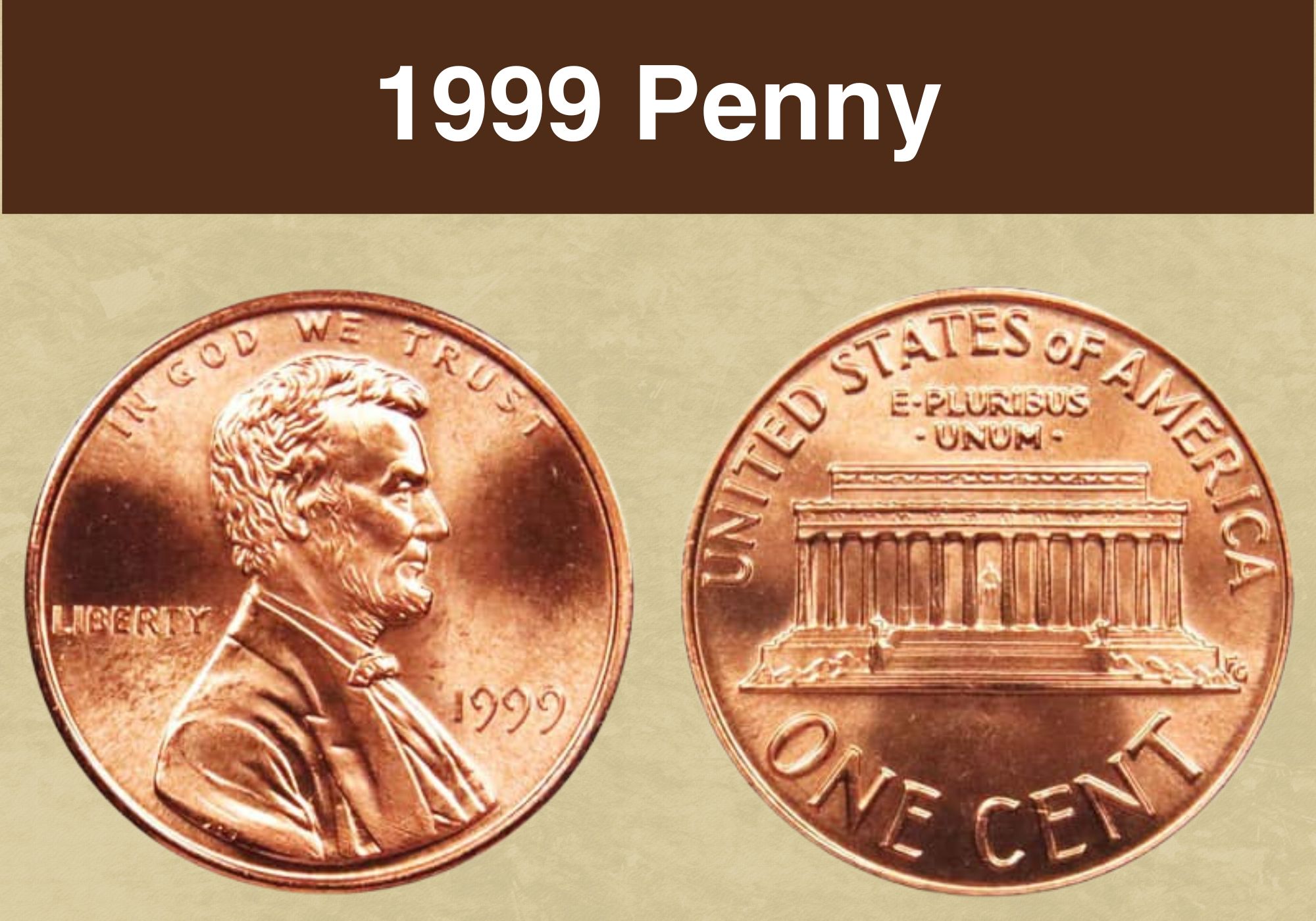
On the obverse of the 1999 penny you will find a right-facing full bust portrait of the much-loved U.S. President Abraham Lincoln.
At the top of the coin is our country’s powerful motto IN GOD WE TRUST. The word LIBERTY appears on the left, behind Lincoln’s back while the date, 1999 appears on the right, in front of his profile.
The Reverse of the 1999 Penny
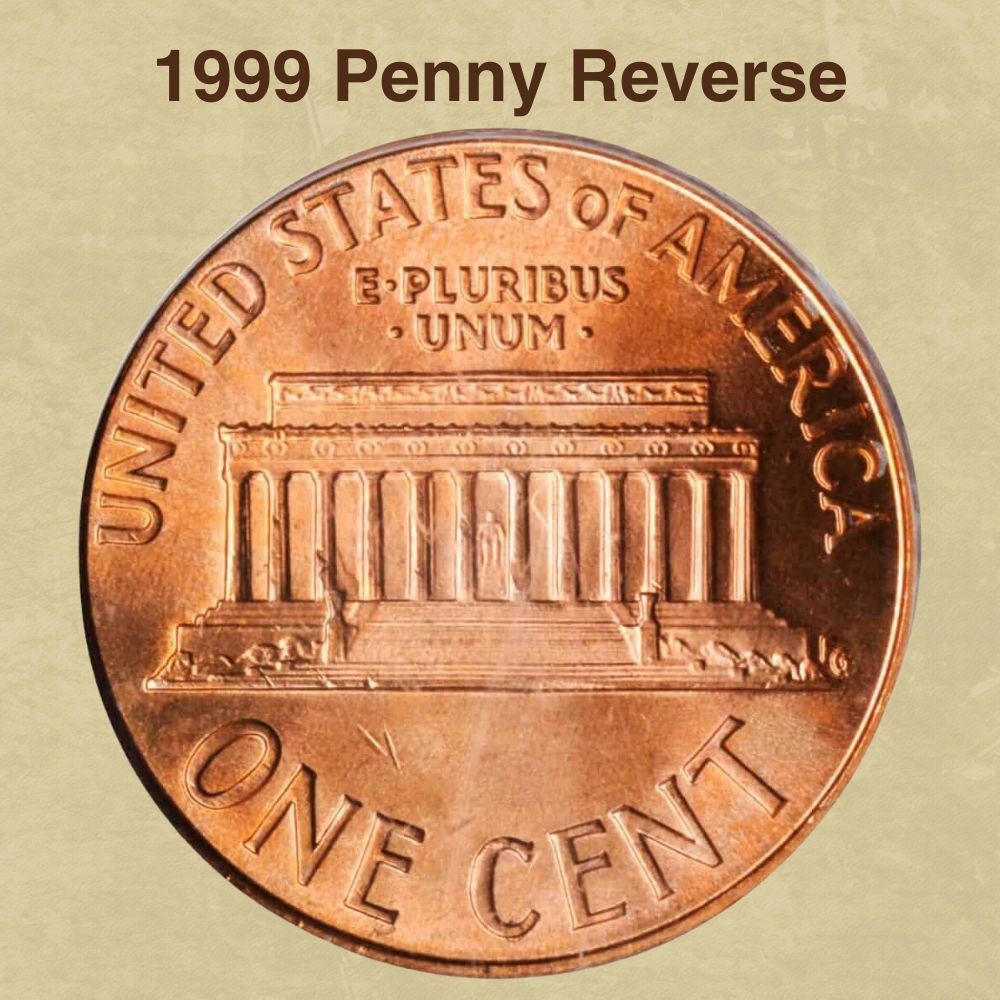
The Lincoln Memorial appears prominently on the reverse of the 1999 penny.
The words UNITED STATES OF AMERICA are imprinted at the top of the coin followed the by the motto E PLURIBUS UNUM in a smaller font size.
The coin’s denomination, ONE CENT, appears at the bottom of the coin around the inner rim.
At a closer look, you will also notice the initials ‘FG’ on the furthest end of the Memorial’s right staircase wing. These initials stand for Frank Gasparro who designed the coin’s reverse.
Other Features of the 1999 Penny
The 1999 penny has other notable features. This coin weighs 2.5 grams and measures 19.00 millimeters in diameter. It has a plain edge.
The coin comprises Copper-plated Zinc and has a plain edge.
In 1999, the Philadelphia, Denver and San Francisco mints struck Lincoln Memorial pennies. But only the coins struck at the Denver and San Francisco facilities have a mint mark D and S respectively on the obverse. The Philadelphia pennies do not have a mint mark.
Also read: 13 Most Valuable Wheat Penny Worth Money
1999 Penny Grading
Lincoln cents are among the most collected coins in American coinage history. So how do you grade your penny and estimate how much it might be worth? The answer lies in the coin’s color and condition.
Your 1999 penny might be classified as red, red-brown, or brown. Although it is normal for copper pennies, including uncirculated ones, to change color due to oxidation and exposure to the elements, most collectors prefer red pennies.
A general rule of thumb when designating colors to your Lincoln pennies is to consider that coins without any red on them are usually categorized as brown (BN), those with 15 to 20% red coloration are designated red-brown (RBN) while those that are 80 to 90% red are graded Red (RD).
Aside from the color, you also want to examine the coin’s condition. Pay close attention to the fields and check for contact marks, dings, and dents, which are a sign of circulation.
Examine the high points including the hair, lower shoulder and beard which are prone to wear and tear. The degree of wear on these points will give you a clue as to the coin’s grade.
Mint state 1999 pennies are more desirable than the circulated variety. For your penny to be graded gem quality or MS65 and above, it should have an appealing mint luster and the original red color. The coin should only have few, if any, contact marks with little to no signs of wear.
| # | Grade |
|---|---|
| 1 | Basal State-1 |
| 2 | Fair |
| 3 | Very Fair |
| 4, 5, 6 | Good |
| 7, 8, 10 | Very Good |
| 12, 15 | Fine |
| 20, 30 | Very Fine |
| 40 | Extremely Fine |
| 50 | About Uncirculated |
| 60 | Mint State |
| 65 | Mint State |
| 70 | Mint State |
Please check our grading guides to know your coin scale, It’s the necessary step to know the exact value of your coin.
Check out now: How to Grade Lincoln Wheat Penny?
1999 Penny Value Guides
In this section, we will answer the question: How much is a 1999 penny worth?
There are three varieties of the 1999 Lincoln Memorial penny. These are the:
- 1999-No Mint Mark Penny
- 1999-D Penny
- 1999-S Proof Penny
Let’s find out how much each is worth in circulated and uncirculated condition. Something interesting to note is that the value of Lincoln pennies may vary slightly depending on the coin’s color.
Brown coins are worth less than red-brown and red-coins. Red coins are less worn and are more desirable to collectors.
1999 No Mint Mark Penny Value
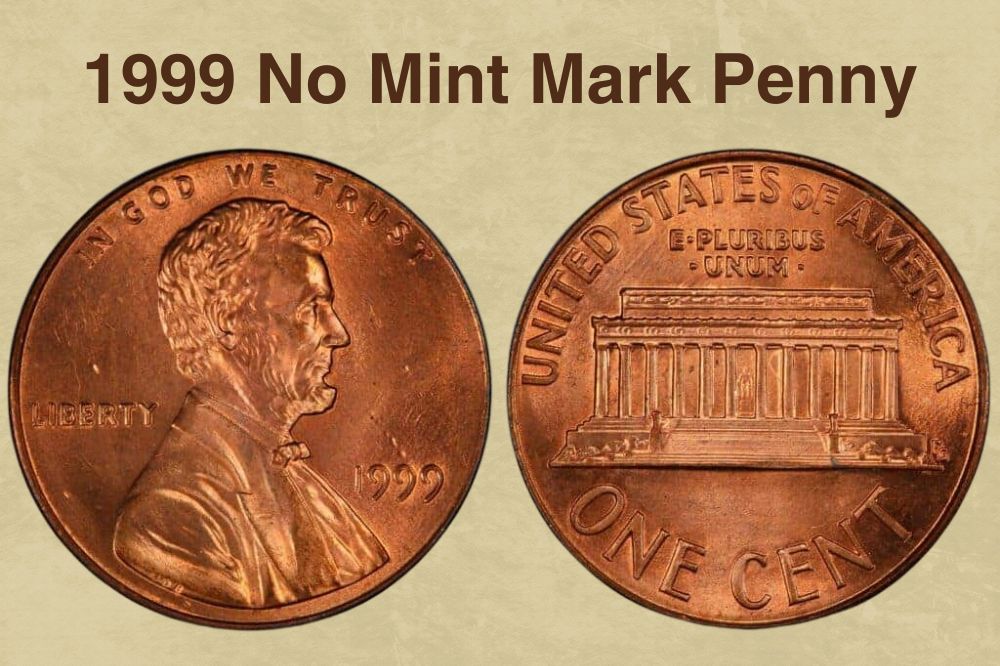
The Philadelphia coin-minting facility struck a whopping 5,237,600,000 Lincoln pennies in 1999. That’s a massive amount of coins released into circulation.
Because of such a large mintage, the 1999 no-mint mark penny is widely available; you can easily find these coins in circulation so do not expect them to be worth much more than their face value.
In fact, in circulated condition, a brown 1999 no-min mark Lincoln Memorial penny is worth between $0.05 and $0.10 while one in mint state graded MS67 is worth as much as $7.50. A rare specimen graded MS66 sold for $1,725 at a Superior Galleries auction in 2003.
In MS67, a brown 1999 no-mint mark penny is worth about $10 while a red one graded MS68 would fetch up to $95. An extremely rare specimen graded MS66 was auctioned in 2006 for an impressive $138,000.
It is worth noting that the Philadelphia mint struck two varieties of the Lincoln Memorial penny in 1999: the close AM and wide AM pennies, both of which are highly sought after collectors’ items.
These letters refer to the A and M in the word AMERICA on the reverse. In some pennies, the letters AM are almost touching while in others there is a notable space between the two letters. Both the wide and close AM varieties struck in Philadelphia are valuable and can fetch as much as $200.
1999-D Penny Value
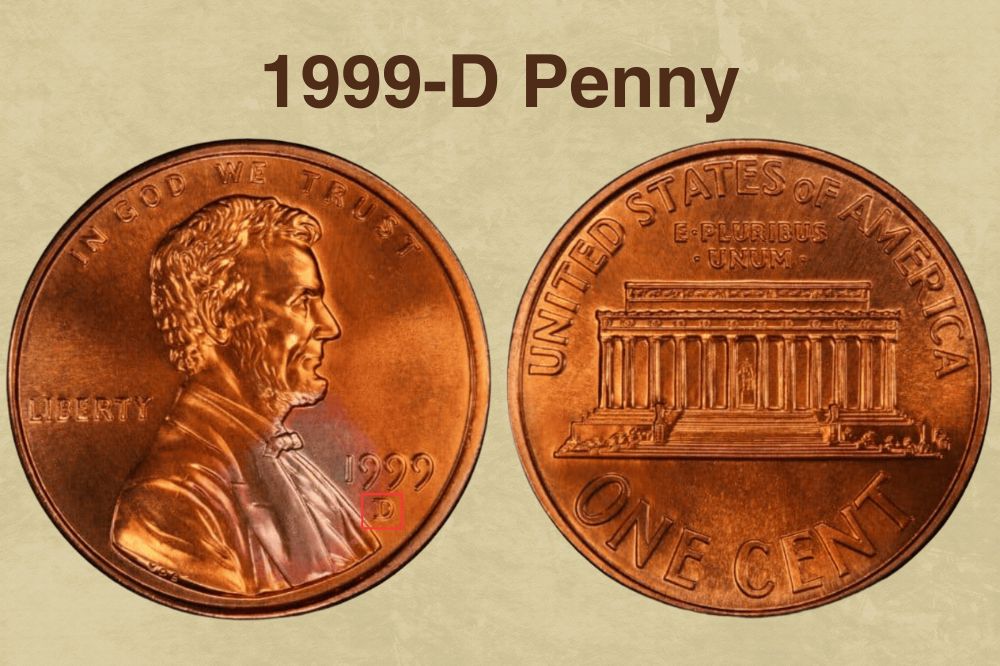
The Denver facility also minted Lincoln Memorial pennies in 1999.
An estimated 6,360,065,000 pennies with the mint mark D on the obverse were struck and released into circulation that year. This was the highest mintage across all three minting facilities.
Lincoln Memorial 1999-D pennies are easily found in circulation and are also very affordable. In their circulated state, these pennies are worth between $0.03 and $0.10.
A brown 1999-D penny in mint state graded MS67 can fetch as much as $7.50. A red-brown in the same grade is worth about $10 while a red one can bring up to $20.
A rare, gem-quality red 1999-D penny graded MS69 was sold at Heritage Auctions in 2013 for an enviable $1, 293.
1999-S Proof Penny Value
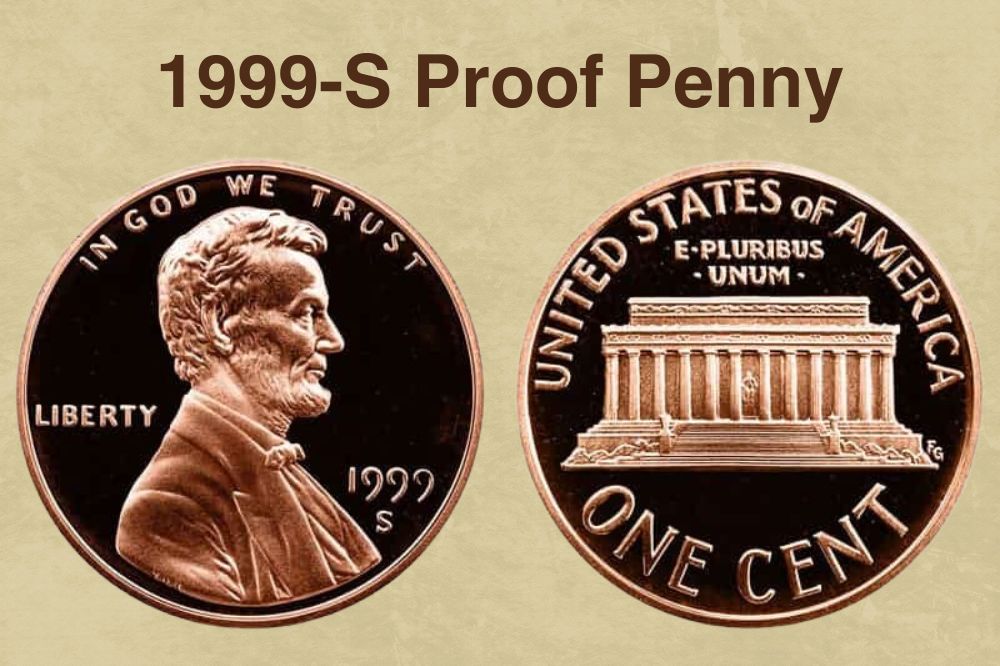
As is tradition, the San Francisco minting facility struck proof pennies for the 1999 date. In addition to their brilliant luster, you will also recognize these proof coins by the S mint mark on the obverse.
As is the case with the Philadelphia pennies, the San Francisco mint also struck close AM and wide AM Lincoln Memorial pennies with the close variety being more desirable to collectors.
The proof pennies struck in 1999 are quite affordable. One graded MS9 or gem quality might set you back $15.
The most expensive example of a 1999-S proof close AM specimen was graded PF69 and sold for $1,063 in 2008. Another 1999-S proof DCAM specimen graded PF70 fetched $2,358 in a 2004 auction.
Also read: 17 Most Valuable Indian Head Penny Worth Money
Rare 1999 Penny Error List
With such a large mintage, you can expect several 1999 penny errors. Some errors are unique and interesting, fetching more than the face value of a regular strike 1999 Lincoln Memorial penny.
Here are a few errors to keep an eye out for:
1999 Doubled- Die Penny Error
A doubled-die error when the die design is struck twice at a slightly different angle. This results into two similar images at a slight offset angle.
This error is quite common among Lincoln cents but is also highly desirable among collectors. At the time of writing, an example with significant doubling of Lincoln’s head is selling on eBay at an asking price of $5,400.
1999 Wide AM Penny Error
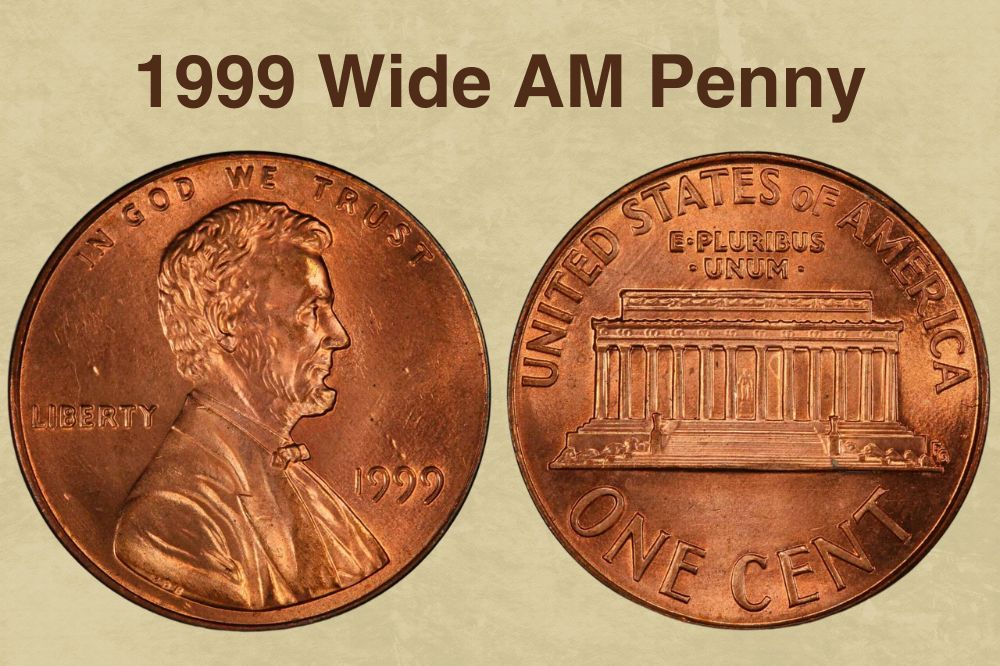
The Wide AM is another highly sought-after error in the 1999 penny series.
This error occurred when mint workers at the Philadelphia and San Francisco facilities accidentally used proof dies to strike pennies pennies resulting in a wider than normal space between the letter A and M in the word AMERICA on the reverse.
Collectors find this error quite fascinating and are willing to pay as much as $300 for a 1999 Wide AM penny.
1999 Double-Struck Off 2nd Off Center Penny Error
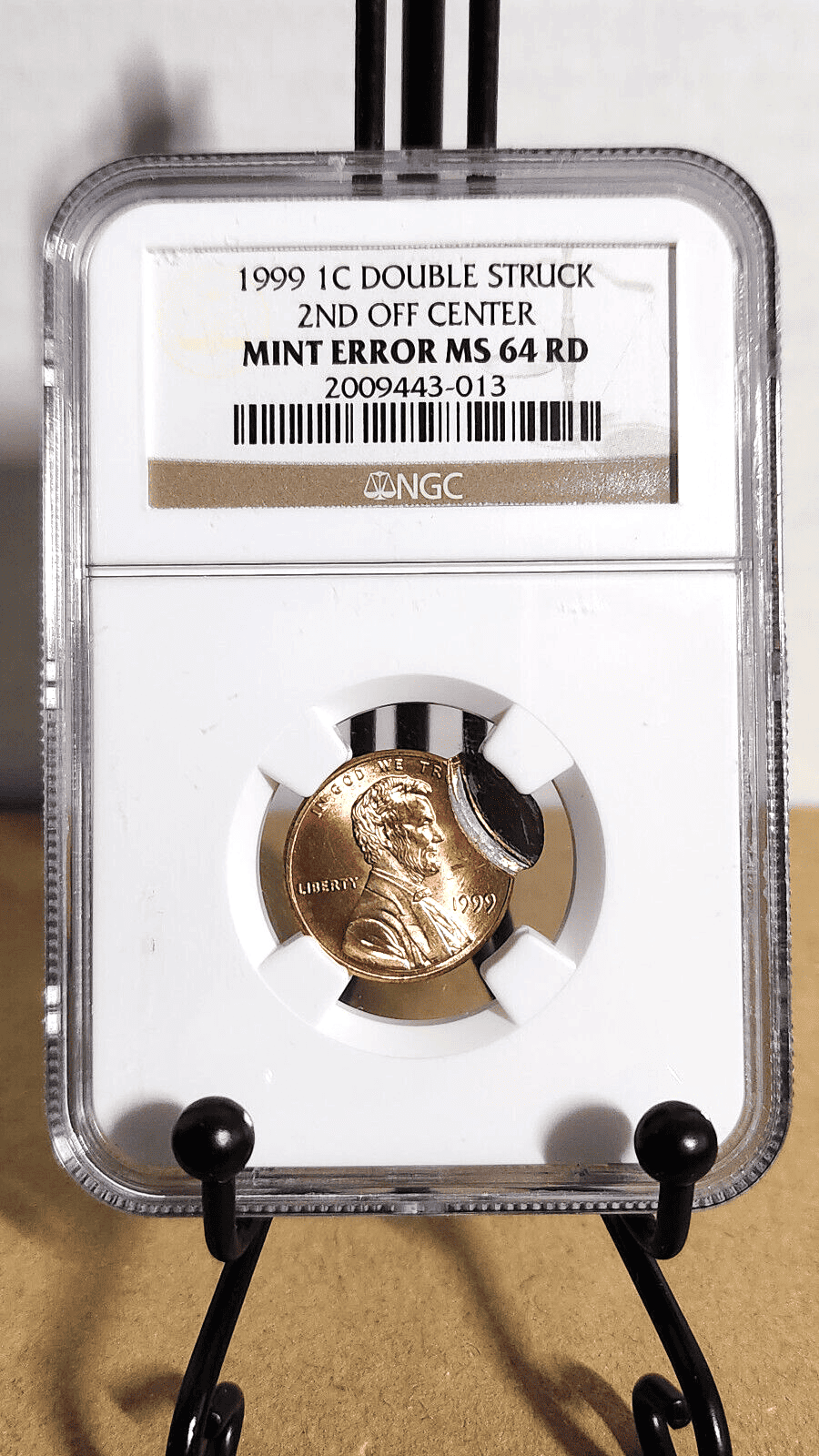
A double struck off-center error is fascinating and collectors are eager to have such a ‘’weird’’ coin in their collection.
This error occurs when a coin is not fully ejected from the die hub after being struck the first time. This results in the coin being struck a second time with the die landing away from the center (off-center).
A 1999 Lincoln penny with a double-struck off-center penny can fetch up to $275 or more if the coin has brilliant luster.
1999 Broad Struck Penny Error
Broad strike errors are relatively uncommon so they tend to generate a lot of interest among collectors.
This error happens when the die hub strikes outside the collar that holds the coin in place and helps to shape its diameter. This gives the impression of a widened penny or one that seems wider than usual.
A broad struck 1999 penny can bring in as much as $85 while one in mint state can be worth up to $100.
Also read: 11 Most Valuable Wheat Penny Errors
Where to Sell Your 1999 Penny ?
Now that you know the value of your coins, do you know where to sell those coins online easily? Don’t worry, I’ve compiled a list of these sites, including their introduction, pros, and cons.
Check out now: Best Places To Sell Coins Online (Pros & Cons)
FAQ
Are any 1999 pennies worth anything?
Most of the 1999 pennies are only worth their face value. All the three mints combined produced more than 10 billion pennies that year, making these coins extremely common. That said, some 1999 pennies are worth slightly more than their face value. Examples of 1999 Lincoln pennies worth money include those with notable errors and pennies in mint state or gem quality.
How much is a 1999 penny with the A and M touching?
If you have a 1999 penny in which the A and M are touching, you have the rare close AM coin. These coins are worth much more than their wide A and M penny and the regular strike coins with a healthy space between the A and M. Close AM coins are worth between $90 and $200 depending on their condition.
What does it mean if the A and the M touch on a penny?
The A and M touching on a 1999 penny is a result of mint workers accidentally using proof dies to strike coins meant for circulation. Only a few of these coins were struck before the mistake was rectified, making the close AM rare. The 1999 close AM pennies are desirable among collectors with some willing to pay as much as $100 for a piece.

I have a 1944 nickel D mint and has transition lines on front and back an is in pretty good condition
I have a 1999 penny in which the AM are touching and I want to know is it worth anything and if so how much is it worth if possible to answer please! It’s in good shape although I have not had it authenticated
Yes I have a 1999 d closed A M Penny
I have a unminted 1999 with the A and M are touching is it worth anything
ihave a few ofthe 1992 close a.m if anyone is inserter let me know
f
I have a 1999 penny the size of a dime but as think as a nickel any clue on the value