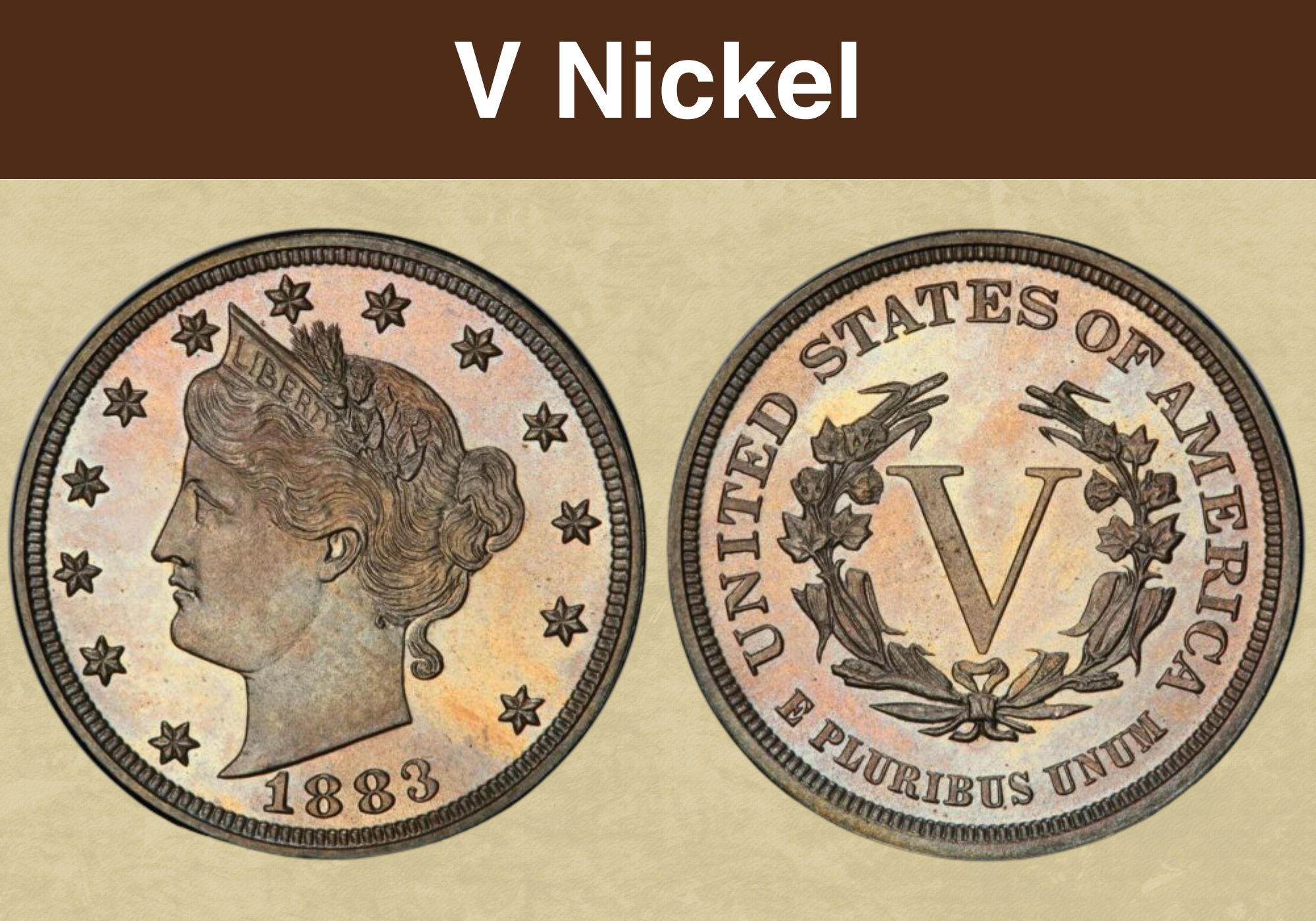
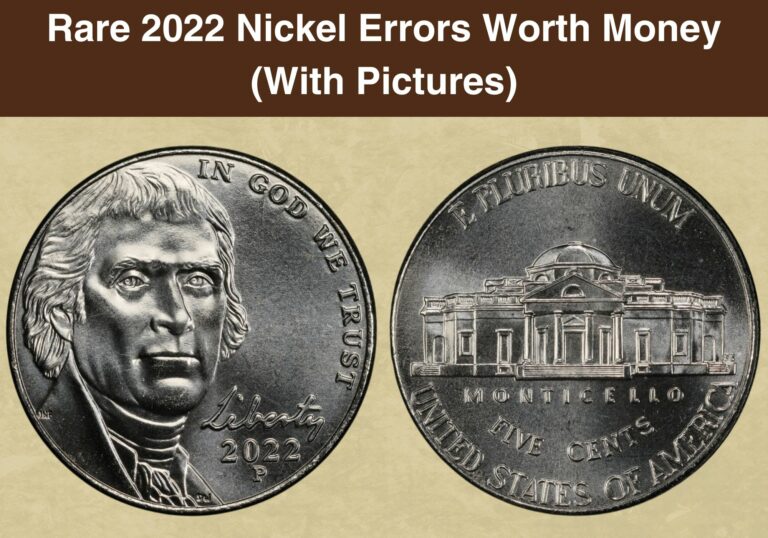
Rare 2001 Nickel Errors Worth Money (Full List With Pictures)

A 2001-P Jefferson nickel with multiple die break errors sold at Stack’s Bowers in 2021 for $1,310. The complete 2001 nickel error list covers nine distinct mint mistakes, with values running from $750 grease-filled proof strikes to four separate errors that crossed the $1,000 mark — including two rare proof coin errors from San Francisco. Every error on this list sold for $750 or more, giving 2001 the highest value floor of any Jefferson nickel year we’ve covered. Here’s every documented error, sorted by value, with auction records and how to identify each one.
1. 2001 Nickel Struck Through Grease Error (Up to $750)

A struck-through error happens when foreign material gets trapped between the die and planchet during striking. Grease — press lubricant pooling in the die’s recessed areas — blocks the design from fully impressing onto the coin.
This 2001-S example is a proof coin, which makes the grease fill doubly unusual. Proof coins are struck on specially prepared planchets with polished dies at San Francisco, using a hand-fed, single-coin process with tighter quality control than business strikes. Grease contamination on a proof press should be caught before any coins leave the building. The fact that this one survived into a GreatCollections auction means the quality system failed at multiple checkpoints.
Value: In 2019, GreatCollections auctioned a 2001-S proof nickel graded MS65 with a reverse grease struck-through error for $750. The grease blurred details on Monticello’s architecture and lettering. Proof grease fills are rarer than business-strike versions because the proof process is supposed to prevent exactly this. Business-strike grease fills on 2001 nickels trade for $50–$200. The proof origin drove the premium.
How to Identify: Look for a localized area on the reverse where Monticello’s columns, windows, or lettering appear weak, mushy, or absent — a smooth blank zone surrounded by the proof’s normal mirror finish. The contrast between the flawless proof surface and the grease-filled area should be dramatic.
Don’t confuse with circulation wear — this is a proof coin, so it shouldn’t show any wear at all. The struck-through zone will have sharp, defined boundaries against the mirror field.
Check whether the coin has an “S” mint mark confirming San Francisco proof origin. Business strikes from Philadelphia and Denver don’t carry the same proof premium on strike-throughs. Fastest confirmation: sharply defined smooth zone on a mirror-finish proof surface with “S” mint mark.
Use Our 2001 Nickel Value Checker
2. 2001 Nickel Partial Collar Strike Error (Up to $870)
A partial collar strike happens when the planchet sits tilted or partially above the collar during striking. The portion inside the collar gets contained normally; the portion above expands freely.
On this 2001-D nickel, the partial collar created a visible ridge along part of the edge — a raised step where the contained section meets the expanded section. Since nickels have a plain edge, the step manifests as a raised lip rather than the reeded-to-smooth transition you’d see on dimes or quarters. The MS67 grade on this example is exceptional for an error coin — most errors trade in the MS60–MS65 range — which explains the $870 price.
Value: In 2006, an eBay collector paid $870 for a 2001-D nickel graded MS67 with a partial collar strike error. The MS67 grade carried much of that premium — the same error in MS63 would bring $200–$400. General market prices for partial collar nickels range from $75–$500 depending on the step’s visibility and the coin’s grade.
How to Identify: Examine the coin from the edge. Look for a distinct step or ridge — a raised lip where part of the edge sits higher than the rest. On a nickel’s plain edge, this appears as an uneven profile rather than the smooth, uniform edge of a properly struck coin.
Use calipers at multiple points. The expanded section may exceed 21.21mm while the contained section stays normal.
Don’t confuse with a broadstrike, which has uniform expansion all the way around. A partial collar has both contained and expanded sections. Post-mint damage from dryers creates uneven distortion with scratches. Fastest confirmation: view edge-on and look for a step between two different edge heights.
Use Our 2001 Nickel Value Checker
3. 2001 Nickel Die Clash Error (Up to $870)

A die clash happens when the obverse and reverse dies strike each other without a planchet between them. The force transfers a mirror image of each die’s design onto the opposing die face.
On this 2001-D nickel, the clash left visible ghost images — Monticello’s columns appearing as faint incuse outlines on Jefferson’s portrait. Heritage Auctions sold it for $870 in 2015. The Monticello design with its columned portico and triangular pediment creates distinctive ghost patterns because the architectural lines are straight and recognizable even as faint impressions on the opposite die.
Value: In 2015, Heritage Auctions sold a 2001-D nickel graded MS65 with a die clash error for $870. Die clashes on circulated Jefferson nickels bring $25–$150. Strong clashes visible to the naked eye on uncirculated coins push $300–$870. The Heritage provenance and MS65 grade drove the top price. Clashes where Monticello’s columns are clearly identifiable on the obverse bring the strongest premiums.
How to Identify: Look for faint design elements that don’t belong on that side of the coin. On the obverse, Monticello’s column outlines ghosting behind Jefferson’s portrait are the primary tell.
The ghost images are incuse (sunken), not raised. Use angled lighting — tilt the coin slowly under a desk lamp and watch for straight lines emerging in the field that match Monticello’s architecture.
Don’t confuse with strike-throughs, which create blank areas. A clash produces a recognizable reversed mirror image. Fastest confirmation: identifiable Monticello column lines ghosting on the obverse under angled light.
Use Our 2001 Nickel Value Checker
4. 2001 Nickel Rotated Die Error (Up to $925)
A rotated die error occurs when one die shifts from its correct orientation during installation. The obverse and reverse end up misaligned relative to each other.
On this 2001-D nickel, the reverse rotated 45 degrees from the correct position. David Lawrence Rare Coins sold it for $925 in 2011. Flipping a properly struck coin shows the reverse perfectly upside-down at 180 degrees. This coin shows Monticello tilted dramatically — the building’s roofline points roughly northeast instead of straight across. A 45-degree rotation is severe enough to notice immediately when someone flips the coin.
Value: In 2011, David Lawrence Rare Coins sold a 2001-D nickel graded MS65 with a 45-degree rotated die error for $925. Minor rotations under 15 degrees carry no premium — they fall within manufacturing tolerance. Rotations of 30–60 degrees push $300–$925. PCGS and NGC require at least 15 degrees for certification. The CoinKnow guide estimates 90-degree rotations at $400–$1,200.
How to Identify: Hold the coin with Jefferson’s portrait upright on the obverse. Flip it along its vertical axis. Monticello on the reverse should appear perfectly upside-down at 180 degrees.
If Monticello is tilted at any other angle, you have a rotated die. Use a protractor or printed rotation gauge to measure the degree of offset. At 45 degrees, the building’s roofline points diagonally — impossible to miss.

Coin Identifier and Value App
Not sure what your coins are worth? Get Instant Value • Grade • Error Detection with coin identifier and value app (FREE Usage Daily)
Minor rotations under 5 degrees are within tolerance and carry no value. Fastest confirmation: flip the coin vertically and check whether the reverse is perfectly inverted — any visible tilt indicates rotation.
Use Our 2001 Nickel Value Checker
5. 2001 Nickel Die Cap Error (Up to $980)
A die cap starts when a freshly struck coin sticks to the upper die and doesn’t eject. That stuck coin becomes a new striking surface, and the press keeps running.
With each successive strike, the stuck coin curls around the die into a bottle-cap shape. Incoming planchets receive a weak, mirror-image impression from the stuck coin instead of the proper die design. On this 2001-D example, the CoinValueChecker description notes that “Jefferson’s face appears stretched out while the Monticello design is barely discernible” — the cap deformed the stuck coin enough to distort everything it subsequently struck.
Value: In 2009, an eBay collector paid $980 for a 2001-D nickel graded MS65 with a die cap error. Die caps on Jefferson nickels generally range from $300–$1,200 depending on how many strikes the cap absorbed and how recognizable the brockage impression remains. Early-stage caps with clear brockage bring higher prices than late-stage caps where the image degenerated into an unrecognizable blob.
How to Identify: The shape is the giveaway. A die cap coin is not flat — it’s concave, cupped, or bowl-shaped. Place it on a flat surface and it will rock. The rim on one side will be dramatically raised.
One side should show a normal or near-normal design. The other may carry a weak, reversed mirror-image impression — Jefferson’s face stretched, Monticello barely visible.
Don’t confuse with a simple brockage, which stays flat. A cap error is always cupped. Weigh it: should still be approximately 5.00 grams. Fastest confirmation: cupped bottle-cap shape plus distorted reversed design on one side.
Use Our 2001 Nickel Value Checker
6. 2001 Nickel Misaligned Die Error (Up to $1,045)

A misaligned die error happens when the dies aren’t properly centered during installation. The design on a misaligned die coin remains complete — unlike an off-center strike, nothing is missing. The entire image sits off-center within the rim.
On this 2001-P nickel, the misalignment was dramatic enough to command $1,045 at Stack’s Bowers in 2018. The MS68 grade — near-perfect for any coin — adds enormous premium. An MS68 Jefferson nickel without any error is already scarce; one with a visible misalignment at that grade is exceptionally rare. The combination of the error’s visual severity and the near-flawless surface preservation drove the price past four figures.
Value: In 2018, Stack’s Bowers auctioned a 2001-P nickel graded MS68 with a misaligned die error for $1,045. Minor misalignments on circulated nickels trade for $10–$50. Dramatic misalignments on uncirculated coins push $200–$600. The MS68 grade on this example inflated the price well above typical misalignment territory.
How to Identify: Examine the rim width around the entire circumference. On a properly struck coin, the rim is uniform. A misaligned die coin shows one side noticeably wider while the opposite side narrows.
The full design will be present — nothing missing. This is the critical distinction from an off-center strike, which always has blank planchet showing. A misaligned die coin has everything, just shifted.
The uneven rim should be consistent — wider on one side, narrower directly opposite. Fastest confirmation: complete design present with obviously uneven rim width around the coin.
Use Our 2001 Nickel Value Checker
7. 2001 Nickel Off-Center Strike Error (Up to $1,210)

Off-center strikes happen when the planchet isn’t seated properly in the striking chamber. The die comes down, but the blank has shifted — only part catches the full impression.
On this 2001-P nickel, approximately 20% of the design was struck off the planchet, leaving a significant blank crescent on one side while Jefferson’s portrait pushed toward the opposite edge. David Lawrence Rare Coins sold it for $1,210 in 2017. The MS67 grade is remarkable for an off-center coin — maintaining gem-quality surfaces while the design itself is displaced takes a lucky combination of clean planchet, sharp strike on the remaining area, and careful handling afterward.
Value: In 2017, David Lawrence Rare Coins sold a 2001-P nickel graded MS67 with an off-center strike error for $1,210. Minor off-center strikes under 10% on circulated nickels trade for $15–$75. Dramatic 20–40% off-centers with visible dates push $400–$1,210. Without a readable date, even impressive off-centers lose most of their appeal.
How to Identify: Look for a clean crescent of blank, featureless metal on one side. The design shifts toward the opposite edge, with part of the lettering or portrait cut off. Both obverse and reverse shift the same direction.
Don’t confuse with a Misaligned Die (MAD) — listed above — which shows the complete design with uneven rim but nothing missing. An off-center always has blank planchet showing.
Post-mint damage creates uneven distortion with scratches. Genuine off-center strikes have clean, smooth unstruck areas. Fastest confirmation: clean blank crescent with design shifted and date readable.
Use Our 2001 Nickel Value Checker
8. 2001 Nickel Double Strike Proof Error (Up to $1,290)
A double strike occurs when the coin fails to eject from the press and gets struck a second time. The planchet may shift between strikes, producing two overlapping impressions.
Coin Identifier and Value App
Not sure what your coins are worth? Get Instant Value • Grade • Error Detection with coin identifier and value app (FREE Usage Daily)
On this 2001-S proof nickel, the second strike landed slightly off-center from the first, creating a doubled design on the reverse. Proof coins are hand-fed one at a time into a slow-speed press — a double strike on a proof represents a failure of the most controlled minting process the Mint runs. GreatCollections sold it for $1,290 in 2020. The mirror-like proof finish amplifies the visual impact because the doubled design disrupts the reflective surface.
Value: In 2020, GreatCollections auctioned a 2001-S proof nickel graded MS66 with a reverse double strike error for $1,290. Double strikes on business-strike nickels bring $300–$800. Proof double strikes command a premium because the proof process is designed to prevent exactly this — when one escapes, the rarity factor multiplies. The contrast between the mirror finish and the doubled design drives the price above business-strike territory.
How to Identify: Look for two distinct impressions of the design overlapping on the reverse. Monticello may appear twice at slightly different positions. The inscriptions will show doubled lettering with visible offset between the two strikes.
Both the obverse and reverse may show evidence of two separate strikes. The second impression is typically weaker than the first.
Don’t confuse with machine doubling, which creates flat shelf-like shadows from a single strike. A double strike shows two fully rounded, three-dimensional impressions. Confirm the “S” mint mark for proof origin. Fastest confirmation: two distinct rounded impressions at different positions on a mirror-finish proof coin.
Use Our 2001 Nickel Value Checker
9. 2001 Nickel Multiple Die Breaks Error (Up to $1,310)
Die breaks form when the steel die fractures from repeated stress. Metal fills the fractures and transfers onto each coin as raised lines. Most die cracks are single lines worth modest premiums.
This 2001-P nickel is different. Multiple die breaks appeared on both the obverse and reverse simultaneously, creating a network of raised lines across the entire coin. Stack’s Bowers sold it for $1,310 in 2021 — the highest price for any 2001 nickel error. The MS68 grade means the coin’s surfaces were near-perfect despite the web of die breaks crossing them. Each crack formed during the die’s progressive deterioration, and the network pattern they create is unique to this specific die pair — no two multi-break coins look exactly alike.
Value: In 2021, Stack’s Bowers auctioned a 2001-P nickel graded MS68 with multiple die break errors on both obverse and reverse for $1,310 — the highest confirmed price for any 2001 nickel error. Single die cracks on circulated nickels add $10–$50. Multiple breaks on both sides of uncirculated coins push $300–$1,310. The MS68 grade and the dramatic multi-break pattern together drove the record price.
How to Identify: Look for multiple thin, raised lines running across both sides of the coin. Each line should be raised — run your fingernail perpendicular across them and they should catch upward.
Use a loupe to trace each crack’s full path. Multiple breaks will create an intersecting network — some lines may cross or branch. Check both sides — the most valuable examples show breaks on both obverse and reverse from the same deteriorating die pair.
Don’t confuse with post-mint scratches, which are recessed. Die breaks are raised with clean, consistent edges. The network pattern of multiple intersecting breaks is distinctive and can’t be replicated by post-mint damage. Fastest confirmation: multiple raised irregular lines on both sides, all catching your fingernail upward.
Use Our 2001 Nickel Value Checker
Conclusion
The 2001 nickel error spectrum runs from $750 proof grease fills to a $1,310 multiple die break that tops the year at Stack’s Bowers. Every error on this list sold for $750 or more — the highest floor of any Jefferson nickel year we’ve covered. Four errors crossed $1,000, and all four major auction houses contributed documented sales: Stack’s Bowers, Heritage, GreatCollections, and David Lawrence. A 10x loupe, a protractor for rotation checks, and side-by-side comparison with a normal coin cover the identification basics for all nine error types here.