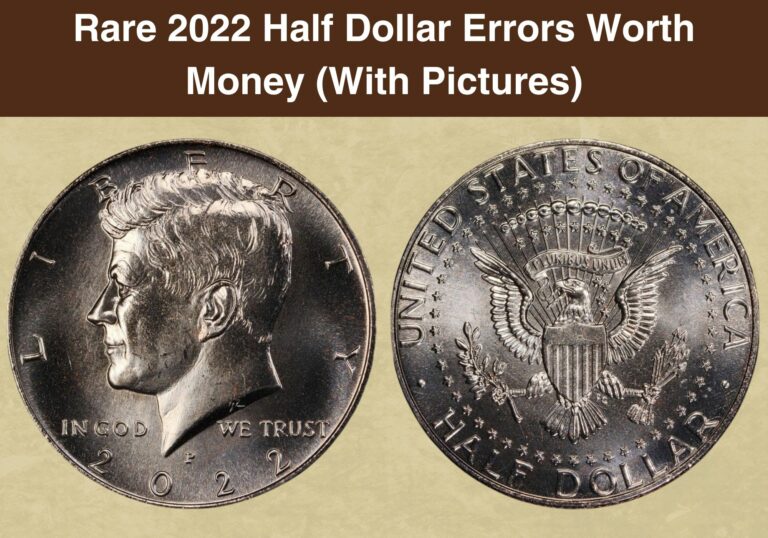
1982 Half Dollar Coin Value: Errors List, “D”, “S” & P Mint Mark Worth

1982 Half Dollar value ranges from $0.50 face value to $4,440. That record was set by a Grade 64 example sold through Heritage Auctions in August 2025. To find out what yours is worth, upload a photo of your coin below for a quick value range. You can also scroll down to check recent eBay sales and see what these are actually going for today.
1982 Half Dollar Value Checker
Identify 1982 Half Dollar D, S and P Mint Mark Price
Front Obverse
Upload or Take a Photo
Back Reverse
Upload or Take a Photo
1982 Half Dollar Value By Variety
If you know the grade of your coin, the chart below will give you the exact price for each mint mark.
| Type | Good(G4-6) | Fine(F12-15) | AU(AU50-58) | MS(MS60-70) | PR(PR60-70) |
|---|---|---|---|---|---|
| ▶1982 P Half Dollar Value | $1 | $1 | $1 | $4 - $960 | — |
| ▶1982 D Half Dollar Value | $1 | $1 | $1 | $4 - $640 | — |
| ▶1982 S DCAM Half Dollar Value | — | — | — | — | $1 - $33 |


Also Read: Top 100 Most Valuable Kennedy Half Dollar Worth Money (1964 – Present)
Top 10 Most Valuable 1982 Half Dollar Worth Money
Most Valuable 1982 Half Dollar Chart
2008 - Present
The king of the 1982 Kennedy series is the 1982-D graded MS67. It brought $3,600 at auction — a jaw-dropping number for a copper-nickel clad coin most people wouldn’t look twice at in pocket change. Only about 21 examples have been slabbed at that grade, with nothing higher. That’s the kind of top-pop scarcity that gets registry set collectors into bidding wars.
Right behind it, the 1982-P MS67 sold for $2,585 in August 2014. The 1982-S PR70 DCAM rounds out the top tier at $633, with that record sale taking place at Heritage Auctions on May 1, 2006. The price gap between a circulated example at face value and these top-grade coins shows just how much condition drives this market.
History of The 1982 Half Dollar
By 1982, the Kennedy half dollar had been around for nearly two decades. It had already gone through its 90% silver phase, the 40% silver era (1965–1970), and settled into the copper-nickel clad format we still see today.
The U.S. Mint was running 24-hour shifts that year to keep up with coinage demand. Quality control sometimes took a back seat.
Here’s the detail that matters most for collectors: the Mint canceled its annual Uncirculated Coin Sets for both 1982 and 1983 as a cost-cutting move. That one decision changed everything. In a normal year, you could buy an official Mint Set and get clean, carefully handled coins. Without those sets, any 1982 half dollar in true uncirculated condition had to come from original bank bags or rolls — and those coins got beat up in transit.
The only uncirculated coins available that year came from Souvenir Sets sold exclusively at the Philadelphia and Denver Mint gift shops. You had to physically visit the Mint to buy one. Production was tiny compared to regular Mint Sets, so gem-quality 1982 Kennedy halves are surprisingly tough to find today.
Total mintage hit about 23.96 million coins across both mints. Sounds like a lot, but the half dollar had basically vanished from everyday pocket change by the early 1980s. Most of these went straight into bank vaults or got dumped into bags.
That production context — plus the discovery of the No FG variety — gives the 1982 Kennedy half dollar a unique spot in the series.
Also Read: Top 35 Most Valuable Franklin Half Dollar Worth Money (1948 – 1963)
Is Your 1982 Half Dollar Rare?
1982-P Half Dollar
1982-D Half Dollar
1982-S DCAM Half Dollar
Circulated 1982 halves? Not rare at all. Worth face value. But here’s what trips people up: the rarity isn’t about mintage — it’s entirely about condition. Millions were struck, but almost none survived without bag marks. An MS65 is still findable. An MS66 is genuinely tough. MS67 is a major rarity for both the P and D, with roughly 21 known examples each and nothing graded higher.
For precise rarity verification and current market positioning of your specific coin, the Coin Identifier and Value App provides comprehensive analysis tools.
Key Features of The 1982 Half Dollar
The 1982 Kennedy half dollar uses the same classic design the series has carried since 1964 — Kennedy’s portrait on the front, the presidential seal on the back. Here’s what to look for when you’re examining one.
The Obverse Of The 1982 Half Dollar
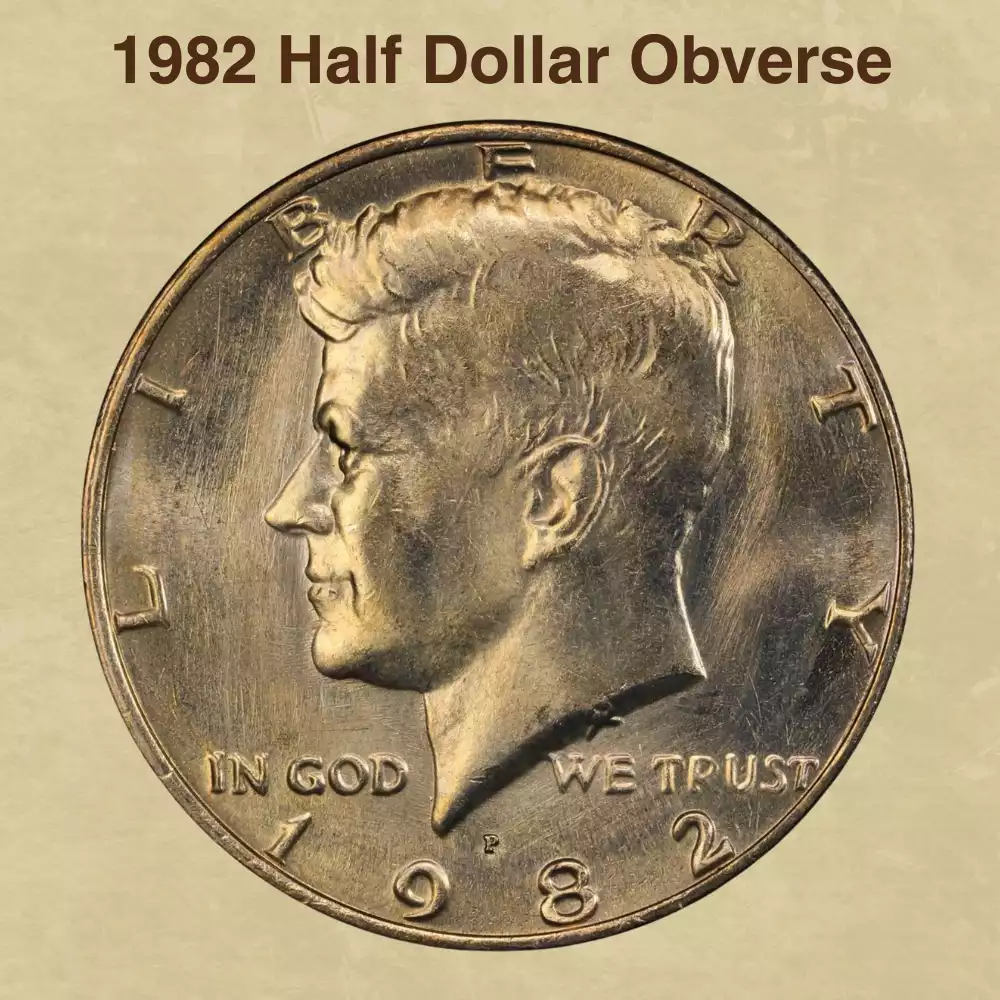
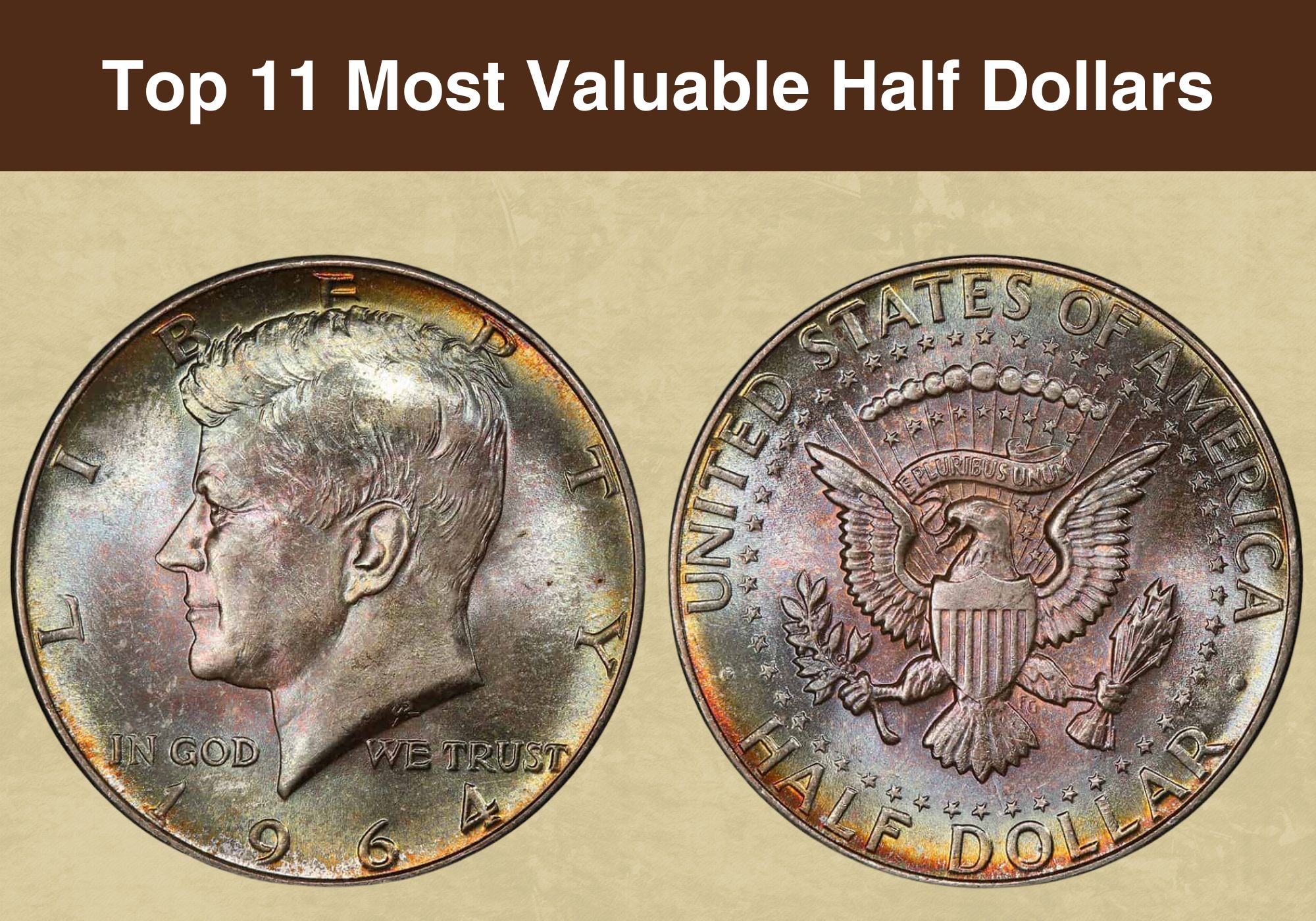
Gilroy Roberts’ left-facing Kennedy portrait dominates the obverse. “LIBERTY” runs along the upper rim, “1982” sits at the bottom. “IN GOD WE TRUST” appears below Kennedy’s chin, and Roberts’ initials “GR” are tucked under the truncated neck.
Check just above the date for the mint mark. Philadelphia coins show a “P,” Denver coins show a “D,” and San Francisco proofs display an “S.”
Quick note: the “P” mint mark on Philadelphia Kennedy halves only started in 1980. Before that, Philly coins carried no mint mark at all — so 1982 is one of the first few years you’ll see that P.
The Reverse Of The 1982 Half Dollar

Flip it over and you’ll see the presidential seal — a heraldic eagle with wings spread wide, head turned right. One talon grips thirteen arrows, the other holds an olive branch with thirteen leaves. “UNITED STATES OF AMERICA” curves along the top, “HALF DOLLAR” along the bottom, and fifty stars circle the eagle.
Now look at the right side of the eagle’s tail feathers. Designer Frank Gasparro’s initials “FG” should be right there. This is the single most important detail to check on a 1982 Kennedy half dollar. If those initials are missing, you may have the highly valuable No FG variety.
Other Features Of The 1982 Half Dollar
The coin measures 30.61 millimeters in diameter with a thickness of 2.16 millimeters and weighs 11.34 grams for clad business strikes. The edge is reeded with 150 reeds, same as every other Kennedy half.
Composition is a pure copper core clad in 75% copper / 25% nickel outer layers. Silver was completely gone from the series after 1970.
Want a quick way to confirm yours is clad and not an older silver version? Look at the edge — you’ll see a visible copper stripe. It also weighs 11.34 grams, noticeably lighter than the 40% silver halves at 11.50 grams.
Also Read: Top 60+ Most Valuable Walking Liberty Half Dollar (1916 -1947)
1982 Half Dollar Mintage & Survival Data
1982 Half Dollar Mintage & Survival Chart
Survival Distribution
| Type | Mintage | Survival | Survival Rate |
|---|---|---|---|
| P | 10,819,000 | 3,786,650 | 35% |
| D | 13,140,102 | 4,599,035 | 35% |
| S DCAM | 3,857,479 | 3,124,557 | 81% |
Denver produced 13,140,102 coins. Philadelphia made 10,819,000. San Francisco struck 3,857,479 Deep Cameo proofs strictly for collectors.
Both Philadelphia and Denver business strikes share an identical 35% survival rate. That means roughly two out of every three coins minted have been lost to circulation damage, melting, or neglect. To put it another way, about 15 million business-strike half dollars from 1982 are just gone.
The San Francisco proofs tell a completely different story — 81% survival rate, with over 3.1 million coins preserved. Collectors bought them, put them in cases, and left them alone.
The low survival in high grades for business strikes ties directly back to the missing Mint Sets. Without that protected distribution channel, coins bounced around in canvas bags and paper rolls. That’s where all those bag marks came from — and why anything above MS65 is so hard to find.
Also Read: What Half Dollars Are Worth Money?
The Easy Way to Know Your 1982 Half Dollar Value
Check Kennedy’s facial features and the eagle’s wings for wear. Those are the first areas to lose detail. Typical uncirculated P and D mint examples start around $8.55, while S proofs trade around $4.91.
Higher grades make a huge difference. MS-65 pieces reach $26–$46, and MS-67 specimens can command $460–$1,021 or more.
Don’t forget to check for the No FG variety. Look just below and to the right of the eagle’s tail feathers on the reverse. If the tiny letters “FG” are absent, you could be sitting on a valuable coin.
The Coin Identifier and Value App offers instant grade evaluation and error detection to help identify your coin’s true worth.

1982 Half Dollar Value Guides
Three varieties make up the complete 1982 Kennedy half dollar set:
- 1982-P (Philadelphia Mint)
- 1982-D (Denver Mint)
- 1982-S DCAM (San Francisco proof with Deep Cameo finish)
You can find affordable circulated examples or go after premium proof specimens — the range is wide.
Coin Identifier and Value App
Not sure what your coins are worth? Get Instant Value • Grade • Error Detection with coin identifier and value app (FREE Usage Daily)
1982-P Half Dollar Value

Most people assume a coin struck by the millions can’t be worth much. They’re right — until you get above MS65. That’s where the 1982-P gets interesting fast.
This Philadelphia business strike carries the “P” mint mark above the date, below Kennedy’s profile. Circulated examples from Good through Extremely Fine run about $0.60. Mint State pieces start around $1 for MS60 and climb to $50 at MS65.
MS66 is where the real scarcity kicks in. Hundreds of examples are known at that grade, so it’s still findable. But MS67? Fewer than a dozen known specimens across all major grading services. According to PCGS CoinFacts, the 1982-P is one of the scarcer issues in Gem condition — on par with the 1984-D and 1990-D.
The auction record of $2,585 was achieved by an MS67 specimen in August 2014. I think this coin is still underappreciated relative to how rare it actually is in top grades.
1982-P Half Dollar Price/Grade Chart
Price by 1-70 Grade (Latest Auction Records Included)
Historical auction records showcase this coin’s performance across various condition levels.
| Date | Platform | Price | Grade |
|---|---|---|---|
| 06/24 | SB | $720 | 67 |
| 04/23 | SB | $780 | 67 |
| 04/22 | HA | $1,980 | 67 |
| 11/21 | SB | $1,560 | 67 |
| 03/19 | HA | $55 | 66 |
| 10/17 | HA | $74 | 66 |
| 09/17 | HA | $43 | 66 |
| 12/16 | HA | $188 | 66 |
| 11/16 | HA | $74 | 65 |
| 09/16 | HA | $74 | 66 |
Market activity indicates a recent increase in collector interest in the 1982-P half dollar.
Market Activity: 1982-P Half Dollar
Market activity score: 53/100 as of Nov 2026 — unchanged since Aug 2026. Currently at its 12-month peak.
1982-P “No FG” FS-901 Half Dollar Value
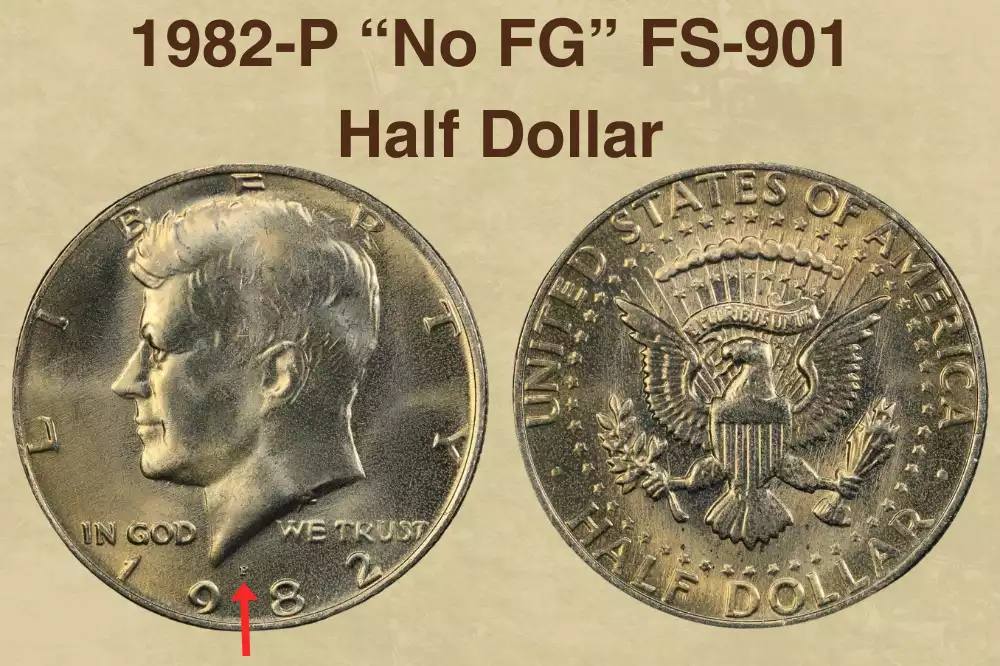
If you’re cherrypicking Kennedy halves, this is the one you’re hunting for. The 1982-P “No FG” ranks alongside the 1964 Heavily Accented Hair Proof and 1974-D Doubled Die Obverse as a must-have for serious Kennedy collectors.
It’s officially cataloged as FS-901 in the Fivaz-Stanton reference system — the standard guide for die varieties. That FS designation means it’s a fully recognized, authenticated variety, not just a quirky die state.
Here’s how it happened: Mint workers were polishing a die to remove clash marks and accidentally ground Frank Gasparro’s initials right off the reverse die. Gone.
About 1,500 examples are estimated to exist total. The finest known grade is MS67, with approximately 21 examples graded at that level by NGC alone as of late 2024. In uncirculated condition, a 1982-P No FG half dollar is worth $150 or more. Even worn specimens bring $20 to $30.
The auction record is $2,820, set in 2016 for an MS67 example graded by PCGS. MS65 specimens typically command around $75 today.
One important warning: the No FG variety is recognized only for the 1982-P. Neither PCGS nor NGC recognizes a true No FG variety for the 1982-D. Any 1982-D coin sold as “No FG” is almost certainly a worn die or filled die — not a genuine variety — and carries only a small premium of $5–$15 at most.
1982-D Half Dollar Value

Here’s a question worth asking: how can a coin with over 13 million struck be worth $3,600? The answer is that only 21 examples have been slabbed at MS67. Zero graded higher. That’s a completely different kind of rare.
From a surviving population of approximately 4,599,035 coins, the value progression is steep. MS63 examples trade around $9. MS66 specimens command $50. And those rare MS67 pieces? $3,600 at auction.
Denver’s strikes from this period tend to be sharper than Philadelphia’s — you can see the difference when comparing them side by side. But sharper strikes don’t mean better preservation. The same bank-bag distribution problem hit Denver coins just as hard. PCGS and NGC both confirm that anything above MS66 is extremely scarce for this issue.
1982-D Half Dollar Price/Grade Chart
Price by 1-70 Grade (Latest Auction Records Included)
Auction performance data shows this Denver variant responding differently to market conditions compared to contemporary Philadelphia strikes.
| Date | Platform | Price | Grade |
|---|---|---|---|
| 08/24 | HA | $3,600 | 67 |
| 05/23 | HA | $552 | 67 |
| 04/23 | DL | $238 | 67 |
| 02/23 | HA | $264 | 67 |
| 07/22 | DL | $35 | 66 |
| 07/20 | HA | $43 | 66 |
| 11/18 | HA | $660 | 67 |
| 11/17 | HA | $300 | 67 |
| 02/17 | HA | $3,525 | 67 |
| 09/16 | HA | $1,184 | 67 |
We think the 1982-D has real sleeper potential — collectors are starting to notice what the population reports have been saying for years.
Market Activity: 1982-D Half Dollar
Market activity score: 37/100 as of Nov 2026 — down 12 points from Aug 2026. 12-month peak: 49 (Aug 2026).
1982-S DCAM Half Dollar Value

A common misconception about proof coins is that they’re all the same. They’re not. “DCAM” stands for Deep Cameo — the raised design elements look frosted white while the background fields are deeply mirrored. It’s the most desirable look a proof coin can have.
One step down is “CAM” (Cameo), where the contrast exists but isn’t as strong. Below that, standard proofs show little to no frost at all. DCAM always commands the highest prices.
With 3,857,479 struck, lower grades are easy to find. But perfect PR70 Deep Cameo is another story. PCGS shows 459 coins certified PR70 DCAM, while NGC has 170. The all-time auction record for a perfect PR70 DCAM example stands at $633, set at Heritage Auctions on May 1, 2006.
GreatCollections has sold 262 examples of the 1982-S Proof DCAM over the past 16 years, with prices ranging from $6 for lower-grade examples to $385 for premium pieces. A recent PCGS Proof-70 DCAM example with the Kennedy Label sold for $302.50 at GreatCollections.
1982-S DCAM Half Dollar Price/Grade Chart
Price by 1-70 Grade (Latest Auction Records Included)
Recent auction performances demonstrate the coin’s evolving market position.
| Date | Platform | Price | Grade |
|---|---|---|---|
| 08/25 | HA | $4,440 | 64 |
| 03/23 | DL | $300 | 68 |
| 10/21 | DL | $42 | 70 |
| 08/21 | DL | $40 | 70 |
| 04/17 | HA | $57 | 70 |
| 09/16 | HA | $43 | 70 |
| 05/16 | DL | $120 | 70 |
| 05/16 | HA | $89 | 70 |
| 06/14 | GC | $10 | 69 |
| 05/14 | GC | $13 | 69 |
Market activity reflects growing collector recognition of the issue’s technical excellence and scarcity in top grades.
Market Activity: 1982-S DCAM Half Dollar
Market activity score: 56/100 as of Nov 2026 — down 5 points from Aug 2026. 12-month peak: 61 (Sep 2026).
Also Read: Rare Half Dollar Coins to Look For
1982 Half Dollar Rare Error List
The 1982 Kennedy half dollar came out during a period of big changes at the Mint — 24-hour shifts, no Mint Sets, cost-cutting everywhere. That kind of pressure on the production floor means errors slipped through. Here’s what to look for.
1. Off-Center Strikes
Off-center strikes are the most common 1982 Kennedy errors you’ll run across. They happen when the planchet isn’t seated properly between the dies. The design shifts to one side, leaving a blank crescent where metal wasn’t struck.
The percentage matters. A 10% off-center is mild and less valuable. A 50% off-center is dramatic and worth real money. General range is $15–$200+, depending on severity.
The key detail: make sure the date is still visible. That one factor can double or triple the value for serious error collectors.
2. Double Die Errors
Doubled dies (DDO for obverse, DDR for reverse) happen during die preparation when slight misalignment occurs during hubbing. You’ll see a secondary image in the lettering, date, or fine details.
Grab a loupe — at least 5x — and focus on “LIBERTY,” “IN GOD WE TRUST,” and the date digits. Those are the spots where doubling shows up most clearly. You’re looking for a clean, separated secondary image. If it just looks mushy or blurry, that’s probably normal die wear, not a true doubled die.
Strong, obvious doubling can bring $25–$300+ from the right buyer.
3. Clipped Planchet
These happen when the blanking press punches too close to a previously punched hole in the metal strip. You get a coin with a bite taken out of the edge — either a straight clip or a curved one.
Most clips remove 5–15% of the coin’s area. Values run $10–$75 depending on size and type. They’re easy to spot, easy to authenticate, and affordable. Great starter errors if you’re just getting into the hobby.
4. Struck-Through Errors
Sometimes a foreign object — wire, cloth, a metal fragment — lands between the die and planchet during striking. The object leaves an impression on the coin’s surface, creating a distinctive indented area.
One confirmed 1982-P example is a “Struck Through Rim Fragment” certified by ICG at MS-60 and sold through GreatCollections. That piece shows a clear impression from a chunk of rim metal caught during the strike.
Values vary wildly. Small, subtle impressions bring a modest premium. Large, clearly defined ones can sell for $50–$200 or more.
5. Misaligned Die Errors
A misaligned die (MAD) error is different from an off-center strike. With an off-center, the planchet is mispositioned. With a MAD error, the dies themselves are shifted. You get a full design on both sides, but the obverse and reverse don’t line up — the gap between the design and the rim looks uneven.
Hold the coin up and compare both sides. If the spacing between the design and the edge is noticeably different on one side versus the other, you may have a MAD error. Examples from this era typically sell for $15–$100 depending on severity.
Coin Identifier and Value App
Not sure what your coins are worth? Get Instant Value • Grade • Error Detection with coin identifier and value app (FREE Usage Daily)
Where To Sell Your 1982 Half Dollar?
When selling your 1982 Kennedy half dollar, consider local coin dealers for quick transactions, online auction platforms for broader reach, or coin shows for direct collector contact. Professional grading from PCGS or NGC can significantly boost value for high-quality specimens — and is especially recommended before selling any coin you believe is MS66 or higher.
Check out now: Best Places To Sell Coins Online (Pros & Cons)
1982 Half Dollar Market Trend
Market Interest Trend Chart - 1982 Half Dollar
Market interest: 1,100 collectors tracking this coin as of Nov 2026 — up 1,100 from Mar 2026. Currently at its 12-month peak.
*Market Trend Chart showing the number of people paying attention to this coin.
FAQ About The 1982 Half Dollar Value
1. Does the 1982 Kennedy half dollar contain silver?
No. It’s copper-nickel clad — silver was eliminated from the series after 1970. Weight is 11.34 grams: a nickel-copper outer layer bonded to a copper core. You can see the copper stripe along the edge.
Want to double-check? Use a kitchen scale. A clad 1982 Kennedy weighs 11.34 grams. A 40% silver half dollar (1965–1970) weighs 11.50 grams. The silver versions also ring differently when tapped against a hard surface.
2. What is the 1982-P “No FG” error worth?
In uncirculated condition, $150 or more. Worn specimens bring $20–$30. The record price is $2,820 for an MS67 example, set in 2016 when it was graded by PCGS. MS65 specimens typically sell for around $75 today.
It’s cataloged as FS-901 in the Fivaz-Stanton reference system. About 1,500 total examples are estimated to exist, with 21 examples known in the finest grade of MS67 at NGC alone as of November 2024.
3. Are 1982 Kennedy half dollars rare in high grades?
Only at the very top. Circulated examples are everywhere — face value coins. The scarcity starts at MS66, where both the P and D become genuinely tough. At MS67, each has only about 21 known examples across all major grading services, with none graded higher. Blame the missing Mint Sets — there was no clean source for pristine coins that year.
4. What is the difference between a CAM and DCAM proof coin?
Both describe the contrast between frosted design devices and mirror-like fields on a proof coin. DCAM (Deep Cameo) means the contrast is strong and dramatic. CAM (Cameo) means some contrast exists but it’s less pronounced. A standard proof with no designation has little to no frost.
DCAM coins are the most valuable and most sought-after. For the 1982-S Kennedy half dollar, DCAM examples command significantly higher prices than standard proofs.
5. How do I find the No FG variety on a 1982-P half dollar?
Flip the coin over and look at the area just to the right of the eagle’s tail feathers, toward the lower right. Under a 5x–10x loupe, you should normally see the small letters “FG” there.
If they’re completely absent and the surface looks smooth — not worn or rough — you likely have the No FG variety. Compare to a normal example if you can. Worn coins can also lose the FG detail through circulation, but the genuine variety shows a polished die surface where the initials should be. If you think you’ve got one, submit it to PCGS or NGC.
6. Is the 1982-D Kennedy half dollar also a No FG variety?
No. The No FG variety is recognized only for the 1982-P. Neither PCGS nor NGC acknowledges it for the 1982-D.
If you see a 1982-D advertised as “No FG,” it’s almost certainly a weak FG from die wear (worth $5–$15 extra) or a partial FG from a grease-filled die (little to no premium). Always verify through PCGS CoinFacts or NGC VarietyPlus before buying.
7. What makes the 1982 and 1983 Kennedy half dollars different from other years?
No official U.S. Mint Sets were produced in 1982 or 1983. That’s the big one. Every other year, collectors could buy Mint Sets containing carefully handled uncirculated coins. Without those sets, the only way to get a pristine 1982 Kennedy was from a Souvenir Set (sold only at Mint gift shops) or a freshly opened bank bag.
Bank bags are rough on coins. Almost all surviving 1982 and 1983 Kennedy halves carry contact marks and bag marks from their trip through the banking system. That’s why true gems in MS67 are so rare and so expensive.
8. How should I store my 1982 Kennedy half dollar to preserve its value?
Use an inert, acid-free holder — Mylar flip, airtight capsule, or a PCGS/NGC slab. Never touch the surfaces directly. Hold it by the edges only, since fingerprint oils cause permanent damage over time.
Keep it somewhere cool and dry, away from humidity and sulfur-containing materials like rubber bands or certain cardboard holders. A fireproof safe works well.
For coins you think might grade MS65 or better, or possible No FG varieties, professional certification through PCGS or NGC is the best move before selling.
9. How much is a circulated 1982 Kennedy half dollar worth?
About $0.50–$0.75 in average circulated condition for either the P or D mint. Even in Almost Uncirculated (AU) condition, you’re looking at $1–$3. The real money starts at Mint State grades, especially MS65 and above.
The 1982-S proof is a bit different — even in lower proof grades like PR65 or PR66, it’s worth $3–$10 because it was struck as a collector coin with better overall quality.
10. What grading services should I use to authenticate a valuable 1982 half dollar?
PCGS and NGC are the two services that matter most. Coins come back in tamper-evident slabs with the grade and variety clearly labeled.
For a 1982-P No FG variety, getting PCGS or NGC certification is strongly recommended before selling. It confirms authenticity and variety attribution — critical for a coin that can be mistaken for a worn regular issue.
ANACS and ICG are also accepted by the market, though PCGS and NGC slabs typically bring the highest prices. Check current population reports through PCGS CoinFacts or NGC Coin Explorer before making any major purchase.