1960 Half Dollar Coin Value: Errors List, “D” & No Mint Mark Worth
1960 Half Dollar value ranges from $0.50 face value to $28,200. That record belongs to a Grade 67 example sold through Heritage Auctions in August 2016. Upload a photo of yours below and we’ll give you a quick value range. Scroll down to check recent eBay sales and see what the market looks like right now.
1960 Half Dollar Value Checker
Identify 1960 Half Dollar D and No Mint Mark Price
✨ No Sign-up Required
Front Obverse
Upload or Take a Photo
VS
Back Reverse
Upload or Take a Photo
Waiting to analyze
1960 Half Dollar Value By Variety
If you know the grade of your coin, you can find the exact price below in the Value Guides section.
Type
Good(G4-6)
Fine(F12-15)
AU(AU50-58)
MS(MS60-70)
PR(PR60-70)
▶1960 No Mint Mark Half Dollar Value
$34
$34
$34
$36 - $2,530
—
▶1960 No Mint Mark Half Dollar (FBL) Value
$2
$4 - $5
$18 - $29
$38 - $33,500
—
▶1960 D Half Dollar Value
$34
$34
$34
$36 - $320
—
▶1960 D Half Dollar (FBL) Value
$1 - $2
$3 - $4
$13 - $23
$26 - $23,000
—
▶1960 Proof Half Dollar Value
—
—
—
—
$31 - $750
▶1960 CAM Half Dollar Value
—
—
—
—
$32 - $1,840
▶1960 DCAM Half Dollar Value
—
—
—
—
$32 - $15,100
1960 No Mint Mark Half Dollar Value — eBay market data
Price trend
View:
Recent eBay sales
Filter:
Sort:
Loading eBay data...
1960 Benjamin Franklin Half Dollar, Actual 90% Silver Coin Shown #12294 Philadelphia Franklin
Sold Sep 26, 2026
$23.02
1960 Franklin Half Dollar Brilliant Uncirculated BU Coin #47334 Philadelphia Franklin
Sold Sep 21, 2026
$34.95
1960 Franklin Half Dollar Brilliant Uncirculated BU Coin #47335 Philadelphia Franklin
Sold Sep 21, 2026
$34.95
1960 Franklin Half Dollar 50C US Coin 90% Silver Business Strike KM#198 P Philadelphia Franklin
Sold Sep 18, 2026
$57.00
1960 FINE / VF SILVER FRANKLIN HALF DOLLAR NICE ORIGINAL COIN FREE SHIPPING Philadelphia
Sold Sep 15, 2026
$49.99
1960 50C Franklin Half Dollar, 90% Silver Philadelphia, Pennsylvania, Philadelphia Franklin
Sold Sep 10, 2026
$39.00
1960 (P) Franklin Half Dollar 90% Silver BU Philadelphia
Sold Sep 09, 2026
$48.45
1960 Franklin Half Dollar 50C PCGS MS64 Silver Coin Philadelphia Franklin Half Dollar
Sold Sep 09, 2026
$37.00
1960 franklin half dollar Franklin
Sold Sep 08, 2026
$16.50
1960 (P) Franklin Half Dollar Very Fine 90% Silver Philadelphia
Sold Sep 07, 2026
$41.40
1960 Franklin Half Dollar (Gem+ Toning) 0347 Philadelphia Franklin
Sold Sep 05, 2026
$20.01
1960 Franklin Half Dollar ABOUT UNCIRCULATED ++
Sold Sep 05, 2026
$24.50
1960 50C Franklin Half Dollar PCGS MS-64 FBL NICE COIN! Weekly 1c Auction! Morgan
Sold Sep 05, 2026
$42.00
1960 50C Franklin Half Dollar Philadelphia, Pennsylvania, Philadelphia Franklin
Sold Sep 03, 2026
$18.00
1960 franklin half dollar Franklin
Sold Sep 03, 2026
$23.01
1960 Franklin Half Dollar 50C PCGS MS64 Silver Coin Philadelphia Franklin Half Dollar MS64
Sold Sep 09, 2026
$37.00
1960 50C Franklin Half Dollar PCGS MS-64 FBL NICE COIN! Weekly 1c Auction! Morgan MS64
Sold Sep 05, 2026
$42.00
1960 Silver Franklin Half Dollar-PCGS MS64 FBL Proof Like Finish-Full Bell Line Philadelphia Franklin MS64
Sold Sep 02, 2026
$72.99
1960 Franklin Half Dollar 50C MS64 Graded Coin 90% Silver Collectible Item Philadelphia Franklin MS64
Sold Aug 30, 2026
$49.23
1960 Franklin Half Dollar 50C PCGS MS64 Silver Coin with Liberty Bell Design Philadelphia Franklin Half Dollar MS64
Sold Aug 27, 2026
$49.23
1960-P Franklin Half Dollar 50C NGC MS64 FBL Full Bell Lines 90% Silver Coin Philadelphia Franklin MS64
Sold Aug 27, 2026
$31.55
NGC MS65 1960 FRANKLIN HALF DOLLAR 90% Philadelphia Franklin MS65
Sold Aug 27, 2026
$32.00
1960 Franklin Half Dollar 50C PCGS MS64 Silver Coin with FBL - Collectible Treas Philadelphia Franklin MS64
Sold Aug 24, 2026
$49.23
1960-P Franklin Half Dollar - PCGS - MS63 (excellent specimen) Philadelphia Franklin MS63
Sold Aug 16, 2026
$25.00
1960 FRANKLIN HALF DOLLAR NGC MS 65 Philadelphia Franklin MS65
Sold Aug 16, 2026
$36.00
1960 50C Franklin Half Dollar NGC MS65 6352379-005 Philadelphia Franklin MS65
Sold Aug 14, 2026
$47.20
1960-P Franklin Half Dollar - PCGS - MS63 (excellent specimen) Philadelphia Franklin MS63
Sold Aug 09, 2026
$27.00
1960 Franklin Half Dollar 50C PCGS MS63 90% Silver Philadelphia Franklin Half Dollar MS63
Sold Aug 08, 2026
$49.29
1960 50C Franklin Half Dollar NGC MS64 6264017-002 Philadelphia Franklin MS64
Sold Aug 08, 2026
$33.60
MS64 FBL 1960 Franklin Half Dollar NGC *3556 MS64
Sold Aug 08, 2026
$59.95
1960 No Mint Mark Half Dollar (FBL) Value — eBay market data
Price trend
View:
Recent eBay sales
Filter:
Sort:
Loading eBay data...
1960 Uncirculated Franklin Half Dollar Actual Coin. Better grade Coin
Sold Jul 13, 2026
$33.00
1960 Franklin Half Dollar Near Gem BU SN8797
Sold Jul 12, 2026
$38.00
1960 Cameo Ben Franklin Half Dollar Gem Proof Brilliant White Uncirculated!
Sold Jul 10, 2026
$150.00
1960-P Franklin Half Dollar - 90% Silver - (4-9)
Sold Jul 10, 2026
$34.99
1960 Franklin Silver Half Dollar In Brilliant Uncirculated Condition
Sold Jul 10, 2026
$27.00
1960-P Ben Franklin Half Dollar
Sold Jul 9, 2026
$31.00
1960 P 50C Franklin Half Dollar FBL
Sold Jul 8, 2026
$44.95
1960 P FRANKLIN SILVER HALF DOLLAR
Sold Jul 7, 2026
$35.00
UNC 1960 Franklin Half Dollar BU FBL 50c 90% Silver U.S Coin P LUSTER GEM
Sold Jul 6, 2026
$34.99
1960 Silver Franklin Half Dollar High Grade
Sold Jul 6, 2026
$21.50
1960 (P) Franklin Half Dollar Gem Proof 90% Silver
Sold Jul 5, 2026
$39.99
*1960 FRANKLIN HALF DOLLAR* *GEM BU+++* NR #P3236
Sold Jul 5, 2026
$22.50
*1960 FRANKLIN HALF DOLLAR* *GEM BU+++* NR #P3233
Sold Jul 5, 2026
$23.50
1960 Proof Franklin Half Dollar - Philadelphia - 90% Silver - Light Toning - BU
Sold Jul 5, 2026
$26.07
1960 Franklin Half Dollar 50C
Sold Jul 5, 2026
$34.77
1960 Franklin Half Dollar ANACS MS62 Silver 50¢ Gem BU Slabbed ✨Blast White AU MS62
Sold Jul 14, 2026
$49.99
1960 Franklin Half Dollar 50C, 90% Silver, PCGS MS64 MS64
Sold Jul 12, 2026
$49.00
1960-P Franklin Half Dollar, 90% Silver, ICG Graded MS 64 MS64
Sold Jul 12, 2026
$39.00
1960 PCGS MS62 FS-401 Bugs Bunny Franklin Half Dollar - 100% White Philadelphia Franklin MS62
Most Valuable 1960 Half Dollar Chart — top auction records (2004 to present)
#
Coin
Grade
Price
Platform
Date
1
1960
67
$28,200
HA
08/16
2
1960
69
$27,600
HA
1/08
3
1960-D
67
$18,300
SB
06/26
4
1960
60
$12,938
SB
08/12
5
1960-D
66
$12,075
HA
5/03
6
1960-D
66
$5,175
HA
11/05
7
1960-D
63
$4,113
HA
09/13
8
1960
68
$3,760
LM
09/16
9
1960
67
$3,120
HA
08/18
10
1960
69
$2,938
HA
02/13
That $28,200 sale for a 1960 Franklin in MS67 tells you exactly where this market stands. Not hype. Scarcity at the top.
Most 1960 Franklins that survived sit in circulated or low Mint State grades. The reverse design made a clean strike almost impossible — metal had to flow perfectly across those Liberty Bell lines, and it rarely did. An MS67 with full bell lines means everything had to go right: fresh dies, a solid planchet, careful handling after the strike. Nobody was controlling for that at the time. Each grade jump above MS65 slashes the certified population, and prices follow.
History Of The 1960 Half Dollar
By 1960, the Franklin Half Dollar was on its way out. The series launched in 1948 after Mint Director Nellie Tayloe Ross pushed to put Benjamin Franklin on a coin, using Chief Engraver John R. Sinnock’s portrait adapted from a 1933 medal. The Commission of Fine Arts rejected both sides. Treasury approved them anyway.
Here’s the fun part about 1960: the master dies had been in service since the late 1940s and were badly worn. The Mint reworked them for this year, sharpening the obverse nicely. The reverse Liberty Bell, though, stayed stubborn. Getting clean, fully struck horizontal lines across that bell remained a headache right through the end of the series in 1963.
That push-and-pull between improved obverse dies and a difficult reverse is exactly what makes the 1960 issue interesting to collect today.
Across all 1960 Half Dollar varieties, rarity ratings range from Scarce to Very Rare within the Franklin Half Dollar series — a distribution you can explore in detail, along with real-time valuations, through the Coin Identifier and Value App.
Key Features Of The 1960 Half Dollar
Knowing what to look for on a 1960 Franklin helps you grade it and spot fakes fast. Here’s what you’ll find on each side.
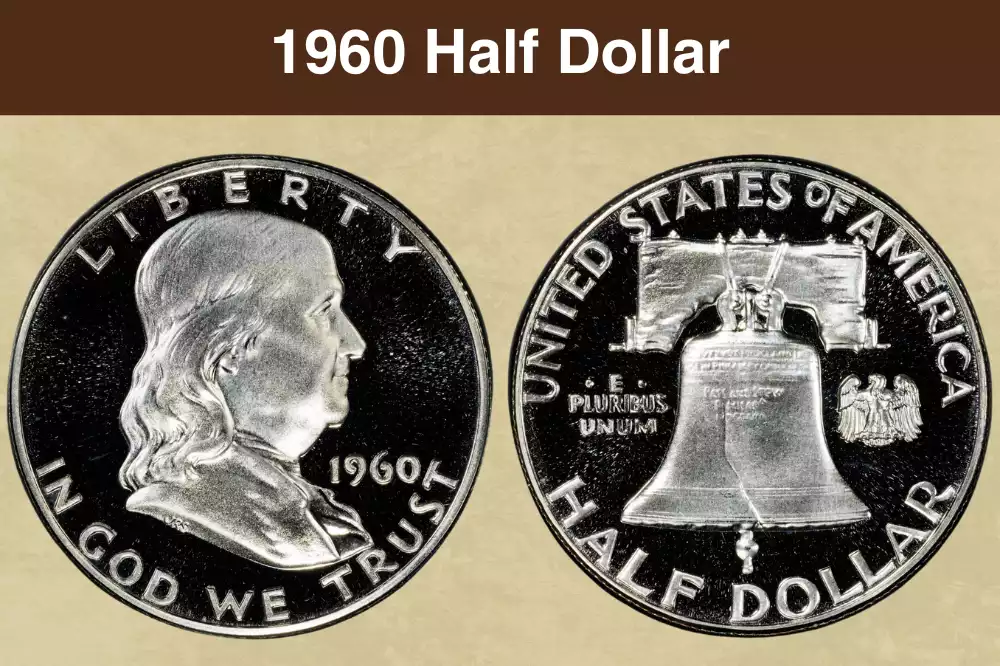
The Obverse Of The 1960 Half Dollar
Franklin faces right in a period suit. The portrait traces back through Sinnock’s 1933 medal to an 18th-century bust by Jean-Antoine Houdon. Look for Sinnock’s initials “JRS” at the bust truncation — that’s your authenticity checkpoint.
LIBERTY arcs above, IN GOD WE TRUST sits below, and the date is to the right of the portrait. On the 1960 issue, those reworked master dies give the obverse noticeably sharper detail than you’ll see on most late-1950s Franklins.
The Reverse Of The 1960 Half Dollar
Flip it over and you’ll see the Liberty Bell front and center, with a tiny eagle tucked to the right. Mint Director Ross deliberately shrank the eagle to keep the bell as the main feature — technically skirting the Coinage Act of 1873.
Sinnock designed most of the reverse but died before finishing it; Gilroy Roberts completed the work. UNITED STATES OF AMERICA and HALF DOLLAR ring the edge, E PLURIBUS UNUM sits left of the bell. Look above the bell’s yoke for the mint mark — a “D” means Denver, blank means Philadelphia.
Other Features Of The 1960 Half Dollar
The coin measures 30.00 mm in diameter, weighs 12.50 grams, and carries a reeded edge. Its composition is 90% silver and 10% copper, yielding 0.36169 troy ounces of fine silver.
Denver outproduced Philadelphia roughly three to one in 1960, but both business strikes share an estimated 10% survival rate across all grades. Sounds like plenty — until you realize that includes everything from beat-up pocket pieces to gem survivors. High-grade coins are a tiny sliver of that 10%.
Proofs survived at nearly 80%, which makes sense. Collectors bought them and tucked them away. But here’s where it gets interesting. Cameo and Deep Cameo designations depend on die freshness — only the first coins off a new die pair show that frosted contrast. Out of 1,691,602 proofs struck, roughly 16,000 Cameo and just 5,500 Deep Cameo examples survive. That’s under 1% and 0.33% respectively. A completely different kind of rare — driven by die wear, not collector behavior.
Three things set the price on a 1960 Franklin: mint mark, grade, and whether the reverse earns the Full Bell Lines designation. A circulated piece trades near melt. An FBL-designated Mint State coin can be worth multiples of that. For proofs, the surface designation — standard, Cameo, or Deep Cameo — matters as much as the grade number.
The most reliable starting point is the Coin Identifier and Value App, which cross-references current market data by variety and condition — removing the guesswork that leads most collectors to either overpay or undersell.
CoinValueChecker APP Screenshot
1960 Half Dollar Value Guides
The 1960 Franklin sits in an interesting spot — common enough that most examples trade for modest sums, but capable of hitting four and five figures when the right qualities line up.
What separates a $20 coin from a headline auction result? Mint origin, grade, the Full Bell Lines designation on business strikes, and for proofs, whether surfaces qualify as standard, Cameo, or Deep Cameo. The 1960 only becomes a conditional rarity at the highest Mint State grades with FBL, while proof values jump sharply once cameo contrast enters the picture.
Here are the main 1960 half dollar categories collectors actively pursue:
1960 No Mint Mark Half Dollar — Philadelphia business strike, common in worn grades.
1960-D Half Dollar — Denver issue, identified by the “D” above the bell.
1960 Proof Half Dollar — Mirror-finish strike from proof sets.
1960 CAM Half Dollar — Proof with light frosted devices against mirrored fields.
1960 DCAM Half Dollar — Proof with the deepest, most pronounced cameo contrast.
Values across these five categories span an enormous range, from a few dollars over melt to serious four- and five-figure auction results at the top of the population.
1960 No Mint Mark Half Dollar Value
Here’s something that surprises newer collectors: the 1960 Philadelphia Franklin is a semi-key date. Mintage runs lower than most other issues in the series, and that matters once you start climbing the grade ladder.
In typical Mint State grades, prices stay reasonable. MS64 examples trade for $40 to $50 without Full Bell Lines, and up to $65 with the FBL designation. Past MS66, the market shifts hard.
A PCGS MS67FBL CAC piece sold for $28,200 at Heritage Auctions on August 10, 2016 — still the auction record. A coin in the same grade without FBL brought $3,120 in 2018. That gap tells you everything. Bag marks and weak strikes keep nearly all survivors out of the top tier. Anything slabbed FBL above MS66 deserves a very close look.
1960 No Mint Mark Half Dollar Price/Grade Chart
Price by 1-70 Grade (Latest Auction Records Included)
1960 No Mint Mark Half Dollar value by grade (updated Oct 6, 2026)
Auction history for the 1960 Philadelphia Franklin maps out clearly across the major grading tiers, from common Mint State pieces to rare top-pop examples.
Date ↓
Platform
Price ⇅
Grade ⇅
06/26
SB
$220
66
11/25
SB
$384
65
11/25
SB
$288
66
04/25
HA
$1,656
67
03/25
SB
$288
66
06/23
HA
$312
66
05/23
HA
$210
66
04/23
DL
$41
64
04/23
DL
$68
65
04/23
DL
$41
65
Recent market activity over the last twelve months shows how month trading volume has moved, giving a clearer picture than catalog values alone.
Market Activity: 1960 No Mint Mark Half Dollar
Market activity score: 72/100 as of Oct 2026 — up 17 points from Jul 2026. 12-month peak: 77 (Sep 2026).
Coin Identifier and Value App
Not sure what your coins are worth? Get Instant Value • Grade • Error Detection with coin identifier and value app (FREE Usage Daily)
Can you find a 1960-D in circulated grades? All day long. Three times the mintage of Philadelphia means these are everywhere at melt-driven prices. The twist is what happens when you chase the strike.
Full Bell Lines on a 1960-D are notoriously hard to find. Most Denver coins from this year show softness right where you want crispness most. That creates a real contradiction in the market: huge supply overall, genuine scarcity in quality.
A circulated 1960-D moves at silver-bullion levels, often $20–$40. A clean MS65 FBL example can ask several hundred dollars retail. The standout sale? A MS66 brought $12,075 at Heritage Auctions on May 1, 2003 — a long-standing record showing how elusive top-end Denver pieces really are. You’re paying for condition rarity here, not mintage scarcity.
1960-D Half Dollar Price/Grade Chart
Price by 1-70 Grade (Latest Auction Records Included)
1960-D Half Dollar value by grade (updated Oct 6, 2026)
Auction results for the 1960-D stretch from routine bullion-level sales up through elite high-grade trophies. The gap between them is wider than most collectors expect.
Date ↓
Platform
Price ⇅
Grade ⇅
03/26
SB
$264
66
01/26
SB
$65
64
03/25
SB
$65
65
07/23
HA
$384
65
04/23
DL
$96
65
04/23
SB
$60
65
04/23
HA
$234
65
04/23
SB
$240
66
02/23
SB
$80
65
11/22
HA
$384
66
Tracking the past year of trends reveals where actual buyer demand sits for the Denver issue, separate from listed price guides.
Market Activity: 1960-D Half Dollar
Market activity score: 68/100 as of Oct 2026 — down 1 point from Jul 2026. 12-month peak: 76 (Sep 2026).
1960 Proof Half Dollar Value
With 1,691,602 struck, standard 1960 proofs are the cheapest way into this date. Supply is comfortable, and that keeps the floor low for year-set builders.
A typical PR65 to PR67 without cameo contrast runs roughly $40–$65. PR68 examples generally trade in the $75–$175 range when surfaces are clean and haze-free. Without any Cameo or Deep Cameo designation, this tier is fairly common up to about PR68. Anything higher gets very scarce.
You’re paying for mirror quality here, not frost. Toning, milk spots, and hairlines from old proof set packaging are the main value killers. Eye appeal matters way more than the number on the holder.
1960 Proof Half Dollar Price/Grade Chart
Price by 1-70 Grade (Latest Auction Records Included)
1960 Proof Half Dollar value by grade (updated Oct 6, 2026)
Records for standard 1960 proofs paint a steady picture across the PR65 to PR68 range, with realized prices that closely track surface quality.
Date ↓
Platform
Price ⇅
Grade ⇅
03/26
SB
$85
67
03/26
SB
$336
69
11/25
SB
$216
69
09/25
SB
$105
68
07/25
SB
$65
66
06/25
SB
$528
69
08/24
SB
$48
68
06/24
SB
$168
69
02/24
SB
$72
67
08/23
HA
$104
66
Recent twelve-month trading shows how the entry-level proof tier has been moving in the current silver market.
Market Activity: 1960 Type 1 Proof Half Dollar
Market activity score: 77/100 as of Oct 2026 — down 2 points from Jul 2026. 12-month peak: 82 (Aug 2026).
1960 CAM Half Dollar Value
Think most proofs qualify as Cameo? Not even close. Before 1971, only the first few hundred coins off a fresh die pair showed that frosted contrast between devices and fields. After that, the frost wore off. That’s why CAM survivors carry real premiums even at common proof grades.
A 1960 PR67 CAM typically trades in the $90–$165 range. PR68 CAM examples often clear $200 — a recent eBay listing for a PCGS PR68 CAM was offered at $219.99.
I think CAM 1960s are the sweet spot for type sets. You get meaningful scarcity without the four-figure entry cost that Deep Cameo demands. That frosted-device-on-mirror-field look is what defines premium mid-century proofs, and anything weaker gets bumped to standard proof status by the graders.
1960 CAM Half Dollar Price/Grade Chart
Price by 1-70 Grade (Latest Auction Records Included)
1960 CAM Half Dollar value by grade (updated Oct 6, 2026)
Sales history for Cameo-designated 1960 proofs shows the premium that frosted devices command, with clear separation from standard proof results.
Date ↓
Platform
Price ⇅
Grade ⇅
06/26
SB
$195
68
03/26
SB
$85
66
11/25
SB
$870
69
05/25
SB
$145
67
10/24
SB
$168
68
08/24
SB
$65
66
03/23
DL
$145
67
03/23
SB
$80
67
12/22
SB
$144
68
11/22
DL
$140
67
Market activity over the past year highlights where CAM examples are actually changing hands, beyond catalog estimates.
Market Activity: 1960 CAM Half Dollar
Market activity score: 66/100 as of Oct 2026 — up 4 points from Jul 2026. 12-month peak: 74 (Sep 2026).
1960 DCAM Half Dollar Value
This is the ceiling for 1960 proofs. Deep Cameo examples are far scarcer than standard or Cameo proofs. PR68 to PR69 Deep Cameo? Good luck finding one.
The Greysheet catalog lists 1960 Franklin proofs with CPG values ranging up to $13,800.00 at the very top. A PR69 DCAM from the Kallenberg Registry collection crossed the block at Heritage Auctions, sold from a set then graded as one of just five at that level with none finer.
Most Deep Cameo survivors show a few hairlines from brief mishandling or bad storage. Clean examples at the top of the population command serious money because of it. We think DCAM 1960s are solid long-term holds — tiny verified populations and active registry-set competition keep demand well above standard proof levels.
1960 DCAM Half Dollar Price/Grade Chart
Price by 1-70 Grade (Latest Auction Records Included)
1960 DCAM Half Dollar value by grade (updated Oct 6, 2026)
Not every 1960 half dollar came out the same. A small handful carry quirks from the minting process that collectors actively hunt. These are variety errors catalogued in the Cherrypickers’ Guide using the FS numbering system.
Here are the key ones worth knowing about.
1. 1960 Half Dollar Doubled Die Obverse (DDO) FS-101
This one only shows up on proofs. Never business strikes. The doubling hit the obverse lettering and date when the working die received misaligned impressions from the master hub.
Grab a loupe and check “IN GOD WE TRUST” and the date. You’ll see a clear secondary outline on the letters and numerals — nothing dramatic, but unmistakable once you know what to look for. Since it’s locked to proof strikes, surface quality stays high across most survivors. The Greysheet catalog lists the FS-101 PR with a value range from roughly $40 at the low end up to $450 for top-grade specimens.
Watch out for mechanical doubling, which is far more common and worth nothing extra. True FS-101 doubling shows clean, separated outlines. Mechanical doubling looks flat and shelf-like. Big difference.
1960 Proof DDO FS-101 Half Dollar Price/Grade Chart
Price by 1-70 Grade (Latest Auction Records Included)
1960 Proof DDO FS-101 Half Dollar value by grade (updated Oct 6, 2026)
This is the fun one. The nickname comes from the famous 1955 variety where two small spikes on Franklin’s upper lip make him look like he has buck teeth. The 1960 version belongs to the same family of die clash errors.
Here’s what happened: the obverse and reverse dies smacked into each other without a planchet between them. The eagle’s feathers left faint impressions on Franklin’s mouth area, and every coin struck from that damaged die carried the marks. On the 1960 issue, the effect is subtler than the 1955 but still identifiable under good light.
Greysheet pricing for the FS-401 business strike runs from about $34 at the entry level up to $4,400 in top-end MS FBL grades. This variety often turns up unattributed in older holders, so cherrypicking is a real possibility if you know what you’re looking at.
1960 Bugs Bunny FS-401 Half Dollar Price/Grade Chart
Price by 1-70 Grade (Latest Auction Records Included)
1960 Bugs Bunny FS-401 Half Dollar value by grade (updated Oct 6, 2026)
Same cause as the Bugs Bunny — dies meeting without a planchet — but different clash marks. Instead of the buck-tooth look on the lip, the FS-402 shows clash impressions in other areas of Franklin’s portrait. Different die pair, different result.
Pricing closely mirrors its Bugs Bunny cousin, with the Greysheet range running from around $34 in lower Mint State grades to $4,400 at the top MS FBL level. FBL examples are notably harder to track down.
If you’re building a complete 1960 variety set, both die clash entries belong on the checklist. They document separate events at the Philadelphia Mint that year.
1960 Obv Die Clash FS-402 Half Dollar Price/Grade Chart
Price by 1-70 Grade (Latest Auction Records Included)
1960 Obv Die Clash FS-402 Half Dollar value by grade (updated Oct 6, 2026)
With your 1960 half dollar’s value established, identifying the right selling venue becomes your priority. Successful sales depend on choosing platforms that attract genuine collectors and offer transparent terms.
Market interest: 2,240 collectors tracking this coin as of Oct 2026 — up 1,000 from Mar 2026. Currently at its 12-month peak.
*Market Trend Chart showing the number of people paying attention to this coin.
FAQ About The 1960 Half Dollar
1. Is the 1960 half dollar made of real silver?
Yes. Every 1960 Franklin half dollar is 90% silver and 10% copper. Each coin weighs 12.50 grams and contains 0.36169 troy ounces of pure silver. Even a heavily worn example has a guaranteed bullion floor, which is why circulated coins typically change hands around $32–$34 in today’s silver market.
2. How can I tell if my 1960 half dollar is from Philadelphia or Denver?
Check the reverse, directly above the Liberty Bell’s yoke. A small “D” means Denver. No letter means Philadelphia. Denver struck 18,215,812 pieces that year while Philadelphia produced 6,024,000, making the no-mint-mark version the lower-mintage business strike.
3. What does FBL mean on a 1960 half dollar?
FBL stands for Full Bell Lines. It means the horizontal lines across the bottom of the Liberty Bell are fully struck and uninterrupted. The Franklin series is notorious for weak strikes in that exact spot, so FBL examples are noticeably scarcer.
The price difference is real. A 1960-D in MS condition trades around $47.80 without FBL, while the same coin with FBL can reach $329.67. For the No Mint Mark FBL variety, MS examples sit around $60.60.
4. Why is my 1960 proof half dollar worth more than my regular one?
Proofs were struck with polished dies and specially prepared planchets, giving them mirror-like fields and sharper details. The 1960 Proof was made only at Philadelphia from a mintage of 1,691,602, sold directly to collectors in annual proof sets.
A standard 1960 Proof typically trades around $40 in PR condition. Cameo (CAM) examples average $69.38, while Deep Cameo (DCAM) reaches $287.75 — frosted contrast against mirrored fields is far rarer.
5. What’s the difference between Cameo and Deep Cameo on a 1960 proof?
Both describe contrast between frosted raised devices and mirrored fields. Cameo means light, visible frost. Deep Cameo means the contrast is so strong it creates a stark “black-and-white” look under direct light.
It all comes down to die freshness. Only the earliest coins from a new die pair show heavy frost. That’s why estimated survival is about 16,000 Cameo and just 5,500 Deep Cameo from the 1,691,602 proof mintage.
6. What is the most valuable 1960 half dollar ever sold?
A 1960 No Mint Mark MS67FBL graded by PCGS and stickered by CAC sold for $28,200 at Heritage Auctions on August 10, 2016. The 1960-D record sits at $12,075, achieved by a PCGS MS66 at Heritage Auctions on May 1, 2003. On the proof side, top-tier 1960 DCAM examples have approached the $13,800 mark in CPG catalog values.
7. What is a 1960 Bugs Bunny half dollar?
A die clash variety where the eagle’s feathers from the reverse left faint impressions on Franklin’s upper lip, creating what looks like buck teeth. Catalogued as FS-401 in the Cherrypickers’ Guide. It happens when the dies strike each other without a planchet between them. The 1960 FS-401 ranges from about $34 in lower Mint State grades up to $4,400 at the top MS FBL level.
8. How do I know if my 1960 half dollar has a DDO error?
The 1960 Doubled Die Obverse FS-101 only appears on proof coins. Check “IN GOD WE TRUST” and the date under magnification for a clear secondary outline on the letters and numerals.
Don’t confuse it with mechanical doubling, which carries no premium. True FS-101 doubling shows clean, separated outlines. Mechanical doubling looks flat and shelf-like. Genuine examples range from roughly $40 to $450 for top-grade specimens.
9. Is the 1960 half dollar considered rare?
Semi-key within the Franklin series, not truly rare in an absolute sense. The Philadelphia issue ranks 48th overall for rarity, while the 1960-D ranks 30th — both in the “Rare” to “Very Rare” tier for the series. Circulated coins are easy to find at bullion levels, but fewer than 200 examples are known in MS66 FBL or higher for the No Mint Mark variety. That’s what pushes top-grade values into four and five figures.
10. Where is the best place to sell my 1960 half dollar?
Depends on what you have. Circulated coins at bullion levels ($32–$34) sell fastest at local coin shops and bullion dealers. Slabbed Mint State or proof examples in PCGS/NGC holders belong at established auction houses like Heritage Auctions, Stack’s Bowers, or GreatCollections.
eBay works for mid-range coins, but you’ll almost always do better with third-party grading first. A raw 1960 half dollar listed online rarely brings what the same coin earns once it’s slabbed.
John Saechao is a respected California-based coin collector, known for his diverse and intricate collection. His lifelong passion for numismatics has shaped an impressive portfolio, spanning multiple eras and continents. Celebrated not just for his collection, John is appreciated for his knowledge-sharing, greatly influencing the coin collecting community.