1891 Indian Head Penny Coin Value

1891 Penny value ranges from about $2 for a well-worn example to $14,950 in an exceptional historical sale. The upper figure belongs to an MS66 Red cent sold by Heritage in April 2009, not an ordinary circulated penny.
Philadelphia struck 47,070,000 circulation cents in 1891, plus an estimated 2,350 Proofs. Condition and surface color can make a large difference to collector value.
This guide covers circulated and uncirculated values, the proof issue, documented errors and varieties, and the top auction results for 1891 Indian Head pennies.
1891 Indian Head Penny Value Checker
Identify your 1891 Indian Head Penny
Front Obverse
Upload or Take a Photo
Back Reverse
Upload or Take a Photo
1891 Indian Head Penny Value Chart
| Type | Good(G4-6) | Fine(F12-15) | AU(AU50-58) | MS(MS60-70) | PR(PR60-70) |
|---|---|---|---|---|---|
| ▶1891 Indian Head Penny MS (RD) | $6 - $7 | $11 - $13 | $44 - $71 | $92 - $5,520 | — |
| ▶1891 Indian Head Penny Proof (RD) | — | — | — | — | $230 - $2,760 |


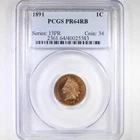
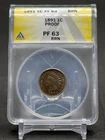
Compare the same grade, variety and strike type. Red copper entries represent original red coins; worn brown examples should not be valued by the Red Mint State figures.
In this value guide:
- 1891 Indian Head Penny Value
- 1891 Dropped A and Misplaced Digits
- 1891 Penny Errors List with Pictures
- 1891 Proof Penny Value
- Top 10 Most Valuable 1891 Indian Head Pennies Sold at Auction
1891 Indian Head Penny Value

A circulated 1891 Indian Head penny in Good condition is worth roughly $2 to $3. In Fine grade the value rises to about $5, and an Extremely Fine example typically sells in the $12 to $16 range.
Uncirculated coins carry noticeably higher premiums. An MS63 Brown piece trades around $85 to $110, while an MS65 Brown commands roughly $220 to $264 at recent auction.
Color designation matters significantly for mint-state coins. Indian Head cents are graded Brown (BN), Red-Brown (RB), or Red (RD) based on how much original copper luster they retain.
An MS63 RB sells near $120 to $150, and an MS63 RD brings roughly $228 to $310.
The word “bronze” in searches for this coin refers to the normal alloy — 95% copper with 5% tin and zinc — used for all Indian Head cents from 1864 onward. It does not indicate a separate rare variety.
Every 1891 Indian Head penny is a bronze coin.
High-grade Red examples are the real prize. An MS65 RD has sold for $690 to $1,320 at major auctions, and the finest certified example — an MS66+ RD PCGS with CAC approval — realized $11,100 at Heritage Auctions in November 2025.
Also Read: [Indian Head Penny Value Guide — All Years]
1891 Indian Head Penny MS (RD) Price/Grade Chart
Price by 1-70 Grade (Latest Auction Records Included)
| Date | Platform | Price | Grade |
|---|---|---|---|
| 11/25 | HA | $11,100 | 66 |
| 03/25 | HA | $1,320 | 65 |
| 03/25 | HA | $10,800 | 66 |
| 01/25 | HA | $5,040 | 66 |
| 08/24 | SB | $456 | 64 |
| 05/24 | HA | $516 | 64 |
| 05/23 | HA | $870 | 65 |
| 04/23 | HA | $564 | 64 |
| 04/23 | HA | $930 | 65 |
| 04/23 | HA | $1,200 | 65 |
1891 Indian Head Penny MS (RD) Market Activity
Market activity score: 51/100 as of Nov 2026 — up 8 points from Aug 2026. Currently at its 12-month peak.
Use Our 1891 Penny Value Checker
1891 Dropped A and Misplaced Digits

Two of the most distinctive varieties on the 1891 Indian Head cent involve extra impressions that can confuse beginners. Understanding how each was made is key to identifying — and correctly valuing — them.
Dropped A Impression (Struck-Through Error)
Some 1891 cents show a shallow, sunken outline of the letter “A” on the reverse. This is not a die variety or an engraving change. It is a struck-through error caused by a piece of die fill (a fragment that fell out of the recessed letter “A” in AMERICA on the die) landing on the planchet before striking.
When the press came down, the loose fill piece was pressed into the coin’s surface, leaving a concave impression shaped like the letter A. The result looks like an extra letter stamped into the field, but it is actually a shallow indentation, not a raised design element.
Look for a faint, recessed A-shaped outline on the reverse, away from the word AMERICA. The impression is typically soft-edged and sits below the coin’s surface plane.
Do not confuse it with a repunched letter or a die clash — those produce raised features, not sunken ones.
This variety is documented by CONECA using an example from the Daniel D. Bonnett collection.
Exact clock position on the reverse has not been extracted from available images. Auction records specific to this variety on the 1891 date are not yet confirmed; value remains to be verified against actual sales.
Misplaced Digits (MPD)
Several 1891 die pairs show portions of date digits protruding into the denticles below the main date. These misplaced digits occurred when a digit punch was struck into the die at an incorrect position before being corrected.
Variety catalogs for this year document at least two groups: the tops of “18” appearing in the denticles, and separate instances of “891” partially visible below the primary date. These are distinct from repunched dates — an MPD appears outside the normal date area, while a repunched date shows overlapping impressions within the date itself.
To check, examine the denticles (the small tooth-like projections along the rim) directly below the date under magnification. Look for faint, partial outlines of numbers that do not belong in that area.
The impressions are typically subtle and require at least 5× to 10× magnification to confirm.
MPD varieties for 1891 are cataloged by Indian cent variety references. Certified examples are uncommon in the marketplace, and confirmed auction prices specific to these MPDs have not been independently verified for this guide.
1891 Penny Errors List with Pictures
Below are the documented errors and die varieties known for the 1891 Indian Head cent. Each entry explains what to look for, how the error formed, and what auction evidence exists.
Where no confirmed sale for this specific date has been found, the value is noted as unverified rather than estimated.
1. 1891 Indian Head Penny Die Clashes

This detail is from a documented 1887 Indian Head cent and illustrates the same error family, rather than a confirmed 1891 specimen.
A die clash happens when the obverse and reverse dies strike each other without a planchet between them. The impact transfers faint impressions of one die’s design onto the opposing die.
Coins struck afterward may show ghostly outlines of the opposite side’s features.
The 1891 date is listed in Greysheet auction archives with a clashed-dies designation. Heritage Auctions sold an 1891 Indian cent graded AU55 by NGC with a “Struck with Clashed Dies” label for $51 in December 2022.

Coin Identifier and Value App
Not sure what your coins are worth? Get Instant Value • Grade • Error Detection with coin identifier and value app (FREE Usage Daily)
The exact location of the clash marks on this particular coin has not been confirmed from available images. The error is preserved here based on the auction house’s certified description.
2. 1891 Indian Head Penny Lamination and Separating Metal

The photograph shows a seller-attributed 1891 specimen; the image alone does not authenticate the error.
A lamination error occurs when the planchet’s metal separates into layers, usually because of impurities or trapped gas introduced during the alloy mixing process. The result is a visible flake, peel, or crack in the coin’s surface.
GreatCollections auction archives list an 1891 Indian Head cent graded G04 by PCGS with a “Laminated Planchet Obverse” designation. The lamination is on the front of the coin; the precise area has not been pinpointed from available catalog images.
Do not confuse lamination with post-mint scratches or corrosion. A true lamination follows the metal’s layers and often has a slightly raised or peeling edge.
Scratches cut across the surface uniformly.
3. 1891 Indian Head Penny Die Cracks, Chips and Cuds

Die cracks appear as thin, raised lines on a coin’s surface. They form when the hardened steel die develops fractures from repeated use.
If a piece of the die rim breaks away entirely, the result is a cud — a raised, featureless blob along the edge.
Cuds and retained rim breaks: Variety catalogs document cuds on the 1891 cent at roughly the 11 to 11:30 position on the obverse (upper rim area) and at the 11:15 to 12:45 position on the reverse. In these areas, a section of the die rim fractured, leaving a raised, shapeless lump where normal design detail and rim should appear.
Die cracks: Multiple die crack positions are cataloged on the reverse at approximately 1, 2:15, 4, 5, 8, 8:30, and 11 o’clock. These show as raised lines running from the rim inward toward the wreath or lettering. Each line traces where the die fractured; the crack fills with metal during striking, producing a ridge.
Do not confuse die cracks with post-mint scratches (which are incuse, not raised) or with the normal denticle pattern along the rim.
Confirmed auction prices specific to 1891 cud and crack varieties have not been independently verified for this guide.
4. 1891 Indian Head Penny Struck-Through Errors

A struck-through error occurs when foreign material — a piece of cloth, grease, die fill, or a fragment from another coin — sits on the planchet or die face during striking. The debris blocks part of the design, leaving an impression or a weak area.
The best-known struck-through variety for 1891 is the Dropped A impression covered in the dedicated section above. That coin shows a concave A-shaped indentation on the reverse, caused by a loose fill piece from the letter A in AMERICA landing on the planchet before the strike.
Other struck-through types (grease fills, cloth impressions) may exist for this date but have not been documented in the sources reviewed. If you find an 1891 cent with a soft or missing area of design that does not match die wear or damage, a struck-through error is worth investigating.
5. 1891 Indian Head Penny Repunched Dates

Before the adoption of single-squeeze hubbing, individual digit punches were hammered into the die by hand. If the punch shifted between blows, the date digits show overlapping or doubled outlines.
The 1891 date has several cataloged repunched date (RPD) varieties. Documented positions include the base of the first “1” shifted south, and the digits “8”, “9”, and the final “1” showing remnants shifted north.
One variety also shows the “9” with traces in both directions.
The most recognized is Snow-3 (FS-301), which has appeared at auction: Heritage Auctions sold a cleaned example graded net AU55 for $114 in March 2026, and Stack’s Bowers sold an EF-45 PCGS example for $105 in December 2025.
To check, examine each date digit under magnification for extra serifs, thickened bases, or ghost outlines that do not align with the primary impression.
6. 1891 Indian Head Penny Misplaced Dates and Digits

See the dedicated section above (“1891 Dropped A and Misplaced Digits”) for a full explanation of misplaced digit varieties on this date. In brief, look for partial date-digit outlines in the denticles below the main date.
7. 1891 Indian Head Penny Off-Center Errors

An off-center strike occurs when the planchet is not properly seated in the collar before the dies come together. Part of the design is missing, and a blank crescent of unstruck metal appears on the opposite side.
Mint Error News documents an 1891 Indian Head cent struck approximately 15% off center toward the 8 o’clock position, graded MS65 BN by NGC. Heritage Auctions sold another 1891 off-center example — struck 15% off center, graded Fine 15 by NGC — for $376 in June 2016.
A 30% off-center piece graded XF40 by ANACS brought $252 at Heritage in October 2022.
The percentage describes how much of the design is missing. Higher percentages with a fully visible date are more valuable because collectors need to identify the year.
8. 1891 Indian Head Penny Doubled Dies: DDO and DDR

A doubled die occurs when the hub imparts a second, misaligned impression on the working die during manufacture. Every coin struck from that die carries the doubling in the same position — unlike machine doubling, which varies coin to coin and appears flat and shelf-like.
Doubled Die Obverse (DDO): The most prominent 1891 DDO is Snow-1, designated FS-101. Doubling is reported on the letters of UNITED STATES OF AMERICA (particularly TATES OF AMER), the word OF, and LIBERTY on the headband. The OF and LIBERTY show the clearest southward spread. Feather tips on the headdress may also help confirm the variety.
Heritage Auctions sold an 1891 DDO Snow-1 (FS-101) graded VF35 by PCGS for $132 in September 2018. A cleaned example with PCGS UNC Details sold for $235 in January 2017.
Doubled Die Reverse (DDR): Variety catalogs list doubling on the left inner oak leaf, the letter C of CENT, olive leaves, the left ribbon, and the bow knot. Another die pair shows doubling on the right leaf veins. These are more subtle than the obverse variety.
A DDR-002 example graded MS61 Brown by ANACS sold for $104 at Heritage in March 2024.
9. 1891 Indian Head Penny Broadstrike Errors

A broadstrike happens when a coin is struck outside the retaining collar that normally constrains the planchet’s diameter. The design is fully impressed, but the metal spreads outward beyond the normal coin edge.
No reeding or uniform rim is formed.
Mint Error News documents an 1891 Indian Head cent described as an uncentered broadstrike, graded MS65 BN by NGC. Heritage Auctions sold an 1891 broadstruck example graded VF20 by ANACS for $69 in October 2007.
Coin Identifier and Value App
Not sure what your coins are worth? Get Instant Value • Grade • Error Detection with coin identifier and value app (FREE Usage Daily)
The key diagnostic is a complete or nearly complete design with an expanded, irregular edge. Compare this with an off-center strike, where part of the design is missing entirely.
A broadstrike retains all or most design elements.
10. 1891 Indian Head Penny Multiple-Strike Errors

A multiple-strike error occurs when a coin fails to eject from the press and is struck a second (or third) time. Each additional strike overlaps the previous design, often at a different angle.
If the coin flips between strikes, the result is called a flip-over double strike.
Double strike (same orientation): Mint Error News catalogs an 1891 Indian cent that received a centered first strike followed by a second strike shifted approximately 20% toward the 3 o’clock position. That coin was graded MS62 BN by NGC.
Flip-over double strike: Heritage Auctions sold an 1891 Indian cent described as a double-struck, flip-over with an off-center second strike, graded Good 6 by NGC, from the Don Bonser Error Collection, for $528 in November 2020.
Triple strike: An 1891 Indian cent with three overlapping strikes, graded AU53 by PCGS, sold for $862 at Heritage in November 2007. A second double-struck example (second strike 90% off center), graded Fine 12 by PCGS, brought $374 in May 2011.
Multiple-strike errors are among the most dramatic and visually striking mint errors on Indian Head cents. The overlap of design elements at different angles is unlike any other error type.
1891 Proof Penny Value

The Philadelphia Mint produced 2,350 proof Indian Head cents in 1891. These were sold directly to collectors in proof sets and are distinctly different from business strikes — they feature sharper details, squared-off rims, and mirror-like fields.
Proof values depend on the color designation, just as with business strikes. Brown (BN) proofs are the most affordable, while full Red (RD) examples carry significant premiums.
| Grade | Proof BN | Proof RB | Proof RD |
|---|---|---|---|
| PR62 | $130–$150 | $195–$228 | $285–$299 |
| PR63 | $225–$488 | $260–$432 | $276–$408 |
| PR64 | $350–$415 | $385–$480 | $494–$767 |
| PR65 | $456–$504 | $450–$540 | $1,300–$1,950 |
| PR66 | — | $1,020–$4,080 | — |
Notable proof sales include a Proof-66 RB (PCGS) that sold for $4,080 at Stack’s Bowers, and a Proof-66+ RB (PCGS) with a Snow-PR1 Repunched Date designation that brought $2,040 at Stack’s Bowers in April 2025.
At the top of the proof market, Red Cameo and Deep Cameo examples are exceptionally rare. Greysheet lists the PR RD CAM range at $1,250 to $9,500 and the PR RD DCAM range at $20,000 to $29,000 — though actual sales at those levels are seldom seen for this date.
Stack’s Bowers notes that there is hidden value in Proof-65 BN and Proof-65 RB examples, which can be visually close to full Red pieces but sell for a fraction of the cost. For collectors on a budget, these color grades offer strong eye appeal relative to their price.
Also Read: [Indian Head Penny Value Guide — All Years]
1891 Indian Head Penny Proof (RD) Price/Grade Chart
Price by 1-70 Grade (Latest Auction Records Included)
| Date | Platform | Price | Grade |
|---|---|---|---|
| 11/24 | SB | $528 | 64 |
| 07/23 | SC | $767 | 64 |
| 05/23 | LM | $1,293 | 65 |
| 05/22 | HA | $2,160 | 65 |
| 04/20 | HA | $1,980 | 66 |
| 12/19 | HA | $1,151 | 65 |
| 05/18 | LM | $1,980 | 65 |
| 10/17 | LM | $3,525 | 66 |
| 03/17 | HA | $376 | 64 |
| 01/17 | HA | $1,528 | 65 |
1891 Indian Head Penny Proof (RD) Market Activity
Market activity score: 38/100 as of Nov 2026 — unchanged since Aug 2026. Currently at its 12-month peak.
Use Our 1891 Penny Value Checker
Our Coin Identifier and Value App can help compare your photos and find relevant value information. Valuable errors still need professional authentication.

Also Read: Rare Penny Errors List with Pictures by Year
Top 10 Most Valuable 1891 Indian Head Pennies Sold at Auction
1891 Indian Head Penny Auction Results
2008 - Present