1887 Indian Head Penny Coin Value

1887 Penny value ranges from about $2 for a well-worn example to $51,750 in an exceptional historical sale. The upper figure belongs to an MS67 Red cent sold by Heritage in July 2008, not an ordinary circulated penny.
The Philadelphia Mint struck 45,223,523 Indian Head cents in 1887, making it a common date in the series. Still, condition and color drive enormous price differences — most surviving coins show heavy wear, so anything grading Extremely Fine or above stands out.
1887 Indian Head Penny Value Checker
Identify your 1887 Indian Head Penny
Front Obverse
Upload or Take a Photo
Back Reverse
Upload or Take a Photo
1887 Indian Head Penny Value Chart
| Type | Good(G4-6) | Fine(F12-15) | AU(AU50-58) | MS(MS60-70) | PR(PR60-70) |
|---|---|---|---|---|---|
| ▶1887 Indian Head Penny MS (RD) | $6 - $7 | $11 - $13 | $44 - $71 | $92 - $27,600 | — |
| ▶1887 Indian Head Penny Proof (RD) | — | — | — | — | $190 - $12,400 |


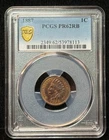

Compare the same grade, variety and strike type. Red copper entries represent original red coins; worn brown examples should not be valued by the Red Mint State figures.
In this value guide:
- 1887 Indian Head Penny Value
- 1887 Repunched and Misplaced Date Pennies
- 1887 Penny Errors List with Pictures
- 1887 Proof Penny Value
- Top 10 Most Valuable 1887 Indian Head Pennies Sold at Auction
1887 Indian Head Penny Value

All 1887 Indian Head pennies were struck at the Philadelphia Mint. There is no mint mark on this coin — the series did not use branch mints until 1908.
In Good (G-4) condition, an 1887 Indian Head penny is worth roughly $2 to $3. At this grade the portrait outline and “LIBERTY” on the headband are mostly worn away, but the date and legends remain readable.
A Fine (F-12) example brings around $5. You can see partial “LIBERTY” letters, and the feather tips show moderate definition.
In Extremely Fine (EF-40), expect values near $18 to $20. Most design details are sharp, with light wear only on the highest points of the hair ribbon and feather tips.
An Uncirculated (MS-60 to MS-63) coin in brown toning ranges from about $28 to $140. Luster is intact, though bag marks and minor contact may be present.
At MS-64 to MS-65 with Red-Brown or Red color, values jump sharply. An MS-64 Red coin has sold in the $400 to $700 range, while an MS-65 Red with CAC approval brought $1,800 to $3,120 at Heritage Auctions.
The top tier — MS-66 and MS-67 Red — is where this otherwise common date becomes genuinely rare. An MS-66 Red example sold for $14,950, and the finest known MS-67 Red PCGS coins have realized $31,200 to $51,750 at auction.
1887 Indian Head Penny MS (RD) Price/Grade Chart
Price by 1-70 Grade (Latest Auction Records Included)
| Date | Platform | Price | Grade |
|---|---|---|---|
| 03/25 | HA | $4,320 | 65 |
| 03/25 | HA | $24,000 | 67 |
| 01/25 | HA | $3,840 | 66 |
| 08/24 | HA | $9,000 | 66 |
| 05/24 | HA | $1,800 | 65 |
| 05/24 | HA | $4,320 | 66 |
| 12/23 | HA | $6,600 | 66 |
| 04/23 | DL | $531 | 64 |
| 04/23 | HA | $1,201 | 65 |
| 01/23 | HA | $12,000 | 66 |
1887 Indian Head Penny MS (RD) Market Activity
Market activity score: 38/100 as of Nov 2026 — down 2 points from Aug 2026. 12-month peak: 46 (Dec 2025).
Use Our 1887 Penny Value Checker
1887 Repunched and Misplaced Date Pennies

Several 1887 Indian Head cents show evidence of repunched dates (RPD) or misplaced dates (MPD). These are two different types of variety, and it is important not to confuse them.
Repunched Dates occur when the date punch was applied more than once, slightly off from the first impression. On 1887 examples, look for doubling or extra outlines near the base serif of the “1,” inside the upper loop of the first “8,” or along the south side of the final “7.” These traces are remnants of the first punch position. Specialist catalogs list multiple RPD die pairs for this year.
Misplaced Dates are a separate phenomenon. Here the date punch accidentally struck into the denticle (tooth) border below the normal date position, leaving partial digit outlines among the denticles. Known 1887 MPD examples show the tops of “1,” “8,” and “8” visible within the denticles below the date, and a separate die shows part of a “7” in the border area.
Do not confuse either of these with random die chips in the denticles, or with general wear that may blur the date digits. A genuine RPD shows a clear ghost of the digit outline near the final position, and a genuine MPD places recognizable digit curves inside the border where no design element belongs.
Repunched dates and misplaced dates on Indian Head cents can carry premiums over normal examples, especially in higher grades. However, authenticated auction results specifically for 1887 RPD and MPD varieties are limited — values depend on the clarity of the variety and the coin’s overall condition.
1887 Penny Errors List with Pictures
The 1887 Indian Head cent has a number of documented mint errors and die varieties. Below is a numbered list covering each major type, with identification tips and sourced evidence where available.
1. 1887 Indian Head Penny Struck-Through Errors

What to look for: Struck-through errors happen when a foreign object sits on the die or planchet during striking, leaving an impression in the finished coin.
Weak Letters and Missing Date Detail: One documented 1887 example shows weak or missing obverse lettering and a partially absent date (the “8” between “1” and “7” is notably weak). This type of struck-through is often caused by grease or debris filling the die. The Stack’s Bowers 1989 auction catalog (lot 3101) specifically listed an 1887 Indian Head cent in EF/AU condition with obverse text and date affected by a filled die. Look for mushy or incomplete letters that differ from normal wear — wear removes metal gradually from the highest points, while a filled die leaves a soft, flat impression across an entire area.
Thread-Shaped Struck-Through Mark: A separate type involves a thin, thread-like depression on the coin’s surface, left by a fiber or cleaning-cloth thread trapped during striking. Collector Charmy Harker documented an 1887 example in the Collectors Universe forums, noting that most specialists attributed the mark to a cleaning-cloth thread. The exact position on the coin requires photo confirmation. Do not confuse these linear impressions with post-mint scratches, which tend to cut across the coin’s surface with sharper edges.
2. 1887 Indian Head Penny Die Clashes

What to look for: A die clash occurs when the obverse and reverse dies strike each other without a planchet between them. This transfers a faint mirror image of one die’s design onto the other.
On documented 1887 examples, look at the obverse between feathers 7 through 9 of the headdress. The Indian Cent Varieties catalog lists a strong die clash on this year, with visible transfer marks from the reverse wreath pattern appearing among the feather details.
To confirm a clash, compare the stray marks against the reverse design — a true clash mark maps to a specific element on the opposite die.
Do not confuse die clash marks with scratches or incuse tooling marks. Clash marks follow recognizable contours of the opposing design.
Coin Identifier and Value App
Not sure what your coins are worth? Get Instant Value • Grade • Error Detection with coin identifier and value app (FREE Usage Daily)
3. 1887 Indian Head Penny Die Cracks, Chips and Cuds

What to look for: Die cracks appear as thin raised lines on the coin, caused by stress fractures in the steel die. When a crack reaches the rim and a piece of the die breaks away, the result is a “cud” — a raised, featureless blob connected to the rim.
Reverse cuds: The Indian Cent Varieties catalog documents examples with rim-connected breaks at roughly 2:30–4:30 and 7:00–8:30 on the reverse. These appear as raised lumps along the rim that may still show faint remnants of the underlying design.
Die cracks on both sides: Multiple die cracks have been cataloged across both the obverse and reverse. On the obverse, look near the date digits and the peripheral lettering. On the reverse, cracks appear through the wreath and along arrow shafts. Some interior cracks expanded into small raised bumps within the wreath area, though these are not rim-connected cuds.
Die cracks are among the most common die varieties on Indian Head cents. Value depends on the size and visual impact of the crack or cud — large rim breaks generally command the highest premiums.
4. 1887 Indian Head Penny Repunched Date Strokes

What to look for: A repunched date shows traces of an earlier punch impression near the final date position. This is distinct from a doubled die, which affects the entire design hub.
On 1887 cents, documented RPD varieties show extra outlines below the serif of the “1,” inside the upper loop of the first “8,” or south of the final “7.” Each of these traces represents the ghost of the first punch attempt. Different die pairs show the doubling in different positions, so the precise location tells you which die variety you have.
The Indian Cent Varieties catalog confirms multiple RPD dies for 1887. Do not confuse repunched dates with mechanical doubling (machine doubling), which produces a flat, shelf-like secondary image rather than a rounded, raised trace.
5. 1887 Indian Head Penny Misplaced Dates and Digits

What to look for: A misplaced date occurs when the date punch accidentally strikes the wrong area of the die, leaving partial digit outlines in the border denticles.
Documented 1887 MPD examples show the tops of “1,” “8,” and “8” protruding into the denticle border below the normal date position. A separate die shows a partial “7” among the denticles.
These arcs are clearly recognizable as digit curves and do not match the uniform tooth pattern of the denticles.
Do not confuse misplaced date traces with random die chips or deterioration in the denticle area. A genuine MPD shows a smooth arc that matches the shape of a specific numeral.
6. 1887 Indian Head Penny Broadstrike Errors

What to look for: A broadstrike occurs when a coin is struck without the collar die that normally restrains the planchet. The result is a coin with an expanded diameter and a flat, featureless edge — but the obverse and reverse designs remain fully struck and centered.
PCGS auction records list an 1887 Indian Head cent certified by NGC as VF-30 BN with a broadstrike designation (certification number 4751471-008). Look for a coin that is noticeably wider than normal, with both sides fully detailed, and an edge that lacks the usual rim definition.
Do not confuse a broadstrike with a roller-expanded coin (which shows stretched design elements) or with an off-center strike (which leaves a blank crescent).
7. 1887 Indian Head Penny Clipped-Planchet Errors

The photograph shows a seller-attributed 1887 specimen; the image alone does not authenticate the error.
What to look for: A clipped planchet error occurs when the blank is punched from a strip that overlaps a previously punched hole, or when a straight-edged strip end is fed into the press. The result is a coin missing a section of its edge.
Mint Error News Issue 26 (page 170, reprinting a 1984 dealer catalog) documents an 1887 Indian Head cent with a large straight clip in BU condition. A straight clip leaves a flat, linear edge where the missing section was cut from the strip.
The exact clock position of this clip has not been confirmed with a photo.
Do not confuse clipped planchets with coins that have been deliberately cut, filed, or broken after minting. Genuine clips typically show a smooth, slightly concave break and may display a Blakesley kick — a weak area on the rim directly opposite the clip.
8. 1887 Indian Head Penny Off-Center Errors

What to look for: An off-center strike occurs when the planchet is not properly seated between the dies, resulting in part of the design missing and a corresponding blank crescent on the opposite side.
Mint Error News documents an 1887 Indian Head cent struck approximately 10% off-center toward the 9 o’clock position, certified by NGC as MS-62 BN. On this coin, the design shifts toward one side, leaving an unstruck blank area on the opposite edge.
The value of off-center errors depends on the percentage of off-center shift and whether the date remains visible. A 10% off-center with a readable date is collectible but less dramatic than 20%+ shifts.
9. 1887 Indian Head Penny Doubled Dies: DDO and DDR

What to look for: A doubled die is created when the working die receives a second, misaligned impression from the hub. This produces consistent doubling on every coin struck from that die.
The recognized 1887 DDO (FS-101, Snow-1) shows doubling on “OF AMERICA” on the obverse, on feathers 3 through 9 of the headdress, on the designer’s initial, and on the “LIBERTY” text of the headband. All of these areas show the same direction and amount of spread, confirming a single doubled-die event rather than mechanical doubling.
This variety is listed by both major attribution services. Recent auction results for the 1887 DDO FS-101 include approximately $49 in Good, $124 in Fine, $228 in XF-40 (ANACS), $270 in VF-30 (PCGS), and $712 in AU-50.
Higher-grade certified examples are scarce.
Do not confuse a doubled die with machine doubling (which produces flat, shelf-like images) or with post-mint damage.
Coin Identifier and Value App
Not sure what your coins are worth? Get Instant Value • Grade • Error Detection with coin identifier and value app (FREE Usage Daily)
10. 1887 Indian Head Penny Multiple-Strike Errors

What to look for: A multiple-strike error occurs when a coin is struck two or more times by the dies, often with the coin shifting between strikes. The result is overlapping design impressions.
Mint Error News documents an 1887 Indian Head cent that received a centered first strike followed by a second strike approximately 85% off-center toward 3 o’clock, certified by NGC as MS-62 BN. The first impression is fully detailed and centered, while the second appears as a dramatic partial overlay extending well beyond the normal coin boundary.
A Heritage Auctions sale of an 1887 Indian cent described as “Doublestruck, 2nd strike 85% Off Center” in AU-53 (NGC) realized $660 in April 2018.
Multiple-strike errors on Indian Head cents are scarce and command significant premiums. Do not confuse them with die doubling, which is a die-making issue and does not shift the entire design.
1887 Proof Penny Value

The Philadelphia Mint produced 2,960 proof Indian Head cents in 1887. These were sold directly to collectors and feature mirrored fields with sharp, frosted design elements.
Proof values are entirely separate from the regular-strike prices listed above. A circulated proof that has lost its mirror finish may still be identifiable by its square, sharply struck rims and exceptional detail.
At PR-60 to PR-62 Brown, an 1887 proof has sold in the $150 to $305 range at auction. These coins show proof surfaces but may have hairlines or minor handling marks.
In PR-64 Brown, expect values around $280 to $340. A PR-64 Red example — significantly rarer — brought $900 at Heritage Auctions.
At PR-65, Brown-designated coins have realized $408 to $660, while Red-Brown examples with rainbow toning have sold for around $476 to $680.
The top proof tier is PR-66. A PR-66 Brown brought $790 to $990, and a PR-66 BN Cameo — with only one known at that grade level — sold for $6,000 on eBay. The standout result is a PR-66 Red PCGS example that realized $16,450 at Heritage Auctions, with an earlier sale of the same grade bringing $9,200.
Because only 2,960 proofs were struck, high-grade examples with red color are genuinely rare. The proof 1887 Indian Head cent should not be confused with a high-grade business strike — look for the squared rim profile and full mirror fields.
1887 Indian Head Penny Proof (RD) Price/Grade Chart
Price by 1-70 Grade (Latest Auction Records Included)
| Date | Platform | Price | Grade |
|---|---|---|---|
| 08/98 | HA | $4,312 | 65 |
| 11/24 | HA | $8,400 | 66 |
| 06/24 | SB | $2,100 | 65 |
| 08/23 | HA | $3,360 | 66 |
| 06/23 | SB | $1,440 | 64 |
| 05/23 | HA | $930 | 64 |
| 10/22 | HA | $900 | 64 |
| 05/19 | LM | $9,106 | 66 |
| 05/18 | LM | $14,688 | 66 |
| 05/16 | LM | $17,625 | 66 |
1887 Indian Head Penny Proof (RD) Market Activity
Market activity score: 38/100 as of Nov 2026 — unchanged since Aug 2026. Currently at its 12-month peak.
Use Our 1887 Penny Value Checker
Our Coin Identifier and Value App can help compare your photos and find relevant value information. Valuable errors still need professional authentication.

Also Read: Rare Penny Errors List with Pictures by Year
Top 10 Most Valuable 1887 Indian Head Pennies Sold at Auction
1887 Indian Head Penny Auction Results
2002 - Present