1885 Indian Head Penny Coin Value (Errors List)

1885 Penny value ranges from about $7 for a well-worn example to $17,250 in an exceptional historical sale. The upper figure belongs to an MS66 Red cent sold by Heritage in January 2006, not an ordinary circulated penny.
Only the Philadelphia Mint struck pennies this year, so every 1885 Indian Head cent carries no mintmark. With a total mintage of 11,761,594, this date sits slightly below average for the 1880s run and is recognized as a modestly scarce issue in higher grades.
Below you will find a complete breakdown of values by grade, a chart comparing business-strike and proof prices, the confirmed error and variety types to look for, and the strongest public auction results on record.
1885 Indian Head Penny Value Checker
Identify your 1885 Indian Head Penny
Front Obverse
Upload or Take a Photo
Back Reverse
Upload or Take a Photo
1885 Indian Head Penny Value Chart
| Type | Good(G4-6) | Fine(F12-15) | AU(AU50-58) | MS(MS60-70) | PR(PR60-70) |
|---|---|---|---|---|---|
| ▶1885 Indian Head Penny MS (RD) | $9 - $10 | $16 - $20 | $62 - $100 | $130 - $5,290 | — |
| ▶1885 Indian Head Penny Proof (RD) | — | — | — | — | $190 - $4,600 |


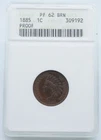
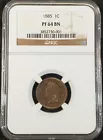

Compare the same grade, variety and strike type. Red copper entries represent original red coins; worn brown examples should not be valued by the Red Mint State figures.
In this value guide:
- 1885 Indian Head Penny Value by Grade
- 1885 Penny Errors List with Pictures
- 1885 Proof Penny Value and Doubled Die Reverse
- Top 10 Most Valuable 1885 Indian Head Pennies Sold at Auction
1885 Indian Head Penny Value by Grade

In lower circulated grades such as Good (G-4) through Fine (F-12), an 1885 Indian Head penny typically sells for $7 to $19. Coins in this range show heavy to moderate wear, with the word LIBERTY on the headband partly or mostly visible.
At Extremely Fine (EF-40) the value jumps to roughly $50–$60, and an About Uncirculated (AU-50 to AU-58) example brings around $75–$140. These coins retain most of their original detail and are popular with collectors who want a sharp-looking piece without the premium of a mint-state coin.
Uncirculated (MS-60 and above) 1885 cents command noticeably higher prices. A brown (BN) mint-state coin starts around $120–$190, while a red-brown (RB) piece in MS-63 to MS-65 can bring $215–$825.
Full original red (RD) examples are the most prized — an MS-64 RD trades near $660–$1,020, and an MS-66+ RD has sold for $8,700 at Heritage Auctions.
Coins that have been cleaned, corroded, or artificially re-colored trade at a steep discount, often 30–60% below values for problem-free examples. Always look for original surfaces with natural toning when evaluating an 1885 Indian Head penny.
1885 Indian Head Penny MS (RD) Price/Grade Chart
Price by 1-70 Grade (Latest Auction Records Included)
| Date | Platform | Price | Grade |
|---|---|---|---|
| 11/25 | HA | $8,700 | 66 |
| 03/25 | HA | $1,440 | 65 |
| 03/25 | HA | $10,500 | 66 |
| 08/24 | SB | $1,080 | 65 |
| 08/24 | SB | $960 | 65 |
| 12/23 | HA | $1,020 | 64 |
| 04/23 | HA | $1,020 | 65 |
| 02/23 | HA | $3,000 | 65 |
| 12/22 | LM | $2,350 | 65 |
| 11/22 | SB | $1,200 | 65 |
1885 Indian Head Penny MS (RD) Market Activity
Market activity score: 45/100 as of Nov 2026 — down 3 points from Aug 2026. 12-month peak: 51 (Oct 2026).
Use Our 1885 Penny Value Checker
1885 Penny Errors List with Pictures
Several die errors and striking varieties have been documented for the 1885 Indian Head cent. Each type below is backed by at least one published catalog or auction source.
If no confirmed sale price exists for a particular variety on this date, the value is listed as pending verification rather than estimated.
1. 1885 Indian Head Penny Lamination and Separating Metal

This detail is from a documented 1866 Indian Head cent and illustrates the same error family, rather than a confirmed 1885 specimen.
A lamination error happens when the bronze planchet separates into layers because of impurities or improper mixing during the alloy preparation. On an 1885 cent, look for a flap of metal lifting away from the surface or a shallow void where a layer has peeled off.
Two distinct sub-types have been reported for this year.
Front Lamination. A public error listing reports an 1885 Indian Head cent with a lamination on the obverse (front) side. Check for a raised or partially detached area on Liberty’s portrait. This is different from corrosion or a scratch — a true lamination follows the contour of the metal’s internal structure. Specific grade and sale price for this example have not been independently confirmed. (Source: CoinValueApp 1885 listing)
Struck Through a Thin Metal Flake. Richard Snow’s documentation of the Robert Lutzel Error Collection records an 1885 Indian Head cent that was struck through a thin metallic fragment resting on the reverse die. The affected area on the reverse shows weakened but still partially visible design details beneath the obstruction. Do not confuse this with a die-filled error, which shows uniformly mushy features — a struck-through flake leaves a distinct obstructed zone with some underlying detail. The original report appears in The Longacre Ledger, Vol. 19 No. 3 (2009), page 19. The exact clock position of the obstructed zone awaits photographic confirmation. (Source: Longacre Ledger via Lutzel collection transcript)
2. 1885 Indian Head Penny Die Clashes

A die clash occurs when the obverse and reverse dies strike each other without a planchet between them. The resulting ghost impressions transfer features from one die onto the opposing die’s working face, and these ghost marks then appear on subsequent coins.
For the 1885 date, Poliquin’s Indian Cent Varieties catalogs this as Variety 8. The key diagnostic is a faint impression of the letter N (from CENT on the reverse) visible on the obverse near Liberty’s neck.
The reverse shows a corresponding ghost outline from the portrait. A PCGS MS-64 BN example is pictured in the catalog entry. ( Source: indiancentvarieties.com, 1885 Variety 008 )
Coin Identifier and Value App
Not sure what your coins are worth? Get Instant Value • Grade • Error Detection with coin identifier and value app (FREE Usage Daily)
Do not confuse clash marks with post-mint scratches or polishing lines. True die clash marks align precisely with the opposing die’s design when the coin is flipped.
3. 1885 Indian Head Penny Die Cracks, Chips and Cuds

Die cracks form when the steel die develops a fracture from repeated use or heat stress. On the coin, a crack appears as a thin raised line.
When a crack reaches the rim and a chunk of the die breaks away, the result is called a cud — a raised, featureless blob along the edge.
Two variety catalogs confirm die cracks and cuds for the 1885 Indian Head cent.
Cud examples. One source documents a raised blob at approximately the 3 to 4 o’clock position on the obverse rim, and a separate example at 10:15 to 11 o’clock. These are classified as marginal die breaks (cuds) because the raised area connects to the rim. (Source: indianvarieties.com, 1885 listing and indiancentvarieties.com)
Die crack examples. Multiple die-crack paths have been cataloged for this year — on the obverse near the 2 and 4 o’clock positions, above the tops of STATES, and on the reverse at roughly 3:45, 6:15, and 8 o’clock. These are all raised lines following the die fracture. Not every crack justifies a separate variety number; they are grouped here as one error type. (Source: indiancentvarieties.com, 1885 varieties table)
Do not confuse die cracks with incuse scratches. A die crack is always raised on the coin’s surface.
4. 1885 Indian Head Penny Misplaced Dates and Digits

A misplaced date (MPD) occurs when one or more digits of the date are punched into the working die at an unintended location before being corrected. Remnants of the initial, wrong-position punch remain visible on the finished coin.
For 1885, the primary diagnostic is a partial digit visible in the denticles below the second 8 in the date. Catalog sources have also noted what appears to be a digit base between the ribbon end and a hair curl on Liberty’s portrait.
The identity of that digit is uncertain — the cataloger noted it could be an 8 or a 5. ( Source: indianvarieties.com and indiancentvarieties.com, 1885 listings )
Look closely with magnification at the denticle area directly under the date. A true MPD shows a portion of a digit that matches the font used in the rest of the date.
5. 1885 Indian Head Penny Off-Center Errors

This detail is from a documented 1887 Indian Head cent and illustrates the same error family, rather than a confirmed 1885 specimen.
An off-center strike happens when the planchet is not fully seated between the dies at the moment of impact. Part of the design is missing, replaced by a blank crescent of unstruck metal.
A dramatic 1885 example sold through Heritage Auctions (Lot 352/8307, from the Larry Rausch Collection Part One). The coin was struck approximately 50% off center toward roughly 12:30, leaving a large blank crescent on that side.
Crucially, the full date 1885 remains visible, which is essential for identification and value. It was certified PCGS XF-40. ( Source: Heritage Auctions, Larry Rausch Collection )
Off-center Indian Head cents with a readable date are considerably scarcer and more valuable than dateless examples. Do not confuse an off-center strike with a broadstrike — a broadstrike retains the full design but expands beyond the normal collar.
6. 1885 Indian Head Penny Repunched Dates

A repunched date (RPD) shows doubling or extra impressions on one or more digits of the date, caused by the date punch being applied more than once in slightly different positions.
Two distinct RPD varieties have been documented for 1885.
Business-strike RPD. Variety catalogs confirm remnants of a prior punch position visible on the lower loop of the second 8 and inside or above the lower curve of the 5. The shift direction is northward (upward). (Source: indianvarieties.com and indiancentvarieties.com, 1885 listings)
Proof RPD (Snow-PR3). A separate repunched-date variety exists on proof strikes. The diagnostic locations are different from the business-strike RPD — look inside the lower loop of the first 8 and at the bottom of the 5. Stack’s Bowers cataloged an example as Lot 5033 in their 2019 ANA sale, certified PCGS PR-67 RD, which realized $3,840. (Source: Stack’s Bowers 2019 ANA Rarities catalog, Lot 5033)
Use magnification of at least 5× and compare both RPD positions side by side. The proof variety has a different shift pattern from the business strike.
7. 1885 Indian Head Penny Broadstrike Errors

A broadstrike occurs when a coin is struck outside the retaining collar that normally constrains its diameter. The result is a coin with a full design that spreads outward beyond the standard 19 mm diameter, with a distorted or absent rim.
Both proof and business-strike broadstrikes have been documented for the 1885 Indian Head cent.
Proof broadstrike. Mike Byers’ Mint Error News reported an 1885 Indian Head cent broadstruck proof graded PR-66 Brown by NGC. The coin shows the full design with natural metal expansion at the edges. This is not a double strike — proof coins receive multiple intentional impressions as standard procedure, and the broadstrike is a separate collar malfunction. (Source: Mike Byers Mint Error News, February 2009)
Coin Identifier and Value App
Not sure what your coins are worth? Get Instant Value • Grade • Error Detection with coin identifier and value app (FREE Usage Daily)
Business-strike broadstrike. Heritage Auctions’ archive includes an 1885 cent graded Broadstruck, ANACS MS-63 Brown. The coin shows a complete design with expanded edges consistent with the absence of the collar die. (Source: Heritage Auctions archive search)
On any broadstrike, the design should remain complete with natural outward metal flow. Reject coins that appear expanded due to post-mint damage such as hammering or rolling.
1885 Proof Penny Value and Doubled Die Reverse


The Philadelphia Mint produced 3,790 proof Indian Head cents in 1885. These were sold directly to collectors in proof sets and feature sharply struck, mirror-like fields that distinguish them from regular business strikes.
Proof values by color designation start at roughly $100 for a PR-60 Brown and climb steeply with grade and color. A PR-65 RB example brought $854 at Heritage Auctions in January 2026, while a PR-67+ BN piece from the Perfection 2 Collection sold for $4,620 in December 2024.
The Snow-PR1 Doubled Die Reverse is documented on 1885 Proofs. Look for inward doubling on the right-side leaves and arrow tips; the specialist catalog notes that this doubling alone does not carry a premium.
Note that the original variety-catalog page lists the leaf and arrowhead doubling under an “Obverse” heading, but the affected design elements (wreath, arrows) belong to the reverse die. The catalog’s own photographs confirm the doubling is on the reverse. (Source: indianvarieties.com, 1885 DDR-001)
The record auction for an 1885 proof with the Snow-PR1 DDR designation is a PR-68 RB certified by PCGS with a CAC sticker, which sold for $15,600 at Heritage Auctions in November 2024. This is an exceptional Proof variety result, not the price of an ordinary 1885 cent.
A separate proof variety — the Repunched Date (Snow-PR3) — is also documented for this year (see Error #6 above). A PR-67 RD example of the Snow-PR3 RPD brought $3,840 at Stack’s Bowers in August 2019. Do not confuse the proof RPD positions with those found on business strikes, as the shift directions differ.
1885 Indian Head Penny Proof (RD) Price/Grade Chart
Price by 1-70 Grade (Latest Auction Records Included)
| Date | Platform | Price | Grade |
|---|---|---|---|
| 05/25 | SB | $840 | 65 |
| 08/24 | SB | $960 | 65 |
| 04/23 | HA | $1,020 | 65 |
| 01/21 | HA | $576 | 64 |
| 03/20 | SB | $3,600 | 67 |
| 01/20 | LM | $2,291 | 66 |
| 08/19 | SB | $3,840 | 67 |
| 07/19 | HA | $312 | 63 |
| 03/19 | HA | $960 | 65 |
| 11/18 | LM | $999 | 65 |
1885 Indian Head Penny Proof (RD) Market Activity
Market activity score: 38/100 as of Nov 2026 — unchanged since Aug 2026. 12-month peak: 46 (Dec 2025).
Use Our 1885 Penny Value Checker
Our Coin Identifier and Value App can help compare your photos and find relevant value information. Valuable errors still need professional authentication.

Also Read: Rare Penny Errors List with Pictures by Year
Top 10 Most Valuable 1885 Indian Head Pennies Sold at Auction
1885 Indian Head Penny Auction Results
2006 - Present