1800 Silver Dollar Coin Value: Errors List & No Mint Mark Worth
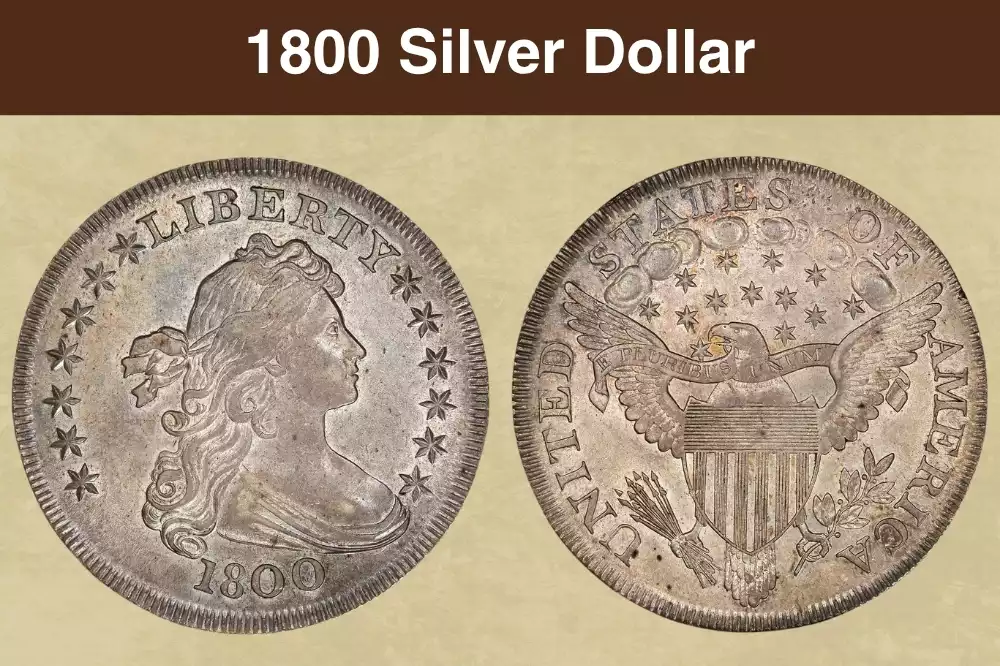
1800 Silver Dollar value ranges from $1.00 face value to $264,000. That record sale was a Grade 62 example sold through Stack’s Bowers in December 2025. Upload a photo of yours below and we’ll give you a quick value range based on condition and variety. Then scroll down to see what real 1800 Silver Dollars are selling for on eBay right now.
1800 Silver Dollar Value Checker
Identify 1800 Silver Dollar No Mint Mark Price
Front Obverse
Upload or Take a Photo
Back Reverse
Upload or Take a Photo
1800 Silver Dollar Value By Variety
The 1800 Silver Dollar came from multiple die pairings, not just one. Each variety has its own quirks that collectors have been chasing for decades.
Figure out which variety you have first — that’s what drives the price. If you already know the grade, jump to the Value Guides section for exact numbers.
| Type | Good(G4-6) | Fine(F12-15) | AU(AU50-58) | MS(MS60-70) | PR(PR60-70) |
|---|---|---|---|---|---|
| ▶1800 No Mint Mark Silver Dollar Value | $1,330 - $1,610 | $2,300 - $2,530 | $7,130 - $21,600 | $27,600 - $230,000 | — |
| ▶1800 Dotted Date Silver Dollar Value | $1,330 - $1,610 | $2,300 - $2,530 | $8,510 - $27,600 | $34,500 - $124,200 | — |
| ▶1800 12 Arrows Silver Dollar Value | $1,330 - $1,610 | $2,300 - $2,530 | $7,130 - $20,700 | $36,800 - $101,200 | — |
| ▶1800 10 Arrows Silver Dollar Value | $1,330 - $1,610 | $2,300 - $2,530 | $9,200 - $52,900 | $71,300 - $96,600 | — |
| ▶1800 AMERICAI Silver Dollar Value | $1,380 - $1,610 | $2,300 - $2,530 | $8,280 - $24,300 | $39,100 - $138,000 | — |
| ▶1800 Wide Date Low 8 Silver Dollar Value | $1,330 - $1,610 | $2,300 - $2,530 | $7,130 - $23,000 | $29,900 - $124,200 | — |


Also Read: Top 100 Rarest Silver Dollar Coins Worth Money (Most Expensive)
Top 10 Most Valuable 1800 Silver Dollar Worth Money
Most Valuable 1800 Silver Dollar Chart
2000 - Present
The top slot belongs to an 1800 BB-190 graded MS62+ that hammered for $264,000 at Stack’s Bowers in December 2025. Think about that — MS62, not some gem-level coin, and it still blew past every other 1800 dollar ever sold. That tells you how hungry the market is for problem-free early dollars in any Mint State grade.
Right behind it: a standard 1800 dollar in MS65+ that brought $246,750 at Legend Rare Coin Auctions in October 2020. The AMERICAI variety grabbed third place when an MS65 hit $223,250. The Dotted Date shows up multiple times in the upper tier too, ranging from $92,000 at MS64 to $126,500 at MS66. Once you cross into MS64 territory, prices get steep fast — and the specific variety on the reverse can push things even higher when two registry set collectors go head-to-head.
History Of The 1800 Silver Dollar
By 1800, the Draped Bust dollar was already five years into its run. The Heraldic Eagle reverse had replaced the Small Eagle in 1798, and Robert Scot’s portrait of Liberty — modeled after Philadelphia socialite Ann Willing Bingham via a Gilbert Stuart drawing — remained on the obverse.
Here’s the fun detail: silver dollars were literally leaving the country. Huge quantities got shipped to China and melted for bullion. By 1800, silver deposits at the Mint were dropping again. Coins that did make it into circulation vanished quickly.
The Philadelphia Mint had its own problems. The national capital was relocating to Washington D.C., and nobody was sure the Mint would survive the move. President Jefferson finally pulled the plug on dollar production in the summer of 1803, mainly to stop American silver from being exported wholesale.
That makes the 1800 issue one of the last meaningful dollar runs before a long gap. It’s also one of the richest in terms of varieties — 16 distinct die marriages under the Bowers-Borckardt system, including the AMERICAI and Dotted Date that collectors still fight over at auction.
Also Read: Top 100 Most Valuable Morgan Silver Dollar Coins Worth Money List
Is Your 1800 Silver Dollar Rare?
1800 No Mint Mark Silver Dollar
1800 Dotted Date Silver Dollar
1800 12 Arrows Silver Dollar
1800 10 Arrows Silver Dollar
1800 AMERICAI Silver Dollar
1800 Wide Date Low 8 Silver Dollar
The rarity rankings here might surprise you. The No Mint Mark variety has about 4,500 survivors — more than the other five varieties put together. Meanwhile, the 10 Arrows sits at roughly 80 known coins. Same date, same denomination, completely different kind of rare. The Coin Identifier and Value App can help you figure out exactly where your coin falls.
Key Features Of The 1800 Silver Dollar
Knowing what to look for on each side of this coin helps with both variety attribution and grading. Here’s a walkthrough.
The Obverse Of The 1800 Silver Dollar

Liberty faces right with flowing hair tied back by a ribbon and drapery across her bust. “LIBERTY” sits above, and the date 1800 below. Thirteen six-pointed stars ring the portrait — seven left, six right — for the original colonies.
Look closely at the star positions. Subtle spacing differences between dies are one of the main tools for attributing specific varieties. The hair detail and the area around the bust are the highest relief points and wear first. That’s where you check grade.
The Reverse Of The 1800 Silver Dollar

Flip it over and you’ll see the Heraldic Eagle with wings spread wide, a shield on its breast, and a ribbon reading “E PLURIBUS UNUM” in its beak. The right talon holds arrows, the left an olive branch. Clouds and stars float above, with “UNITED STATES OF AMERICA” around the rim.
This is where most variety action happens. Count the arrows — some dies show 10, others 12 instead of the standard 13. Look right after “AMERICA” for the AMERICAI die flaw. The eagle’s wing feathers and shield sharpness are your key grading checkpoints on this side.
Other Features Of The 1800 Silver Dollar
The coin is 90% silver, 10% copper — standard for the era. It weighs 27.00 grams and measures 40 millimeters across.
Check the edge. It reads “HUNDRED CENTS ONE DOLLAR OR UNIT” with decorations between the words. This lettering was applied before striking and is one of the best authentication features on genuine pieces.
Every 1800 Silver Dollar came from the Philadelphia Mint — the only U.S. mint operating at the time. No mint mark appears because Philadelphia didn’t mark its coins until 1942.
Also Read: Top 80+ Most Valuable Sacagawea Dollar Worth Money (2000-P to Present)
1800 Silver Dollar Mintage & Survival Data
1800 Silver Dollar Mintage & Survival Chart
Survival Distribution
| Type | Mintage | Survival | Survival Rate |
|---|---|---|---|
| No Mint | 220,920 | 4,500 | 2.0369% |
| Dotted Date | 220,920 | 350 | 0.1584% |
| 12 Arrows | 220,920 | 300 | 0.1358% |
| 10 Arrows | 220,920 | 80 | 0.0362% |
| AMERICAI | 220,920 | 450 | 0.2037% |
| Wide Date Low 8 | 220,920 | 125 | 0.0566% |
The Philadelphia Mint struck 220,920 silver dollars in 1800, spread across six major die varieties. No per-variety mintage breakdown exists, so that 220,920 figure applies to all six.
The survival numbers tell a wild story. The No Mint type leads with 4,500 known coins — more than the other five varieties combined. The 10 Arrows? About 80 survivors. That’s a 0.04% survival rate. To put it another way, for every 2,762 coins originally struck, roughly one 10 Arrows example exists today.
Melting episodes during 19th-century silver price spikes wiped out huge numbers. The scarcer die varieties simply started with fewer coins in circulation, so they had almost no margin for survival.
Also Read: Top 40+ Most Valuable Presidential Dollar Coins Worth Money
The Easy Way to Know Your 1800 Silver Dollar Value
Variety and condition — those two things control everything on this coin. The six major varieties have drastically different survival numbers, so nailing down your specific die variety through details like arrow count or date spacing comes first.
After that, condition does the heavy lifting. The same variety can range from a few hundred dollars well-worn to tens of thousands in Mint State.
The Coin Identifier and Value App makes this fast. Snap both sides, and the AI identifies your variety and returns a value in seconds. When the difference between varieties can mean thousands of dollars, that’s a solid starting point.

1800 Silver Dollar Value Guides
Six major varieties make up the 1800 Draped Bust Silver Dollar. All came from the Philadelphia Mint, so none carries a mint mark.
- 1800 No Mint Mark Silver Dollar — The standard variety; most survivors known today.
- 1800 Dotted Date Silver Dollar — Die defect caused dots and blobs within and around the first “0” in the date.
- 1800 12 Arrows Silver Dollar — Features 12 arrows in the eagle’s talon rather than the standard 13; relatively common among specialists.
- 1800 10 Arrows Silver Dollar — Only 10 arrows held in the eagle’s claw; scarcer and more sought after than the 12 Arrows variety.
- 1800 AMERICAI Silver Dollar — A die flaw on the reverse mimics the letter “I” immediately after AMERICA, visible to the naked eye.
- 1800 Wide Date Low 8 Silver Dollar — The digits in the date are spaced wider than normal, with the “8” aligned lower relative to the other numerals.
Circulated examples turn up regularly, though most show heavy wear from 225 years of handling. Mint State survivors are genuinely scarce across every variety. The sweet spot for value? A scarcer variety in a higher grade. That’s where prices really take off.
1800 No Mint Mark Silver Dollar Value

Most collectors start here. It’s the most available 1800 dollar, and circulated examples typically fall in the $1,150–$7,250 range. About Uncirculated pieces bring $7,750–$26,500.
Mint State is a different world. An MS60 runs at least $30,000, and MS63 can hit $63,250. The ceiling? Legend Rare Coin Auctions sold an MS65+ for $246,750 in October 2020 — the highest price ever for any standard 1800 dollar.
When grading, focus on Liberty’s cheek and hair curls, the drapery folds, and the eagle’s breast feathers on the reverse. Higher-grade coins keep their original mint luster. Lower circulated pieces show bag marks, scratches, or toning issues. Even small differences in surface preservation can jump you across a grade boundary — and that means real money.
No mint mark here because Philadelphia didn’t mark its coins until 1942. With the largest survival pool of any 1800 variety, problem-free examples in honest circulated grades give you genuine early American history at prices that won’t break the bank.
1800 No Mint Mark Silver Dollar Price/Grade Chart
Price by 1-70 Grade (Latest Auction Records Included)
The auction history for this variety spans decades of sales at major houses including Heritage and Legend Rare Coin Auctions.
| Date | Platform | Price | Grade |
|---|---|---|---|
| 04/25 | SB | $3,840 | 40 |
| 01/25 | SB | $2,880 | 25 |
| 11/24 | SB | $4,080 | 40 |
| 01/24 | HA | $3,000 | 30 |
| 01/24 | HA | $3,120 | 30 |
| 01/24 | HA | $2,880 | 35 |
| 01/24 | HA | $3,840 | 40 |
| 01/24 | HA | $6,600 | 40 |
| 07/23 | SC | $2,950 | 30 |
| 06/23 | SB | $2,640 | 20 |
The chart below tracks how this variety has moved across the past year.
Market Activity: 1800 No Mint Mark Silver Dollar
Market activity score: 71/100 as of Oct 2026 — up 8 points from Jul 2026. Currently at its 12-month peak.
1800 Dotted Date Silver Dollar Value

Coin Identifier and Value App
Not sure what your coins are worth? Get Instant Value • Grade • Error Detection with coin identifier and value app (FREE Usage Daily)
You can spot this one without a loupe. Die deterioration left small raised chips and dots clustered around the date, especially the first “0” in 1800. That makes attribution easy even on well-worn coins.
At F15, you’re looking at around $2,750. VF and XF pieces bring roughly $5,000. The real fireworks happen up top — Heritage Auctions got $126,500 for an MS66 in May 2008.
Pay attention to the dots themselves when buying. They’re raised metal on the coin’s surface because they came from die deterioration, not post-strike damage. If the marks are incuse or scratched in, that’s something else entirely.
I think the Dotted Date is one of the most satisfying varieties to own. The die characteristic is visible, it’s genuinely scarce at Rarity-4.1, and the feature itself — not just the grade — drives serious price separation from coin to coin.
1800 Dotted Date Silver Dollar Price/Grade Chart
Price by 1-70 Grade (Latest Auction Records Included)
A selection of notable auction results for the Dotted Date is recorded below.
| Date | Platform | Price | Grade |
|---|---|---|---|
| 04/25 | SB | $6,900 | 50 |
| 01/24 | HA | $6,300 | 53 |
| 08/23 | SB | $6,600 | 53 |
| 10/22 | HA | $1,980 | 15 |
| 08/22 | HA | $45,600 | 63 |
| 07/22 | HA | $2,402 | 30 |
| 07/22 | DL | $24,500 | 58 |
| 04/22 | LM | $21,738 | 58 |
| 09/21 | LM | $42,300 | 63 |
| 03/21 | SB | $2,220 | 30 |
The activity chart reflects when collector interest has concentrated over the past twelve months.
Market Activity: 1800 Dotted Date Silver Dollar
Market activity score: 46/100 as of Oct 2026 — up 6 points from Jul 2026. Currently at its 12-month peak.
1800 12 Arrows Silver Dollar Value

Here’s a common misconception: people assume any arrow-count variety is rare. Not always. The 12 Arrows (BB-196) is actually the most common die marriage in the entire 1800 series. It shows up at auction regularly.
The standard design calls for 13 arrows in the eagle’s right talon. This die came up one short — a cutting error nobody caught. In average circulated condition, expect around $2,000. Mint State examples push past $40,000, with the auction ceiling at $46,000 for an MS63 sold at Heritage Auctions in 2008.
If you’re building a complete set of major 1800 types, this is a practical starting point. The arrow count difference is subtle but easy to verify, and slabbed examples with BB attribution are widely available. Good entry-level variety for the series.
1800 12 Arrows Silver Dollar Price/Grade Chart
Price by 1-70 Grade (Latest Auction Records Included)
Past auction appearances for the 12 Arrows variety are documented below.
| Date | Platform | Price | Grade |
|---|---|---|---|
| 03/96 | BM | $4,180 | 58 |
| 09/95 | BM | $2,420 | 50 |
| 05/95 | BM | $6,050 | 58 |
| 01/24 | HA | $4,200 | 45 |
| 01/24 | HA | $10,800 | 55 |
| 08/23 | SB | $5,520 | 50 |
| 07/23 | HA | $5,160 | 50 |
| 02/23 | DL | $3,207 | 30 |
| 07/22 | HA | $2,400 | 25 |
| 06/22 | GO | $2,220 | 25 |
This chart offers a snapshot of how this variety has performed in the market recently.
Market Activity: 1800 12 Arrows Silver Dollar
Market activity score: 40/100 as of Oct 2026 — unchanged since Jul 2026. Currently at its 12-month peak.
1800 10 Arrows Silver Dollar Value

Only about 80 known. That’s it. The BB-195 shows 10 complete arrows plus three arrowheads without shafts — you can count them yourself under decent light. It’s ranked 25th among all Draped Bust Dollar rarities.
The price gap between this and the 12 Arrows tells the whole story. Heritage Auctions realized $34,500 for an EF45 in January 2006 — strong money for a circulated coin. In average condition, the 10 Arrows currently sits around $1,300, with Mint State examples reaching $77,500 or more.
Finding a problem-free mid-grade example takes patience. High-grade survivors are genuinely few. If you spot one raw at a show, it’s worth a very careful look — cherrypicking opportunities still exist on this variety.
1800 10 Arrows Silver Dollar Price/Grade Chart
Price by 1-70 Grade (Latest Auction Records Included)
The table captures auction results for this scarce variety across multiple sales.
| Date | Platform | Price | Grade |
|---|---|---|---|
| 01/96 | BM | $1,320 | 40 |
| 05/22 | HA | $4,320 | 45 |
| 04/19 | HA | $3,240 | 30 |
| 11/17 | LM | $4,510 | 45 |
| 01/16 | HA | $3,290 | 30 |
| 10/14 | SB | $2,350 | 30 |
| 07/13 | SB | $4,113 | 40 |
| 02/13 | HA | $6,463 | 45 |
| 01/13 | HA | $1,998 | 12 |
| 01/13 | HA | $2,350 | 25 |
Recent market movement for the 10 Arrows is also illustrated in the chart below.
Market Activity: 1800 10 Arrows Silver Dollar
Market activity score: 35/100 as of Oct 2026 — unchanged since Jul 2026. 12-month peak: 38 (Nov 2025).
1800 AMERICAI Silver Dollar Value

Ask any early dollar collector to name one 1800 variety off the top of their head, and they’ll say AMERICAI. That die flaw — a thick vertical line right after “AMERICA” that looks like the letter “I” — is visible without magnification. Name recognition alone keeps demand strong.
Values run from about $2,000 in lower circulated grades to over $30,000 in AU58. At the top, an MS65 sold for $223,250 in 2013 at auction.
Here’s what matters when you’re buying: the AMERICAI exists in two die marriages. BB-191 pairs the AMERICAI reverse with the Wide Date Low 8 obverse and carries a Rarity-4 designation — considerably scarcer than BB-192. Confirming which die marriage you have changes the conversation entirely. These two coins occupy very different positions in the market.
We think this is the variety most new collectors go after first, and for good reason. The die flaw reads clearly even on worn coins, and secondary market liquidity stays strong across all grades.
1800 AMERICAI Silver Dollar Price/Grade Chart
Price by 1-70 Grade (Latest Auction Records Included)
Auction records for the AMERICAI — among the strongest of any 1800 variety — are listed.
| Date | Platform | Price | Grade |
|---|---|---|---|
| 07/97 | BM | $1,430 | 45 |
| 01/97 | HA | $1,610 | 45 |
| 05/95 | BM | $3,190 | 53 |
| 06/24 | SB | $3,960 | 30 |
| 01/24 | HA | $5,520 | 50 |
| 08/23 | SB | $10,200 | 55 |
| 07/23 | SC | $3,540 | 30 |
| 06/23 | SB | $3,120 | 35 |
| 04/23 | HA | $4,320 | 40 |
| 12/22 | HA | $6,300 | 55 |
The chart below maps how the AMERICAI has circulated through the market over the past year.
Market Activity: 1800 AMERICAI Silver Dollar
Market activity score: 67/100 as of Oct 2026 — up 5 points from Jul 2026. Currently at its 12-month peak.
1800 Wide Date Low 8 Silver Dollar Value

$115,000. That’s what an MS64 brought at American Numismatic Rarities in June 2005. For a variety some collectors overlook, that number gets your attention fast.
You identify this one on the obverse: the date digits are spaced noticeably wider than normal, and the “8” in 1800 drops lower than the other numerals. Both features need to be present for correct attribution. Compare against reference images until you’re confident — it clicks once you’ve seen it.
The AU range is where serious buyers concentrate. An AU58 described as lustrous with attractive toning has appeared on the market. With only about 125 survivors across all grades, Mint State coins are genuinely hard to find.
Get this one slabbed if it isn’t already. Attributed examples with BB designation trade much more confidently. Demand comes from both variety specialists and general early dollar collectors — that overlap tends to support prices well over time.
1800 Wide Date Low 8 Silver Dollar Price/Grade Chart
Price by 1-70 Grade (Latest Auction Records Included)
The auction record below reflects the range of results this variety has achieved at major sales.
| Date | Platform | Price | Grade |
|---|---|---|---|
| 03/98 | BM | $1,760 | 45 |
| 03/96 | BM | $7,700 | 62 |
| 01/96 | BM | $2,750 | 50 |
| 05/95 | BM | $4,180 | 58 |
| 11/25 | SB | $4,560 | 40 |
| 09/25 | SB | $3,360 | 35 |
| 07/22 | HA | $14,400 | 53 |
| 08/20 | HA | $3,360 | 45 |
| 01/20 | HA | $2,880 | 40 |
| 06/19 | HA | $7,200 | 53 |
How this variety has moved among collectors over the past year is shown in the chart below.
Market Activity: 1800 Wide Date Low 8 Silver Dollar
Market activity score: 43/100 as of Oct 2026 — unchanged since Jul 2026. 12-month peak: 56 (Nov 2025).
Also Read: 17 Rare Dollar Coin Errors List with Pictures (By Year)
Rare 1800 Silver Dollar Error List
True mint errors on the 1800 silver dollar are rare and completely different from the die varieties covered above. Varieties like the AMERICAI or Dotted Date came from how the die was made — every coin from that die shows the same feature. Errors are one-off mishaps: planchet problems, press malfunctions, or dies breaking during use.
1. 1800 Silver Dollar Double Strike Error

A double strike happens when a coin doesn’t eject after the first hit and gets struck again. One documented 1800 example — a BB-196 certified by NGC as AU53 — took its second strike about 10% off-center, leaving overlapping images of Liberty and the Heraldic Eagle on both sides.
These early presses were hand-operated screw presses. Workers ejected finished coins manually. A dollar that stuck in place could catch another blow before anyone noticed.
Here’s what makes surviving examples remarkable: a double-struck silver dollar is impossible to miss. It’s huge and obviously wrong. That’s exactly why most got pulled and melted at the Mint. A comparable 1800 Draped Bust Dollar error graded VF35 by PCGS sold for nearly $25,000 in 2008. The very thing that should have destroyed these coins is what makes survivors so valuable.
2. 1800 Silver Dollar Planchet Adjustment Marks
These get misidentified constantly. Before striking, Mint workers weighed each silver planchet by hand. Overweight blanks got filed down to meet the legal standard from the Coinage Act of 1792. Those parallel grooves across the surface? Adjustment marks.
They’re not errors like a double strike. They were intentional — standard procedure in 1800. But they are mint-caused and they affect how a coin looks.
NGC notes that on Draped Bust dollars, adjustment marks appear as irregular incised lines and don’t affect grade unless they’re severe. That’s a key distinction from post-mint scratches, which do hurt grades and can prevent certification.
Learning to tell them apart is worth your time. Adjustment marks run in consistent directions, often with a slight arc, and sit beneath the coin’s original luster because they were there before striking. Post-mint scratches go random directions, cross over raised devices, and catch light differently.
Some specialists actually seek these out. They’re physical proof of how coins were made by hand at the earliest U.S. Mint.
3. 1800 Silver Dollar Die Cracks and Cuds
Die cracks are just what happens when you hammer steel dies thousands of times on a screw press. Hairline fractures develop and transfer to every coin struck afterward as thin raised lines.
On the 1800 dollar, minor cracks show up across multiple die marriages. The BB-190 reverse, for example, developed a crack running from a leaf through the letter C to the border — a detail specialists use to confirm later die states of that pairing.
Coin Identifier and Value App
Not sure what your coins are worth? Get Instant Value • Grade • Error Detection with coin identifier and value app (FREE Usage Daily)
Cuds are the dramatic version. A chunk at the die’s edge breaks away completely, and planchet metal flows into the gap during striking. You get a featureless raised blob along the rim. Cuds are far scarcer than ordinary cracks and much more collectible.
Quick rule of thumb: a raised line running across the surface is probably a die crack, not damage. Grading services recognize die cracks as mint-caused. Post-mint scratches are a different story entirely and hurt value.
Where To Sell Your 1800 Silver Dollar?
You’ve learned the value of your 1800 silver dollars and what makes certain pieces worth keeping. The next step is finding the right marketplace to sell them. Below, you’ll find trusted platforms for selling coins online, complete with detailed information about their features, benefits, and potential drawbacks.
Check out now: Best Places To Sell Coins Online (Pros & Cons)
1800 Silver Dollar Market Trend
Market Interest Trend Chart - 1800 Silver Dollar
Market interest: 3,980 collectors tracking this coin as of Oct 2026 — up 1,000 from Mar 2026. Currently at its 12-month peak.
*Market Trend Chart showing the number of people paying attention to this coin.
FAQ About The 1800 Silver Dollar
1. How much is an 1800 Silver Dollar worth today?
It depends on variety and condition. A standard No Mint Mark starts around $1,418 in Good grade and can reach $60,375 in Mint State. The 10 Arrows tops out at $78,200 in Mint State — it’s the scarcest of the six varieties.
The current record is $264,000 for a BB-190 graded MS62+ at Stack’s Bowers in December 2025. Even the more common Wide Date Low 8 fetches $41,400 at MS grade. This is a broadly valuable series.
2. How do I know which variety of 1800 Silver Dollar I have?
Start with the reverse. Count the arrows in the eagle’s right talon — the standard is 13, so 10 or 12 arrows means you have a variety. The AMERICAI shows a thick vertical line right after “AMERICA,” visible without magnification.
For the Wide Date Low 8, check the obverse date: wider digit spacing with the “8” sitting lower than the other numerals. The Dotted Date has raised dots and blobs around the first “0” in 1800. If you can’t tell from visual inspection, PCGS or NGC can attribute the specific BB die marriage.
3. What is the rarest 1800 Silver Dollar variety?
The 10 Arrows. About 80 known examples — a 0.04% survival rate from the original 220,920 struck. The Wide Date Low 8 follows with roughly 125 survivors.
The No Mint Mark variety has around 4,500 survivors, more than the other five combined. Finding a problem-free mid-grade 10 Arrows takes real patience.
4. What does “No Mint Mark” mean on an 1800 Silver Dollar?
It means Philadelphia. That was the only operating U.S. mint in 1800, and Philadelphia didn’t use a mint mark until 1942. Every 1800 silver dollar — all six varieties — came from Philadelphia with no mint mark. Completely normal and expected on genuine examples.
When you see “1800 No Mint Mark Silver Dollar,” that refers specifically to the Normal Dies variety, as opposed to the five varieties with distinct die characteristics.
5. How do I grade my 1800 Silver Dollar at home?
Check the high points first: Liberty’s cheek, hair curls, and drapery on the obverse; eagle’s breast feathers on the reverse. These wear first. Good grade means heavy wear with most detail gone but a legible date. Fine shows moderate detail. About Uncirculated keeps most design elements with just slight friction on the peaks.
Surface quality matters too. Higher-grade coins retain original mint luster — that frosty sheen across the fields. Scratches, dark spots, or unnatural brightness from cleaning are red flags. For anything potentially worth over $1,000, send it to PCGS or NGC.
6. What is the AMERICAI variety on the 1800 Silver Dollar?
A die flaw left a thick vertical line right after “AMERICA” on the reverse, making it look like “AMERICAI.” What happened: the die cutter engraved an extra letter “A” at the end, then tried to polish it away. Only the left portion got removed, leaving that vertical mark.
It exists on two die marriages — BB-191 (paired with the Wide Date Low 8 obverse, Rarity-4, scarcer) and BB-192 (more common). Values range from about $2,000 in lower circulated grades to over $30,000 in AU58, with an MS65 selling for $223,250 at Heritage Auctions in November 2013.
7. Is the 1800 Silver Dollar a good investment?
Early American dollars have performed well long-term, with quality examples in VF and better appreciating at an average annual rate of 6–8% since the 1970s. Scarcer varieties like the 10 Arrows and Dotted Date tend to show the strongest gains because problem-free examples are hard to find.
The grade jump from AU to Mint State is dramatic — a No Mint Mark goes from around $11,270 in AU to $60,375 in MS. For buyers looking at long-term upside, problem-free certified examples in the VF-to-AU range offer the most accessible entry.
8. How many 1800 Silver Dollars survive today?
Roughly 5,805 across all six varieties and all grades. The No Mint Mark accounts for about 4,500, followed by AMERICAI at 450, Dotted Date at 350, 12 Arrows at 300, Wide Date Low 8 at 125, and 10 Arrows at just 80.
Those numbers include everything from barely identifiable Good examples to rare Mint State coins. Problem-free pieces in VF and above are considerably fewer.
9. What should I look for when buying an 1800 Silver Dollar?
Certification first. Any 1800 dollar worth serious money should be slabbed by PCGS or NGC. They authenticate, attribute the BB variety, and assign a grade. This date has been a counterfeiting target since the 19th century — raw examples carry real risk.
Check the label carefully. A “Details” grade — like “VF Details, Cleaned” — sells at a 40–70% discount versus problem-free. When a standard VF20 already commands around $2,675, that penalty adds up fast. Surface quality, strike sharpness, and the specific BB attribution all affect where within a grade range the coin actually trades.
10. What is the highest price ever paid for an 1800 Silver Dollar?
$264,000 for an 1800 BB-190 (Wide Date Low 8) graded MS62+ by PCGS, sold at Stack’s Bowers in December 2025. MS62 isn’t a top-tier Mint State grade — the price reflects both variety scarcity and fierce demand for problem-free early dollars in any uncirculated grade.
Next: a standard No Mint Mark in MS65+ at $246,750 (Legend Rare Coin Auctions, October 2020), and the AMERICAI at MS65 for $223,250 (Heritage Auctions, November 2013). The Dotted Date also appears multiple times in the upper tier, from $92,000 at MS64 to $126,500 at MS66.