1913 Liberty Nickel Coin Value: Errors List & No Mint Mark Worth

1913 Liberty Nickel value spans from $0.05 face value all the way to $4,560,000 — a range few coins can match. That record came from a Grade 66 PR example sold through Stack’s Bowers in August 2018. Upload a photo of yours below for a quick value range, then scroll down to check recent eBay sales and see what collectors are actually paying today.
1913 Liberty Nickel Value Checker
Identify 1913 Liberty Nickel No Mint Mark Price
Front Obverse
Upload or Take a Photo
Back Reverse
Upload or Take a Photo
1913 Nickel Value By Variety
The 1913 Proof Nickel ranges from $2,300,000 at AU grade to $4,600,000 in Proof condition. If you know your coin’s grade, check the exact price in the Value Guides section below.
| Type | Good(G4-6) | Fine(F12-15) | AU(AU50-58) | MS(MS60-70) | PR(PR60-70) |
|---|---|---|---|---|---|
| ▶1913 Proof Nickel Value | — | — | — | — | $2,760,000 - $6,210,000 |
Also Read: Top 100 Rarest Nickels Worth Money (Most Expensive)
Top 3 Most Valuable 1913 Nickel Worth Money
Most Valuable 1913 Nickel Chart
2010 - Present
A PR63 specimen brought $3,172,500 at auction. The PR66 — just three grade points higher — sold for $4,560,000. That’s a $1.4 million gap for a tiny difference in surface quality.
With only five coins in existence, every grade point matters enormously. Fewer survivors at higher grades means collectors fight harder for them. The bidding gets exponential in a hurry.
No new supply is ever coming. Five coins is the ceiling. Every time one crosses the auction block, it’s a once-in-a-generation event. I think the spread between lower and higher-graded examples will only keep widening as more collectors chase trophy coins.
History of the 1913 Nickel Value: How These Coins Were Born in Secrecy
The 1913 nickel was never officially released into circulation. The Liberty Head series ended in 1912, replaced by the Buffalo Nickel the following year.
That transition was planned well in advance. On December 13, 1912, Mint Director George H. Roberts wrote to Philadelphia Mint Superintendent John H. Landis, explicitly telling him to “do nothing” regarding five-cent coins for 1913 — James Earle Fraser’s Buffalo Nickel design was waiting for final approval. No Liberty Head Nickels were supposed to be struck in 1913. Period.
Yet somehow, Liberty Head nickels were minted in 1913 — most likely at the Philadelphia Mint. That’s what makes this story so wild.
The first public clue surfaced in December 1919, when Samuel W. Brown showed one of the coins at a Chicago Coin Club meeting. Shortly after, Brown placed an ad in the December 1919 issue of The Numismatist, offering $500 for any 1913 Liberty Head Nickel.
By August 1920, Brown appeared at the ANA annual convention with all five coins. The widely accepted theory? Brown was a confirmed employee at the Philadelphia Mint in 1913 and struck the nickels illegally using genuine dies — creating rare coins he’d later sell for profit.
Here’s the fun detail: the statute of limitations for prosecuting a mint official expired in 1919 — the exact year Brown went public. Coincidence or careful planning? Nobody’s ever proven it either way.
In January 1924, Brown sold all five coins. They passed through several dealers before landing with Colonel E.H.R. Green — son of the famous “Witch of Wall Street,” Hetty Green — who held them until his death in 1936. Dealers Eric P. Newman and B.G. Johnson then purchased the lot and broke up the set for the first time.
All five specimens have been sold and resold multiple times, each commanding premium prices — with one ultimately selling for more than $6 million. They’re named after notable owners: the Eliasberg, Olsen, Norweb, McDermott, and Walton specimens. The 1913 nickel holds the distinction of being the first U.S. coin to sell for more than $100,000 at public auction.
Also Read: Top 60+ Most Valuable Buffalo Nickels Worth Money
Is Your 1913 Nickel Rare? Understanding the Rarity of This Coin
1913 Proof Nickel
Five coins. That’s it. You can count every surviving example on one hand, and the Coin Identifier and Value App lays out the data behind each one.
Two of the five have genuine proof surfaces, while the other three were struck using standard techniques. The numismatic community considers all five “Proofs” — coins struck with extra care using specially polished dies — since none were ever meant for circulation.
If you come across a 1913 Liberty Head Nickel outside these five documented specimens, treat it as a counterfeit until proven otherwise. Authentication by PCGS (Professional Coin Grading Service) or NGC (Numismatic Guaranty Corporation) is non-negotiable before any transaction.
Key Features of the 1913 Nickel
The 1913 nickel looks like earlier Liberty Head nickels at first glance, but its rarity and a few subtle details set it apart. Here’s what to look for.
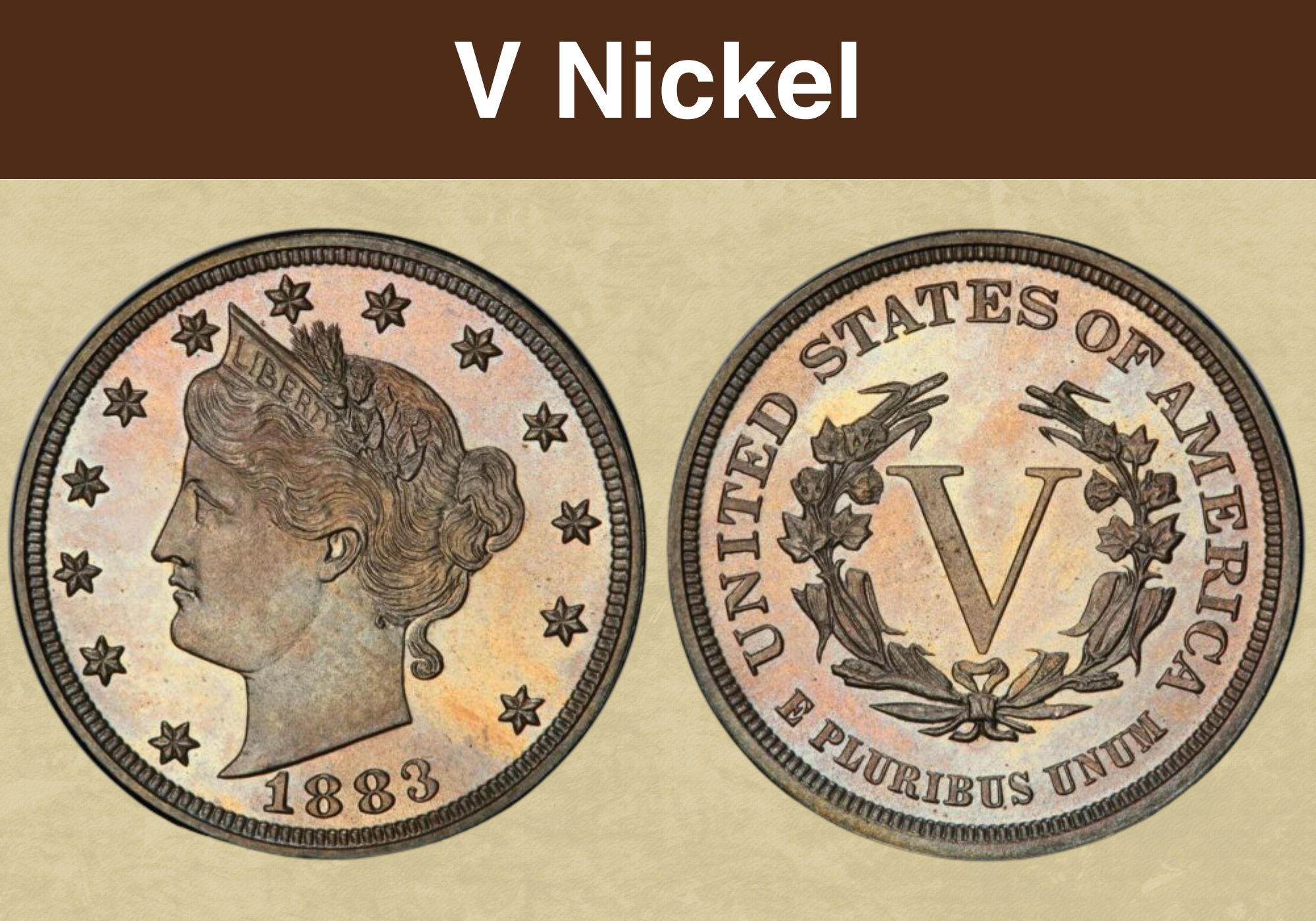
The Obverse of the 1913 Nickel

Flip the coin to the front and you’ll see Lady Liberty in profile, hair tied back, wearing a coronet inscribed LIBERTY. Chief Engraver Charles E. Barber designed the portrait, reportedly modeling it after the goddess Diana according to Mint records.
Thirteen stars circle Liberty’s profile — one for each original colony. The date 1913 sits below.
The Reverse of the 1913 Nickel

Turn it over and you’ll see a large “V” — the Roman numeral for five, marking the denomination. A wreath of corn, cotton, and wheat leaves frames the V, a nod to the country’s agricultural roots.
UNITED STATES OF AMERICA arcs across the upper half, with E PLURIBUS UNUM in smaller letters below it. CENTS appears along the bottom edge.
Other Features of the 1913 Nickel
- Diameter: 21.20 millimeters
- Weight: 5 grams
- Edge: Smooth
- Metal composition: 75% copper and 25% nickel
Like other Liberty Head nickels from Philadelphia, the 1913 nickels carry no mintmark on either side. Worth noting: 1912 was actually the first year branch mints (Denver and San Francisco) struck Liberty Head Nickels, making the 1912-D and 1912-S notable coins in their own right.
Also Read: Top 100 Most Valuable Jefferson Nickels Worth Money List (1938-Present)
1913 Nickel Mintage & Survival Data
1913 Nickel Mintage & Survival Chart
Survival Distribution
| Type | Mintage | Survival | Survival Rate |
|---|---|---|---|
| Proof | 5 | 5 | 100% |
Five struck. Five surviving. That’s a 100% survival rate — unmatched in American numismatics. Every single one is individually documented and accounted for.
Samuel W. Brown struck them outside any official authorization, making them contraband from day one. Each piece entered private hands with everyone fully aware of how special it was, passing through documented auctions and famous collections for over a century.
Today, every specimen carries not just extraordinary monetary value but a fully traceable provenance — the documented chain of ownership that adds enormously to authenticity and desirability. A rarity within a rarity.
Coin Identifier and Value App
Not sure what your coins are worth? Get Instant Value • Grade • Error Detection with coin identifier and value app (FREE Usage Daily)
Also Read: Jefferson Nickel Value (1938-Present)
The Easy Way to Know Your 1913 Nickel Value
Grade, variety, and provenance all move the needle on a coin like this. You need more than a quick look.
Run your coin through Coin Identifier and Value App for an instant, data-backed assessment. The difference between face value and a multi-million-dollar result comes down to precision — and precision starts with the right tool.

1913 Nickel Value Guides: The Five Known Specimens
The Five Known 1913 Proof Nickel Specimens:
- Eliasberg specimen — finest known, graded PCGS PR-66 and NGC PR-66
- Olsen-Hydeman specimen — most famous, graded PCGS PR-64 and NGC PR-64
- Norweb specimen — permanently housed at the Smithsonian Institution, graded NGC PR-64
- Walton specimen — missing for over 40 years, rediscovered in 2003, graded PCGS PR-63
- McDermott-Bebee specimen — held at the American Numismatic Association Money Museum; the only example showing evidence of circulation
Each of the five known 1913 Liberty Head Nickels has its own ownership trail, winding through some of the most famous private collections and auction records in the hobby. These aren’t just rare coins — they’re individually catalogued artifacts, each identified by the name of a prominent former owner.
1913 Proof Nickel Value: Each Specimen Explained
1913 Nickel Eliasberg Specimen

The Eliasberg specimen is the king of the group. Graded PR66 by both PCGS and NGC, it’s the finest of all five 1913 Liberty Head Nickels. Early owners Eric P. Newman and B.G. Johnson sold this Proof nickel to the Numismatic Gallery, who then sold it to Louis Eliasberg — the legendary collector who assembled the only complete collection of U.S. coins by date and mintmark.
Eliasberg kept the coin until after his death. In May 1996, Bowers and Merena auctioned it to rarities dealer Jay Parrino for $1,485,000 — the first time any coin had ever crossed the million-dollar mark at public auction. It sold again in March 2001 for $1,840,000.
In May 2005, Legend Numismatics paid $4,150,000. They sold it in 2007 to an unnamed California collector for $5,000,000. In August 2018, it came back through Stack’s Bowers at $4,560,000, purchased by Legend Numismatics’ Laura Sperber, her partner Bruce Morelan, and an anonymous third buyer.
Later in 2018, the Eliasberg specimen changed hands again in a private deal reported at $6,400,000 — cementing it as the highest-valued example of the five.
1913 Nickel Olsen-Hydeman Specimen

You might recognize this one from TV. The Olsen specimen appeared on Hawaii Five-O in 1973 — Season 6, Episode 14, titled “The $100,000 Nickel.” It was also once owned by Egypt’s King Farouk. That kind of backstory makes it the most famous of the five. It carries a grade of Proof-64 by both PCGS and NGC.
Newman and Johnson first sold this coin to James Kelly, who sold it to collector Fred Olsen — its namesake. Olsen then sold it to King Farouk.
In 1972, World Wide Coin Investments acquired it for $100,000, the first time any coin had broken that price barrier. That milestone directly inspired its TV appearance the following year. Superior Galleries doubled the price to $200,000 in 1978.
The specimen then passed through a remarkable string of owners: department store magnate Edwin Hydeman, Los Angeles Lakers owner Dr. Jerry Buss, Texas oilman Reed Hawn, and California collector Dwight Manley. Manley sold it via private treaty to Bruce Morelan and Legend Numismatics for $3,000,000 in June 2004. Heritage Auctions sold it for $3,737,500 in January 2010. Most recently, in 2021, Stack’s Bowers Galleries facilitated a private sale exceeding $4,000,000.
1913 Nickel Norweb Specimen
Two of the five 1913 Liberty Head Nickels live permanently in museums. The Norweb specimen sits at the Smithsonian Institution’s National Numismatic Collection, where you can see it on display today. NGC graded it PR-64.
Newman and Johnson first sold the coin to collector F.C.C. Boyd, who sold it to the Numismatic Gallery. In 1949, King Farouk of Egypt acquired it — and when he later obtained the Olsen specimen as well, he sold this one as a duplicate.
After Farouk was deposed by Gamal Abdel Nasser in 1952, his possessions were auctioned in Cairo under Sotheby’s London office. Numismatists Abe Kosoff and Sol Kaplan acquired it there and transferred it to Emery May Holden Norweb, the coin’s namesake.
In 1978, Mrs. Norweb and her husband, Ambassador R. Henry Norweb, donated the specimen to the Smithsonian to commemorate their sixtieth wedding anniversary. That’s one heck of an anniversary gift.
1913 Nickel Walton Specimen

This is the one that vanished for 40 years. The Walton specimen has one of the wildest stories in American numismatics. It’s graded PCGS PR-63, making it the third finest of the five.
In 1945, George Walton bought the coin from Newman and Johnson for approximately $3,750. On March 9, 1962, Walton was killed in a car crash on his way to a coin show where he’d planned to exhibit the nickel. The coin was recovered from the wreck, but when Walton’s heirs tried to auction it in 1963, it was mistakenly declared counterfeit. Back into a closet it went — for over four decades.
In 2003, the ANA arranged a public display of the four known specimens. Former ANA governor Donn Pearlman, on behalf of Bowers and Merena, launched a nationwide search for the missing fifth coin — offering a minimum of $1,000,000 to acquire it and a $10,000 reward just for the chance to examine it. PCGS Co-Founder David Hall led a team that authenticated the coin at a secret midnight session during the 2003 ANA World’s Fair of Money in Baltimore. The Walton heirs came forward, PCGS confirmed it genuine, and the $10,000 reward was paid out.
On April 25, 2013, the coin sold at Heritage Auctions for $3,172,500 to Jeff Garrett of Lexington, KY and Larry Lee of Panama City, FL. In June 2018, Garrett and Lee sold it via private treaty for a reported $3 to $4 million to Martin Burns and his brother Ron Firman. In October 2022, the Firman family sold the Walton specimen to GreatCollections for $4,200,000.
1913 Nickel McDermott-Bebee Specimen

Ever wonder what happens when you carry a multi-million-dollar coin in your pocket? The McDermott specimen is the only one of the five with signs of circulation — and there’s a good reason for that.
James Kelly bought this nickel from Johnson and Newman and later sold it to collector J.V. McDermott. Unlike the other owners, McDermott reportedly carried his coin around regularly, showing it off to bar patrons and bragging about its rarity and value. That cost the coin its mint luster. He eventually put it in a protective holder to stop the damage.
After McDermott’s death, his family auctioned the coin to Aubrey Bebee in 1967 for $46,000. In 1989, Bebee and his wife donated it to the ANA’s Money Museum, where it’s displayed to this day — the only one of the five you can view for free.
1913 Proof Nickel Price/Grade Chart
Price by 1-70 Grade (Latest Auction Records Included)
This table documents the most significant public auction results for the 1913 Liberty Head Proof Nickel across decades of active trading.
| Date | Platform | Price | Grade |
|---|---|---|---|
| 08/18 | SB | $4,560,000 | 66 |
| 01/14 | HA | $3,290,000 | 64 |
| 04/13 | HA | $3,172,500 | 63 |
| 01/10 | HA | $3,737,500 | 64 |
| 03/01 | SU | $1,840,000 | 66 |
| 8/18 | SB | $4,560,000 | 66 |
This chart tracks collector interest and market activity for the 1913 Proof Nickel over the past year.
Market activity: 1913 Proof Nickel
Market activity score: 35/100 as of Oct 2026 — unchanged since Jul 2026. Currently at its 12-month peak.
Also Read: 22 Rare Nickel Errors List with Pictures (By Year)
1913 Nickel Error List: What You Need to Know
None of the five 1913 Liberty Head Nickels has a known minting error. Any coin claiming to be a 1913 Liberty error nickel is almost certainly fake.
All five show strong strikes, intact surfaces, and clear details. The McDermott specimen’s wear comes from being carried around in a pocket — not from any die problem. Researchers have confirmed that the five coins share characteristic “planchet flaws and a weakly struck ear of corn” — diagnostic markers that helped authenticate the Walton specimen in 2003.
The 1913 Liberty Nickel is itself one of the most famous “unauthorized date” coins in U.S. history. The Liberty Head series officially ended in 1912, yet five more were struck in 1913 — coins that should never have existed.
Coin Identifier and Value App
Not sure what your coins are worth? Get Instant Value • Grade • Error Detection with coin identifier and value app (FREE Usage Daily)
One counterfeit method to watch for is date alteration. Forgers take a common-date Liberty Nickel — an 1883, 1887, or 1903 — and tool the date to read 1913. Under magnification, you’ll spot tooling marks and unnatural depth around the numerals. Professional authentication from PCGS or NGC is the only reliable way to confirm you’ve got the real thing.
Where to Sell Your 1913 Nickel
Given the extraordinary rarity and value of the 1913 Liberty Head Nickel, consigning through a reputable auction house — such as Heritage Auctions, Stack’s Bowers, or GreatCollections — remains the most effective route to achieving full market value.
These houses have handled all five specimens across multiple transactions and have the expertise, buyer networks, and international reach to attract serious bidders. Never sell a coin of this caliber through casual online marketplaces.
Check out now: Best Places To Sell Coins Online (Pros & Cons)
1913 Nickel Market Trend
Market Interest Trend Chart - 1913 Nickel
Market interest: 5,260 collectors tracking this coin as of Oct 2026 — up 1,000 from Mar 2026. Currently at its 12-month peak.
*Market Trend Chart showing the number of people paying attention to this coin.
FAQ About the 1913 Nickel Value
1. How many 1913 Liberty Head Nickels exist today?
Five. Each is individually documented and named after a prominent former owner. Two live in museums — the Smithsonian (Norweb) and the ANA Money Museum (McDermott-Bebee). Three remain in or have recently moved into private hands. No credible evidence of a sixth specimen has ever surfaced.
2. Were the 1913 Liberty Head Nickels officially authorized by the U.S. Mint?
No. The Liberty Head design was retired after 1912, replaced by James Earle Fraser’s Buffalo Nickel. On December 13, 1912, Mint Director George H. Roberts wrote to Philadelphia Mint Superintendent John H. Landis, explicitly ordering a halt to any 1913 nickel production. The five known specimens are widely believed to have been struck without authorization by Mint employee Samuel W. Brown.
3. How much is a 1913 Liberty Head Nickel worth?
It depends on grade and provenance. Public auction prices have ranged from $3,172,500 to $4,560,000, with one private transaction reportedly hitting $6,400,000. A single grade point on the Sheldon scale can mean millions of dollars at this level.
4. Are there any known errors on the 1913 Liberty Head Nickel?
No. All five show strong strikes with clear details. Coins claiming to be 1913 Liberty error nickels are almost certainly fake — submit to PCGS or NGC before doing anything.
5. Who designed the 1913 Liberty Head Nickel?
Charles E. Barber, the sixth Chief Engraver of the United States Mint. He served from 1879 to 1917 and also designed the Liberty Head dimes, quarters, and half dollars — collectively known as “Barber coinage.” The Liberty Nickel debuted in 1883 and ran unchanged until the Buffalo Nickel replaced it in 1913.
6. What is the difference between the five known specimens in terms of grade?
The Eliasberg is the finest at PR-66 (PCGS and NGC). The Olsen and Norweb are both PR-64. The Walton comes in at PR-63 (PCGS), making it third finest. The McDermott-Bebee is the lowest grade due to circulation wear. Each grade point translates to millions of dollars in value difference.
7. Why did Samuel Brown wait until 1919 to reveal the 1913 nickels?
Most numismatic historians think it was deliberate. The statute of limitations for prosecuting a Mint employee for unauthorized coin production would have expired by 1919 — exactly when Brown placed his ad in The Numismatist and showed a coin at the Chicago Coin Club.
Research published in Numismatic News in 2017 confirmed this December 1919 Chicago Coin Club showing as the earliest documented public display, predating the 1920 ANA convention.
8. Can I still find a 1913 Liberty Head Nickel for sale?
All five are accounted for — either in museums or with known private collectors. Treat any supposed sixth example as a counterfeit until a professional grading service says otherwise. If a genuine specimen ever came to auction, it would be front-page news in the hobby.
9. What is the role of Colonel E.H.R. Green in the history of these coins?
Colonel Green was the son of Hetty Green, the Gilded Age investor known as the “Witch of Wall Street.” After Samuel Brown sold all five 1913 nickels in January 1924, the intact set eventually reached Colonel Green, who kept all five together until his death in 1936.
His estate was auctioned, and dealers Eric P. Newman and B.G. Johnson purchased the lot — becoming the last owners to hold all five as a complete set. They’ve been separated ever since.
10. How can I identify a counterfeit 1913 Liberty Head Nickel?
The most common trick is date alteration — filing and re-engraving the date on a legitimate Liberty Head Nickel from another year. Genuine specimens weigh exactly 5 grams and measure 21.20 mm in diameter. Under magnification, look for tooling marks, unnatural depth inconsistencies, or fuzzy edges around the date numerals.
All five genuine 1913 specimens share specific die characteristics including a weakly struck ear of corn on the reverse wreath. Only PCGS, NGC, or ANACS authentication can definitively confirm authenticity — never buy any claimed 1913 Liberty Nickel without a slabbed holder from one of these services.