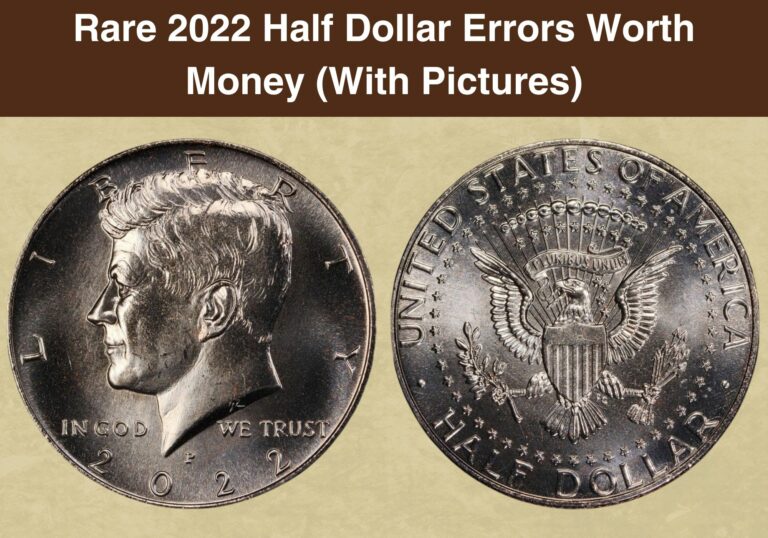
19 Rare Half Dollar Errors List with Pictures (By Year)
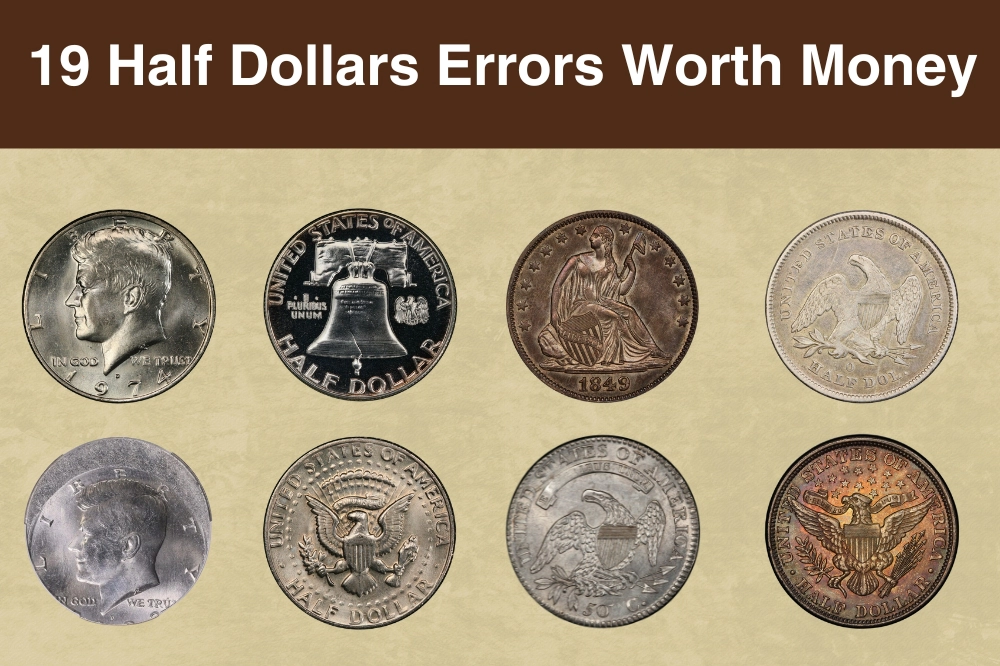
A 1964 Kennedy half dollar from a Special Mint Set sold for $156,000 at auction — the highest price ever paid for a Kennedy half dollar error. The complete list of rare half dollar errors spans both the Franklin series (1948–1963) and the Kennedy series (1964–present), with values ranging from $15 for a minor clipped planchet to six figures for a handful of trophy-tier varieties.
Here is every major error type and year-specific variety, sorted by value from lowest to highest.
1. 2021 Half Dollar Clipped Planchet Error (Up to $100)

Clipped planchets form when the blanking press punches discs from a metal strip and the strip fails to advance properly between punches. The next punch overlaps the hole from the previous blank, creating a planchet with a curved bite taken out of its edge.
The incomplete planchet travels through the entire production process, carrying the missing chunk to the finished coin. On half dollars, the large 30.6 mm diameter makes even a small clip visually obvious — and larger clips that cut through Kennedy’s portrait or the eagle reverse command the strongest premiums.
Value: No single clipped planchet Kennedy half dollar has broken major auction records. General market pricing: small clips under 10% sell for $15 to $30, medium clips of 10% to 20% bring $30 to $50, and large clips over 25% with visible dates reach $75 to $100.
How to Identify: Look for a smooth, curved indentation along the edge where metal is missing. The clip interrupts the normal reeded edge — you will see smooth planchet metal instead of reeding at the clip.
Check for the Blakesley effect — a weak or absent rim directly opposite the clip, 180 degrees away. This diagnostic signature forms because the metal could not flow properly during upsetting.
Weigh the coin — a clipped half dollar will be under the standard 11.34 grams (clad) or 12.50 grams (90% silver). The fastest test: Blakesley effect plus interrupted reeding at the clip.
Use Our Rare Half Dollar Value Checker
2. 2018 Half Dollar Die Crack Error (Up to $128)

Die cracks form when the steel dies fracture from repeated high-pressure strikes. Hairline fractures split the die face, and metal flows into those fissures during striking, leaving raised lines on every coin produced from the damaged die.
When a large chunk of the die edge breaks away completely, it creates a rim cud — a raised, featureless blob at the rim. A 2018-D Kennedy half dollar with a significant rim cud error sold for $128 in 2020, showing that even modern half dollar die breaks can bring real money.
Value: The 2018-D Kennedy half dollar rim cud sold for $128 in 2020. Minor die cracks on Kennedy halves add $5 to $15, while cracks crossing Kennedy’s portrait bring $20 to $50.
Large cuds covering part of the rim or major design elements can reach $100 to $128. Die cracks on older silver Kennedys (1964–1970) carry a slight premium over clad examples.
How to Identify: Scan both sides under magnification and bright, angled light. Die cracks appear as raised lines — run your fingernail across a suspected crack and you should feel a ridge.
For rim cuds, look for a raised, smooth, featureless blob touching the rim. The opposite side of the coin should strike normally, distinguishing cuds from post-mint damage.
Scratches are incised and rough; die cracks are raised and smooth. The fastest test: if the line is raised, it is a die crack; if incised, it is damage.
Use Our Rare Half Dollar Value Checker
3. 2021 Half Dollar Struck Through Error (Up to $150)

Struck-through errors happen when foreign material — wire, cloth, grease, or metal shavings — lands between the die and planchet just before striking. The debris blocks the die from fully transferring its design, leaving a weak or blank zone on the finished coin.
On Kennedy half dollars, the large planchet surface gives debris more room to land. Grease-filled die errors are the most common subtype, creating smooth featureless patches where the design was blocked.
Value: A 2021-P Kennedy half dollar graded PCGS MS66 with a strike-through error appeared on GreatCollections. General pricing for Kennedy half struck-throughs: $20 to $65 for certified minor examples, and $100 to $150 for dramatic retained struck-throughs with visible debris.
How to Identify: Look for areas where design details are weak, blurred, or absent while surrounding areas show full-strike detail. The affected zone should have defined boundaries — not a gradual fade like wear.
Grease fills produce smooth, flat patches. Wire strikes leave thin raised lines, and fabric struck-throughs may show thread textures.
Check whether foreign material remains on the coin — retained objects dramatically increase value. The fastest test: sharply defined blank zone on one side only, with the opposite side struck normally.
Use Our Rare Half Dollar Value Checker
4. 2021 Half Dollar Rotated Die Error (Up to $192)

A rotated die error occurs when the obverse and reverse dies fall out of their intended alignment — on a normal coin, flipping it on its vertical axis shows the reverse upright, but with a rotated die the reverse appears tilted. The die loosens in its seat inside the press, and minor rotations of 5 to 10 degrees are common and worth little.
A 2021-P Kennedy half dollar with a 30-degree rotation sold for $192 on eBay — meaningful money for a modern coin that normally trades at face value.
Value: The 2021-P Kennedy half dollar with a 30-degree rotation sold for $192 on eBay. Minor rotations of 15 to 45 degrees sell for $29 to $75.
Rotations exceeding 90 degrees can bring $150 to $300 depending on grade. A full 180-degree rotation — reverse completely upside down — commands the strongest premiums.
How to Identify: Hold the coin with Kennedy’s portrait facing you upright. Flip it along the vertical axis, left to right, like turning a page.
On a normal coin, the reverse eagle also appears upright after flipping. If the eagle is tilted at any angle, you have a rotated die error — use a protractor or phone app to estimate the degrees.
Both sides should show complete, fully struck design details. The fastest test: flip the coin and check whether the eagle is tilted.
Use Our Rare Half Dollar Value Checker
5. 1976 Half Dollar Broadstrike Error (Up to $300)

A broadstrike happens when the restraining collar fails to engage during striking. Without that collar, the planchet spreads outward under die pressure and produces an oversized coin with a smooth edge instead of the normal reeded edge.
On Bicentennial (1976) Kennedy half dollars, broadstrikes are particularly collectible because the special Independence Hall reverse adds a commemorative layer to the error. The design appears on both sides and is usually well-centered, but the coin is wider, thinner, and completely smooth-edged.
Value: No specific 1976 Kennedy broadstrike has a major auction record, but certified examples appear regularly on eBay and dealer sites. General pricing: minor broadstrikes with barely smooth edges bring $50 to $100, and dramatic obviously-oversized examples reach $200 to $300.
How to Identify: Measure with calipers. A normal half dollar is 30.61 mm — any reading above that warrants closer inspection.
Check the edge — a broadstrike has a flat, knife-like edge with no reeding at all, whereas every normal half dollar has a fully reeded edge. The coin will also feel thinner than normal because the same amount of metal spread across a larger area.
Do not confuse with dryer coins, which have thickened, rounded rims. The fastest test: wider than 30.61 mm plus completely smooth edge.
Use Our Rare Half Dollar Value Checker
6. 1955 Half Dollar Bugs Bunny Die Clash Error (Up to $300)

The “Bugs Bunny” error is exclusive to Franklin half dollars. It results from a die clash — the obverse and reverse dies striking together without a planchet — that transfers the eagle’s wing feathers from the reverse onto Franklin’s face near his upper lip.
The transferred feather lines create the appearance of buck teeth protruding from Franklin’s mouth, hence the cartoon nickname. This die clash pattern appeared across multiple Franklin years but is most prominent on certain 1955 and 1956 specimens.
Value: Bugs Bunny Franklin half dollars range from $20 to $300 depending on year, grade, and how dramatic the “teeth” appear. MS65+ Full Bell Lines examples from key years bring the top end.
Circulated examples with clearly visible teeth typically sell for $20 to $75. Uncirculated specimens with strong clash marks push toward $150 to $300.
How to Identify: Examine Franklin’s upper lip area under 5x to 10x magnification. Look for thin raised lines curving outward from beneath the nose — these are the eagle’s wing feather tips transferred during the die clash.
The “teeth” should be raised and smooth, consistent with die transfer. Check the reverse for corresponding ghost images of Franklin’s profile near the eagle.
Multiple Franklin years show this variety — 1948 through 1963 are all possibilities. The fastest test: raised lines protruding from Franklin’s upper lip area that look like buck teeth.
Use Our Rare Half Dollar Value Checker
7. 1968 Half Dollar Missing Clad Layer Error (Up to $315)

Kennedy half dollars from 1965 to 1970 are 40% silver clad — a silver-copper outer layer bonded to a copper core. A missing clad layer means one of those outer skins failed to bond during strip preparation, exposing the copper core on one side.
The result is a two-toned coin: normal silver-white on one face and reddish-brown copper on the other. A 1968-D Kennedy half dollar graded PCGS MS62 with a missing obverse silver-clad layer was listed at $315 — it weighed only 9.5 grams instead of the standard 11.50 grams.
Value: The 1968-D missing clad layer example was listed at $315 on eBay. General pricing for Kennedy half dollar missing clad layers: clad-era (1971+) examples bring $50 to $150, and silver-era (1965–1970) examples command $100 to $315 due to the higher base metal value.
How to Identify: Start with a digital scale. A 1965–1970 half dollar should weigh 11.50 grams (a 1971+ clad half weighs 11.34 grams), and a missing clad layer reduces weight noticeably — the 1968-D example weighed only 9.5 grams.
If your coin looks copper on one side but weighs normal, it is environmental damage, not a mint error. Check the edge for an asymmetric sandwich where one layer is absent.
The fastest test: wrong weight on a precise scale plus copper color on one side.
Use Our Rare Half Dollar Value Checker
8. 1966 Half Dollar No FG Error (Up to $400)

“No FG” means the initials of reverse designer Frank Gasparro — the letters “FG” normally located between the eagle’s right leg and tail feathers — are completely absent. This is a die variety, not a random strike error: the initials were polished off the working die during maintenance.
The 1966 No FG appears exclusively on coins from that year’s Special Mint Sets. It is distinct from “Weak FG,” where faint traces of the letters remain — Weak FG is worth nothing.
Value: 1966 SMS No FG Kennedy half dollars sell for $275 to $400 or more depending on grade. MS65 and above brings the top end of the range.
This is the least common of the three major No FG varieties (1966, 1972-D, 1982-P). The SMS-only origin limits supply since no circulation strikes have this variety.
How to Identify: Examine the area between the eagle’s right leg and the tail feathers on the reverse under 5x magnification. On a genuine No FG, the area is completely clean with die polish lines confirming the initials were removed at the die level.
“Weak FG” shows faint traces of the letters — even a partial curve of the “G” or vertical bar of the “F” disqualifies the coin. This distinction is critical and non-negotiable.
Confirm the coin is a 1966 SMS issue — it should have a slightly different finish from standard circulation strikes. The fastest test: zero trace of FG under 5x magnification, with die polish lines visible in the blank area.
Use Our Rare Half Dollar Value Checker
Coin Identifier and Value App
Not sure what your coins are worth? Get Instant Value • Grade • Error Detection with coin identifier and value app (FREE Usage Daily)
9. 1976 Half Dollar Off-Center Strike Error (Up to $400)
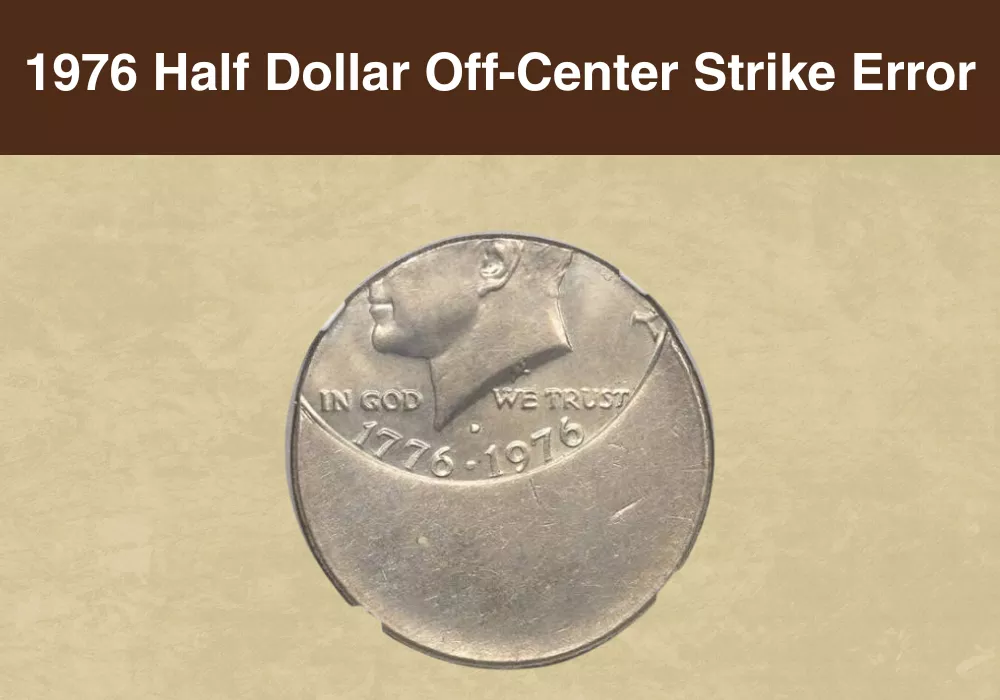
An off-center strike occurs when the planchet feeds into the press misaligned with the dies. The dies stamp the design toward one edge, leaving a blank crescent where no design transferred.
On Kennedy half dollars, off-center strikes are rarer than on smaller denominations because the large 30.6 mm planchet is harder to misposition in the collar. A 1976-D Bicentennial Kennedy half dollar with a 50% off-center strike sold for over $400 at auction — the Independence Hall reverse adds collector appeal.
Value: A 1976-D Kennedy half with approximately 50% off-center strike sold for over $400. General pricing: 5% to 15% displacement sells for $25 to $75, and 20% to 35% brings $75 to $200.
Dramatic 40% to 50% strikes with visible dates reach $300 to $400. Date visibility is the main value driver on off-center half dollars.
How to Identify: Look for design elements cut off along one edge with a blank crescent on the opposite side. The blank area should show raw planchet surface.
The reeding will be incomplete on the shifted side. Measure displacement as a percentage of the 30.61 mm diameter.
Do not confuse with broadstrikes, which show the full design on an oversized coin. The fastest test: blank crescent plus partial design, with the date visible.
Use Our Rare Half Dollar Value Checker
10. 1971 Half Dollar Die Cap Error (Up to $1,000)

A die cap error begins when a freshly struck coin sticks to the upper die instead of ejecting. That stuck coin becomes a new die face — its reverse stamps every subsequent planchet, producing mirror-image brockage coins.
As it gets hammered deeper with each strike, the coin wraps around the die and takes on the shape of a cap or thimble. On a half dollar, the 30.6 mm diameter makes the resulting die cap visually spectacular — a large, bowl-shaped piece of metal with a distorted design.
Value: No specific Kennedy half dollar die cap has a widely publicized major auction record. General pricing for half dollar die caps: early-stage caps with mild distortion bring $200 to $500, and fully formed caps with dramatic metal stretching push past $1,000.
Die cap half dollars are scarce because the Mint’s quality control catches most press malfunctions on the larger denomination. Any that survive are prized by error specialists.
How to Identify: The coin will be obviously deformed — curved or bowl-shaped rather than flat. One side shows a normal strike; the other shows a raised, mirror-image impression where text reads backward.
The edges will be stretched and curved upward, giving the cap shape. Weight may differ from the standard 11.34 grams due to metal displacement.
The fastest test: bowl-shaped coin with backward text on one side. Nothing else produces this shape.
Use Our Rare Half Dollar Value Checker
11. 1982 Half Dollar No FG Error (Up to $2,000)

The 1982-P No FG is the most commonly encountered of the three major No FG Kennedy varieties, and the best entry point for collectors new to this error type. Frank Gasparro’s initials are completely absent from the reverse between the eagle’s leg and tail feathers.
Many 1982-P No FG coins were unknowingly packaged by the Mint in 1982 Souvenir Sets, making those sets the primary hunting ground. While accessible in MS63 grades, scarcity at the top drives prices dramatically — an MS66+ example is worth over twenty times its MS63 counterpart.
Value: Heritage Auctions sold a 1982-P No FG Kennedy half dollar graded PCGS MS67 for $1,440 in January 2020. MS63 examples sell for $95 to $150, and MS65 brings $300 to $600.
MS66 can reach $800 to $1,200, and top-grade MS67+ specimens push past $1,440 to $2,000. The steep price curve above MS65 reflects genuine condition rarity.
How to Identify: Check the reverse under 5x magnification. The area between the eagle’s right leg and tail feathers must show absolutely no trace of the “F” or “G” initials — not even a partial curve or bar.
Die polish lines should be visible in the blank area, confirming the initials were removed from the die itself. “Weak FG” from normal die wear shows faint remnants and is worth nothing.
Confirm the coin is a 1982-P (Philadelphia mint mark on obverse above date). The fastest test: zero initials under magnification plus die polish lines in the blank area.
Use Our Rare Half Dollar Value Checker
12. 1972 Half Dollar No FG Error (Up to $2,400)

The 1972-D No FG is the rarest and most valuable of the three major No FG Kennedy varieties. Like the 1982-P and 1966, the designer’s initials were polished off the working die during routine maintenance.
What makes the 1972-D special is its scarcity. Far fewer 1972-D No FG coins survived compared to the more common 1982-P, and even a nice AU-grade example commands $400 or more.
Value: 1972-D No FG Kennedy half dollars range from $275 in circulated condition to $2,400 for uncirculated MS65+ examples. Even well-worn AU specimens bring $400 to $600.
MS63 examples sell for $600 to $1,000. The price curve is steeper than the 1982-P because the 1972-D starts from a much smaller surviving population.
How to Identify: The identification process is identical to the 1982-P No FG — check the reverse under magnification for completely absent initials between the eagle’s leg and tail feathers.
Confirm the coin is a 1972-D (Denver mint mark). Die polish lines in the blank area confirm die-level removal versus simple wear.
Many collectors confuse “Weak FG” with “No FG” — even faint partial traces disqualify the coin from the No FG designation. The fastest test: Denver mint mark plus absolutely zero trace of FG under 5x magnification.
Use Our Rare Half Dollar Value Checker
13. 1974 Half Dollar Doubled Die Obverse Error (Up to $4,080)

The 1974-D DDO FS-101 is the most famous Kennedy half dollar doubled die variety. Bold doubling is visible on “IN GOD WE TRUST” without magnification — the letters appear thick, notched, and clearly doubled.
This variety was created during die manufacturing when the hub shifted between impressions, leaving a permanent doubled image on every coin struck from that die. The 1974-D DDO is listed in the Cherrypickers’ Guide (FS-101) and the Red Book, giving it mainstream recognition that drives demand.
Value: Heritage Auctions sold a 1974-D DDO FS-101 graded PCGS MS64 for $4,080 in March 2020. Circulated examples with clear doubling sell for $25 to $150.
MS63 brings $200 to $400, while MS64 reaches $1,000 to $4,080 depending on eye appeal. This variety is still findable in original bank rolls, making it the best “treasure hunt” Kennedy error.
How to Identify: Examine “IN GOD WE TRUST” on the obverse first. The letters should show thick, rounded, three-dimensional doubling — a clear secondary image offset from the primary text.
Machine doubling — flat, shelf-like steps on one side of letters — is worthless and far more common. True DDO doubling is rounded and raised, not flat.
Check the date “1974” and “LIBERTY” for consistent doubling, and confirm the Denver mint mark. The fastest test: thick, notched lettering on “IN GOD WE TRUST” visible without magnification.
Use Our Rare Half Dollar Value Checker
14. 1964 Half Dollar Wrong Planchet Error (Up to $5,000)

Wrong planchet errors occur when a blank intended for a different denomination enters the half dollar striking press. The dies stamp whatever feeds through, producing a coin with the Kennedy design on the wrong-sized, wrong-metal planchet.
A Kennedy half dollar struck on a quarter planchet (5.67 grams, copper-nickel clad) would appear undersized with the design running off the edges. These errors are extremely rare on half dollars because the large planchet size makes misfeeds far less likely than with smaller denominations.
Value: General pricing for Kennedy half dollar wrong planchet errors: strikes on quarter planchets bring $1,000 to $3,000, and strikes on cent or dime planchets can reach $3,000 to $5,000 depending on authentication.
Always get suspected wrong planchet errors certified by PCGS or NGC before selling. The authentication alone can multiply your return significantly.
How to Identify: Weigh the coin on a digital scale — a normal 1964 half weighs 12.50 grams (90% silver), 1965–1970 weighs 11.50 grams, and 1971+ weighs 11.34 grams. Any significant deviation from these figures suggests a wrong planchet.
Measure the diameter — a quarter planchet is 24.26 mm versus the half dollar’s 30.61 mm. The design will appear oversized on a smaller planchet, running off the edges.
Check the edge and color for composition clues. The fastest test: wrong weight on a precise scale.
Use Our Rare Half Dollar Value Checker
15. 1977 Half Dollar Silver Transitional Error (Up to $6,900)

The 1977-D silver transitional error occurs when a 40% silver clad planchet — leftover from the 1965–1970 silver half dollar production — was accidentally fed into a 1977 pressing run that should have used standard copper-nickel clad planchets.
The resulting coin carries a 1977-D date on a planchet of the wrong composition and wrong weight: approximately 11.50 grams instead of the standard 11.34 grams, with a solid silver-grey edge instead of the copper-orange stripe visible on normal clad halves.
Value: 1977-D silver transitional Kennedy half dollars have sold for $6,900 or more. PCGS and NGC authentication is mandatory because the weight difference between silver clad (11.50g) and copper-nickel clad (11.34g) is small — just 0.16 grams.
Without certification, no serious buyer will pay transitional error prices. The premium reflects both the extreme rarity and the cost of professional verification.
How to Identify: Weigh the coin to 0.01 gram accuracy — a standard 1977-D clad half weighs 11.34 grams, while a silver transitional reads approximately 11.50 grams. That 0.16 gram difference is your first clue.
Check the edge carefully. A copper-nickel clad half shows a distinctive copper-orange stripe sandwiched between silver-toned layers, while a silver transitional shows a solid silver-grey edge with no copper stripe visible.
Do not rely on appearance alone — professional grading is essential. The fastest test: 11.50 grams on a precise scale plus no copper stripe on the edge.
Use Our Rare Half Dollar Value Checker
16. 1971 Half Dollar Silver Transitional Error (Up to $13,000)

In 1971, the Denver Mint shifted from 40% silver clad to standard copper-nickel clad planchets for Kennedy half dollars. Silver planchets from the 1970 production — likely intended for mint sets — were mixed into the 1971 run.
The resulting 1971-D coins carry copper-nickel clad dies on silver planchets, creating a wrong-composition error. This is the most valuable of the two known Kennedy silver transitional dates, with prices roughly double the 1977-D.
Value: 1971-D silver transitional Kennedy half dollars range from $6,000 to $13,000 or more depending on grade and certification. PCGS and NGC authentication is non-negotiable for this error.
Coin Identifier and Value App
Not sure what your coins are worth? Get Instant Value • Grade • Error Detection with coin identifier and value app (FREE Usage Daily)
MS63 examples bring $6,000 to $8,000, while MS65+ pushes toward $13,000. Raw, uncertified coins claiming to be silver transitionals are almost always rejected by serious buyers.
How to Identify: The diagnostic process is identical to the 1977-D. Weigh the coin to 0.01 grams — a silver transitional reads approximately 11.50 grams versus the standard 11.34 grams.
Check the edge for a solid silver-grey color with no copper-orange stripe. On a normal 1971-D clad half, the copper core is clearly visible as an orange line sandwiched between silver layers.
The ring test can help — silver coins produce a clear, sustained ring when tapped, while clad coins produce a dull thud. The fastest test: 11.50 grams plus silver-grey edge with no copper stripe.
Use Our Rare Half Dollar Value Checker
17. 1961 Half Dollar Proof Doubled Die Reverse Error (Up to $22,800)

The 1961 Proof DDR is the single most important Franklin half dollar variety. The reverse shows extreme doubling on “E PLURIBUS UNUM,” “UNITED STATES OF AMERICA,” and “HALF DOLLAR” — all visible to the naked eye without magnification.
An estimated 1,500 to 2,000 examples were struck before the Mint caught the error and replaced the die. It is listed as FS-801 in the Cherrypickers’ Guide and is a Red Book variety with mainstream collector recognition.
Value: Stack’s Bowers sold a PCGS PR67CAM example for $22,800 in June 2023 — the top recorded price for this variety. A PR68 regular proof sold for $15,000 at Stack’s Bowers in 2020.
PR65 examples bring $2,200 to $3,150, while PR66 reaches $5,000. Cameo and Deep Cameo contrast add steep premiums on top of the base DDR value.
How to Identify: Flip the coin to the reverse and examine the lettering. The doubling on “E PLURIBUS UNUM” and “HALF DOLLAR” is dramatic — you can see it without a loupe.
Look for bold, clearly separated secondary images of the letters, especially on the left and bottom portions of the reverse. This is a proof coin, so the mirror fields make the doubled lettering especially sharp and obvious.
Confirm it is a proof (mirror fields, sharp rims) and dated 1961. The fastest test: naked-eye doubling on “HALF DOLLAR” on a proof Franklin.
Use Our Rare Half Dollar Value Checker
18. 1964 Half Dollar Accented Hair Proof Error (Up to $45,000)

The 1964 Accented Hair variety was the original design for the Kennedy proof half dollar. In the early weeks of 1964 proof production, an estimated 50,000 to 100,000 coins were struck before Gilroy Roberts modified Kennedy’s hair detail at Jacqueline Kennedy’s request.
The Accented Hair version shows stronger, more detailed hair strands above Kennedy’s ear, and the “I” in “LIBERTY” has a distinct pointed serif that was softened on later dies. Deep Cameo examples are extraordinarily rare because the heavy hair detail made consistent frost contrast difficult to achieve.
Value: Heritage Auctions sold a 1964 Accented Hair Proof graded PR68 Deep Cameo for $19,200 in April 2021. A PR69 DCAM example reportedly brought $45,000 or more in 2024.
Regular proof (non-cameo) Accented Hair coins in PR65 sell for $50 to $100, and cameo examples bring $200 to $1,000. Deep Cameo is where values explode — PR67 DCAM can reach $3,000 to $10,000.
How to Identify: Compare the hair detail above Kennedy’s ear to a standard 1964 proof. The Accented Hair shows thick, sharply defined strands — the standard version has softer, less pronounced hair.
Check the “I” in “LIBERTY” — on the Accented Hair, the bottom serif is noticeably longer and sharper. Some references also note slight differences in the jawline detail.
This variety appears only on 1964 proof coins, not business strikes. The fastest test: strong hair detail above the ear plus pointed serif on the “I” in “LIBERTY.”
Use Our Rare Half Dollar Value Checker
19. 1964 Half Dollar SMS Error (Up to $156,000)

The 1964 SMS Kennedy half dollar is the rarest and most valuable Kennedy half dollar error. Only about 12 examples are believed to exist, and they were likely produced as unauthorized Special Mint Set specimens — coins struck with a satin or specimen finish that was neither a standard business strike nor a regular proof.
These coins display brilliant mirror-like fields with thick frost on Kennedy’s portrait, similar to a proof but with subtle differences in surface quality. The Mint has never officially acknowledged their production, which adds to the mystique and controversy surrounding these coins.
Value: Stack’s Bowers sold a 1964 SMS Kennedy half dollar graded PCGS SP68 for $47,000 in August 2019. Higher-grade examples with Deep Cameo contrast have brought $108,000 to $156,000 at auction.
With roughly 12 known, each appearance at auction is a major numismatic event. Authentication by PCGS or NGC is absolutely mandatory — no raw coin will be accepted as genuine SMS by serious buyers.
How to Identify: The 1964 SMS has a distinctive finish that falls between a business strike and a proof — mirror fields with strong frost, but struck on a standard planchet rather than a specially prepared proof blank.
The surfaces show fewer die polish lines than a standard proof. Edge, weight, and diameter are identical to a regular 1964 Kennedy (12.50 grams, 30.61 mm, 90% silver).
Only professional grading services can authenticate this variety, so if you believe you have one, do not clean or handle it with bare hands. The fastest test: submit to PCGS or NGC — there is no reliable at-home diagnostic for this coin.
Use Our Rare Half Dollar Value Checker
Conclusion
The rare half dollar error market spans from $15 for a minor clipped planchet to $156,000 for the legendary 1964 SMS specimen. The findable errors — 1982-P No FG, 1974-D DDO, clipped planchets, and missing clad layers — are still turning up in bank rolls and inherited collections.
A precise digital scale, a 10x loupe, and knowledge of what to look for are the only equipment separating a face-value coin from a four-figure find.