19 Rare Dollar Coin Errors List with Pictures (By Year)

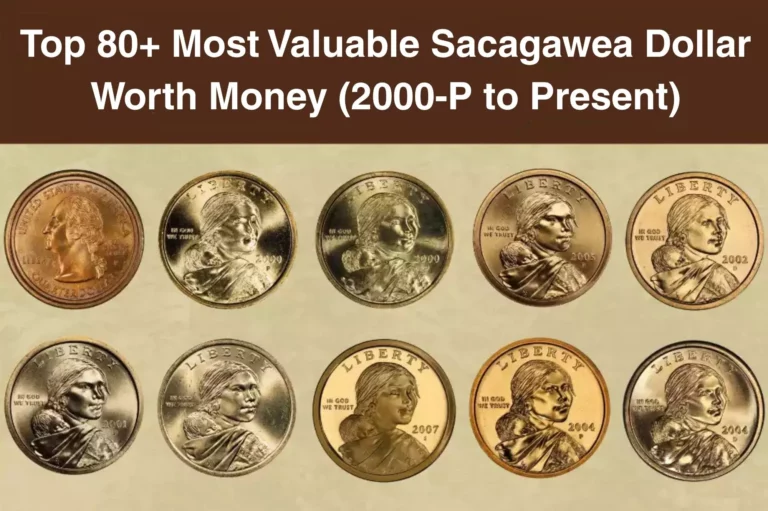
A 2000-P Sacagawea dollar accidentally struck with a Washington Quarter obverse die sold for $194,000 at Stack’s Bowers Galleries — the most expensive modern U.S. mint error ever auctioned. The full list of rare dollar coin errors spans the Eisenhower, SBA, Sacagawea, and Presidential series, with values ranging from $50 for a minor variety to six figures for the rarest minting mistakes.
Here is every major error type sorted by value, from pocket change to auction headline.
1. 1979 Dollar Wide Rim Error (Up to $100)

The 1979-P SBA dollar exists in two rim varieties: the standard “Narrow Rim” has a visible gap between the date and the inner rim, while the scarcer “Wide Rim” has the date positioned noticeably closer. The Wide Rim was produced from a modified die early in 1979 and is the less common of the two.
The difference is subtle but consistent — this is a die variety, not a random error, and it appears only on 1979-P coins.
Value: 1979-P Wide Rim SBA dollars sell for $25 to $50 in circulated condition and $75 to $100 in uncirculated MS63 or better. No major auction house record exists above $100 for this variety.
The price has remained stable for years because supply matches demand. This is an accessible entry-level variety that most SBA collectors want in their sets.
How to Identify: Compare the gap between the bottom of the “1” in the date and the inner rim. On the Wide Rim variety, the date nearly touches the rim — the gap is minimal.
On the standard Narrow Rim, a clear space separates the date from the rim. Reference photos on PCGS CoinFacts show both versions side by side.
The coin is a standard SBA: 26.5 mm diameter, 8.1 grams, copper-nickel clad with a reeded edge. The fastest test: date nearly touching the inner rim on a 1979-P.
Use Our Rare Dollar Coin Value Checker
2. 2020 Dollar Clipped Planchet Error (Up to $150)

Clipped planchets form when the blanking press punches discs from a metal strip and the strip fails to advance properly. The next punch overlaps the hole from the previous blank, creating a planchet with a curved bite taken out of its edge.
On modern dollar coins (Sacagawea and Presidential), the clip removes part of the lettered edge and interrupts the design. The incomplete planchet goes through the entire production process, carrying the missing chunk to the finished coin.
Value: General pricing for modern dollar coin clipped planchets: small clips under 10% sell for $25 to $50, medium clips of 10% to 20% bring $50 to $75, and large clips over 25% with visible dates reach $100 to $150.
Larger clips on Eisenhower dollars command slightly higher prices due to the bigger coin size and heavier collector demand.
How to Identify: Look for a smooth, curved indentation along the edge where metal is missing. On Sacagawea and Presidential dollars, the clip interrupts the incused edge lettering.
Check for the Blakesley effect — a weak or absent rim directly opposite the clip, 180 degrees away. This diagnostic signature confirms a genuine clip.
Weigh the coin — a clipped dollar will be under the standard 8.1 grams (Sacagawea/Presidential) or 22.68 grams (Eisenhower clad). The fastest test: Blakesley effect on the opposite rim plus interrupted edge lettering.
Use Our Rare Dollar Coin Value Checker
3. 2016 Dollar Die Crack Error (Up to $200)

Die cracks form when the steel dies fracture from repeated high-pressure strikes. Hairline fractures split the die face, and metal flows into those fissures during striking, producing raised lines on the finished coin.
When a large chunk of the die edge breaks away, it creates a rim cud — a raised, featureless blob where the design should be. On dollar coins, cuds are proportionally more visible than on smaller denominations because of the larger surface area.
Value: No single modern dollar die crack has a widely publicized major auction record above $200. General pricing: minor die cracks add $5 to $25, significant cracks crossing major design elements bring $25 to $75, and large rim cuds on dollar coins reach $100 to $200.
How to Identify: Scan both sides under magnification and bright, angled light. Die cracks appear as raised lines — run your fingernail across a suspected crack and you should feel a ridge.
For rim cuds, look for a raised, smooth, featureless blob touching the rim. The opposite side should strike normally.
Scratches are incised and rough; die cracks are raised and smooth. The fastest test: if the line is raised, it is a die crack; if incised, it is damage.
Use Our Rare Dollar Coin Value Checker
4. 1976 Dollar Doubled Die Obverse Error (Up to $300)

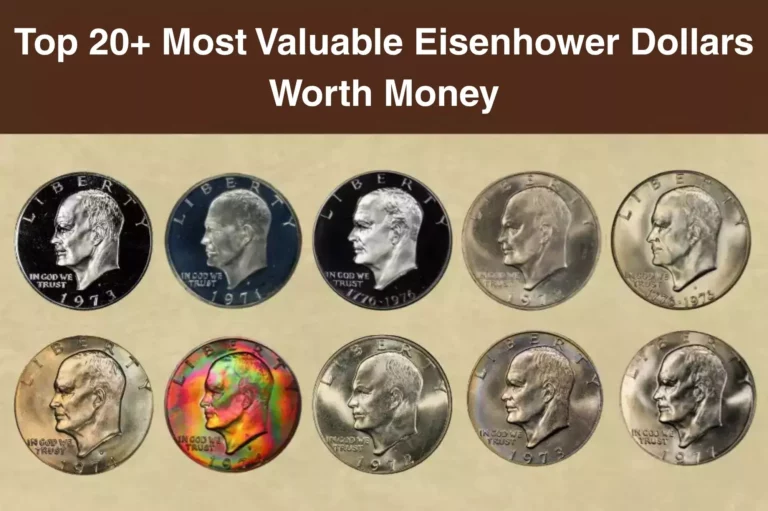
The 1976 Eisenhower Bicentennial dollar exists with a doubled die obverse showing clear doubling on “LIBERTY,” “IN GOD WE TRUST,” and the dual date “1776-1976.” The doubling was created during die manufacturing when the hub shifted between impressions.
Eisenhower dollars were the last large-format U.S. dollar coins at 38.1 mm diameter, making design doubling more visible than on smaller coins. The Bicentennial reverse featuring the Liberty Bell and moon adds collector appeal to any 1976 Ike error.
Value: 1976 Eisenhower DDO coins sell for $150 to $300 depending on grade and doubling strength. Circulated examples with clear doubling bring $50 to $150.
Uncirculated specimens with strong, visible doubling on multiple design elements push toward $300. Machine doubling — flat and shelf-like — is common and worthless on Ike dollars.
How to Identify: Examine “IN GOD WE TRUST” and “LIBERTY” under 10x magnification. True doubled dies show rounded, three-dimensional doubling offset from the primary design.
Machine doubling appears flat and shelf-like on one side of letters only. Check the date “1776-1976” for consistent doubling patterns.
The coin is a standard Ike: 38.1 mm diameter, 22.68 grams (clad) or 24.59 grams (40% silver). The fastest test: rounded, raised doubling on multiple design elements, not flat shelf-like steps.
Use Our Rare Dollar Coin Value Checker
5. 2015 Dollar Struck Through Error (Up to $400)

Struck-through errors happen when foreign material lands between the die and planchet just before striking. Wire fragments, cloth fibers, grease, or metal shavings block the die from fully transferring its design.
On golden dollars, the manganese brass surface makes blank patches especially visible against the bright golden color. When the foreign object stays embedded, it is a retained struck-through — worth significantly more because the culprit remains visible.
Value: General pricing for dollar coin struck-throughs: minor grease fills add $25 to $75, dramatic struck-throughs with large blank areas sell for $75 to $200, and retained struck-throughs with visible debris push past $300 to $400.
How to Identify: Look for areas where design details are weak, blurred, or absent while surrounding areas show full-strike detail. The affected zone should have defined boundaries, not a gradual fade like wear.
Grease fills produce smooth, flat patches. Wire strikes leave thin raised lines across the surface.
Check whether foreign material remains embedded in the coin. The fastest test: sharply defined blank zone on one side only, with the opposite side struck normally.
Use Our Rare Dollar Coin Value Checker
6. 1976 Dollar Off-Center Strike Error (Up to $500)

An off-center strike occurs when the planchet feeds into the press misaligned with the dies. On Eisenhower dollars, even a small off-center percentage is dramatic because the 38.1 mm planchet makes displacement obvious in hand.
More displacement means more value — but only if the date remains visible. A 1976 Bicentennial Ike with a 50% off-center strike is particularly collectible because the Independence Hall reverse and Liberty Bell design add a commemorative layer to the error.
Value: General pricing for dollar coin off-center strikes: 5% to 15% displacement sells for $50 to $100 on modern dollars. Dramatic 30% to 50% strikes with visible dates on Eisenhower dollars reach $300 to $500.
Sacagawea and Presidential dollar off-centers in the same range bring slightly less than Ikes due to lower collector demand.
How to Identify: Look for design elements cut off along one edge with a blank crescent on the opposite side. The blank area should show raw planchet surface.
The rim and edge details will be incomplete on the shifted side. Measure displacement as a percentage of the coin’s diameter.
Do not confuse with broadstrikes, which show the full design on an oversized coin. The fastest test: blank crescent plus partial design, with the date visible.
Use Our Rare Dollar Coin Value Checker
7. 2001 Dollar Missing Clad Layer Error (Up to $600)

Sacagawea dollars are manganese brass clad — a golden outer layer bonded to a pure copper core. A missing clad layer means one outer skin failed to bond during strip preparation, exposing the copper core on one side of the coin.
The result is a two-toned dollar: golden on one face and reddish-brown copper on the other. Weight drops noticeably because the missing brass layer accounts for a measurable portion of the standard 8.1 grams.
Value: Sacagawea dollar missing clad layer errors sell for $150 to $600 depending on grade and how complete the layer absence is. A coin weighing approximately 6.0 grams instead of 8.1 grams confirms the missing layer.
Bright, uncirculated examples with vivid copper color contrast bring the top end. Circulated pieces with partial missing clad sit closer to $150.
How to Identify: Start with a digital scale. A standard Sacagawea dollar weighs 8.1 grams — a missing clad layer drops the weight to approximately 6.0 grams.
If the coin looks copper-toned but still weighs 8.1 grams, it is environmental tarnish, not a mint error. Sacagawea dollars are especially prone to dark toning that mimics a missing layer.
Check the edge for an asymmetric sandwich where one layer is absent. The fastest test: wrong weight on a precise scale plus copper color on one side.
Use Our Rare Dollar Coin Value Checker
8. 1972 Dollar Broadstrike Error (Up to $1,000)

A broadstrike happens when the restraining collar fails to engage during striking. Without that collar, the planchet spreads outward under die pressure and produces an oversized coin with a smooth edge instead of the normal reeded edge.
On Eisenhower dollars, broadstrikes are visually impressive because the 38.1 mm coin expands even larger. The edge loses all reeding and becomes flat and knife-like, while the design spreads beyond its normal boundaries.
Value: Eisenhower dollar broadstrikes have been offered at up to $1,299 on the collector market. General pricing: minor broadstrikes with barely smooth edges bring $75 to $200, and dramatic, obviously oversized examples reach $500 to $1,000.
Sacagawea dollar broadstrikes — identifiable by their completely smooth edge with no incused lettering — trade in similar ranges.
How to Identify: Measure with calipers — an Eisenhower dollar is 38.1 mm and a Sacagawea/Presidential dollar is 26.5 mm, so any reading above standard warrants closer inspection.
Check the edge — a broadstrike has a flat edge with no reeding (Ike/SBA) or no incused lettering (Sacagawea/Presidential), and the coin will feel thinner than normal.
Coin Identifier and Value App
Not sure what your coins are worth? Get Instant Value • Grade • Error Detection with coin identifier and value app (FREE Usage Daily)
The fastest test: wider than standard diameter plus completely smooth or unlettered edge.
Use Our Rare Dollar Coin Value Checker
9. 2010 Dollar Position B Edge Lettering Error (Up to $1,100)

Edge lettering on Sacagawea and Presidential dollars can be applied in two orientations: Position A (normal) has edge text reading upright when the obverse faces up, while Position B (inverted) has the same text reading upside down. The orientation difference occurs because the Schuler edge-lettering machine accepts coins from either direction.
Position B results are less common and carry a collectible premium, with certain year and mint mark combinations being scarcer than others.
Value: GreatCollections sold a 2010-D Sacagawea dollar graded MS65 with Position B edge lettering for $1,100 in 2020. Lower-grade Position B examples sell for $25 to $100.
MS64 and above brings $200 to $600. The premium varies by year — some dates have a higher ratio of Position A to Position B than others.
How to Identify: Hold the coin with the obverse facing you, right side up. Examine the edge lettering without flipping the coin.
On Position A, the text reads upright left to right. On Position B, the text appears upside down — you would need to rotate the coin 180 degrees for the edge text to read normally.
Check the full circumference to confirm consistent orientation. The fastest test: edge lettering reads upside down when the obverse faces up.
Use Our Rare Dollar Coin Value Checker
10. 2009 Dollar Missing Edge Lettering Error (Up to $1,800)

Missing edge lettering errors occur when a struck coin bypasses the Schuler edge-lettering machine entirely. The coin exits production with a completely smooth, plain edge — no date, no mint mark, no “E PLURIBUS UNUM,” and no stars.
The 2007 Presidential dollar series generated national media coverage when missing edge lettering coins appeared in circulation, and the public nicknamed them “Godless dollars” because “IN GOD WE TRUST” was part of the edge text. The 2009 Sacagawea dollar with missing edge lettering holds the highest confirmed auction record.
Value: Heritage Auctions sold a 2009 Sacagawea dollar with missing edge lettering for $1,800 in January 2018. Presidential dollar missing edge lettering examples sell for $50 to $300 depending on the president and grade.
The 2007 George Washington is the most common. Earlier dates command higher premiums because the Mint improved quality control over time.
How to Identify: Run your finger around the entire edge. A normal Sacagawea or Presidential dollar has incused text you can feel — date, mint mark, motto, and stars.
If the edge is completely smooth with no text whatsoever, you have a missing edge lettering error. Do not confuse with weak edge lettering, where text is present but faint.
Weigh the coin to confirm it is genuine (8.1 grams for Sacagawea, same for Presidential). The fastest test: completely smooth edge with no incused text at all.
Use Our Rare Dollar Coin Value Checker
11. 1976 Dollar Indented Strike Error (Up to $1,997)

An indented strike occurs when two planchets feed into the press simultaneously, overlapping. The top planchet gets struck between the die and the bottom planchet, leaving a round, unstruck depression where the second planchet sat underneath.
A 1976 Eisenhower Bicentennial dollar with a reverse indented by a quarter dollar planchet is a particularly unusual example — the quarter-sized blank sat on top of the dollar blank during striking, creating a moon-shaped void in the reverse design.
Value: Heritage Auctions sold a 1976 Eisenhower dollar graded MS64 by PCGS with a reverse indented by a quarter planchet for $1,997.50 in January 2017. The quarter planchet did not remain attached, but the void it created is unmistakable.
Indented strike errors on dollar coins are uncommon because the large planchet makes double-feeding mechanically less likely. Minor indents bring $100 to $500.
How to Identify: Look for a smooth, round depression on one side of the coin where the design is absent or partially formed. The depression should match the diameter of whatever planchet caused the indent.
The indentation is dish-shaped — concave, not flat — because the second planchet absorbed the striking pressure in that area. The opposite side of the coin should show a normal strike.
Check for design weakness opposite the indent on the other side. The fastest test: round, dish-shaped depression matching another coin’s diameter.
Use Our Rare Dollar Coin Value Checker
12. 1972 Dollar on Half Dollar Planchet Error (Up to $2,800)

This wrong-planchet error occurred when a copper-nickel clad Kennedy half dollar planchet was accidentally fed into the 1972-S Eisenhower dollar proof press at the San Francisco Mint. Both denominations were being struck at the same facility, creating the opportunity for planchet mix-ups.
The resulting coin carries an Eisenhower proof design on a half-dollar-sized blank — noticeably smaller than a standard Ike, with the design running off the edges. The proof finish on a wrong-sized planchet makes this a visually dramatic error.
Value: GreatCollections auctioned a 1972-S proof Eisenhower dollar struck on a clad half dollar planchet, graded PF67DCAM by PCGS, with bidding exceeding $2,800 in 2021. A more off-center example graded PF62 sold for $322.
The value depends on how much of the design made it onto the undersized planchet and the proof quality preservation.
How to Identify: Weigh the coin — a Kennedy half dollar planchet weighs 11.34 grams versus the standard Ike planchet at 22.68 grams (clad) or 24.59 grams (silver). That weight difference is impossible to miss.
Measure the diameter — a half dollar planchet is 30.61 mm versus the Ike’s 38.1 mm. The design will appear oversized, running off the edges.
Check for the proof finish (mirror fields, frosted devices) which confirms the San Francisco origin. The fastest test: Eisenhower design on a coin that weighs 11.34 grams.
Use Our Rare Dollar Coin Value Checker
13. 2000 Dollar Wounded Eagle Error (Up to $5,160)

The “Wounded Eagle” is a die gouge variety on the 2000-P Sacagawea dollar, designated FS-901 by PCGS. A raised diagonal line appears on the eagle’s breast on the reverse, resembling a spear or wound — hence the name.
The gouge was created when a foreign object scratched the working die, and every coin struck from that damaged die carries the same mark. This is not post-mint damage; the line is raised (coming from a void in the die) rather than incised.
Value: Wounded Eagle examples range from $100 to $5,160 depending on grade. Circulated AU specimens bring $100 to $250, and MS64 examples sell for $400 to $800.
MS66 and above pushes past $2,000. The top-grade examples above MS67 command $3,000 to $5,160.
How to Identify: Examine the reverse under magnification. Look for a raised diagonal line running across the eagle’s breast from approximately the 7 o’clock to 1 o’clock position.
The line must be raised, not incised — this confirms it originated from the die rather than from post-mint scratching. Compare your coin to PCGS FS-901 reference images.
Confirm it is a 2000-P (Philadelphia mint mark). The fastest test: raised diagonal line on the eagle’s breast on a 2000-P Sacagawea.
Use Our Rare Dollar Coin Value Checker
14. 1974 Dollar Silver Transitional Error (Up to $8,000)

In 1974, the Denver Mint was supposed to strike Eisenhower dollars exclusively on copper-nickel clad planchets. However, 25 to 30 silver-clad planchets from San Francisco — intended for collector silver Ikes — were accidentally shipped to Denver and struck with 1974-D dies.
The resulting coins carry a Denver mint mark on a 40% silver planchet: wrong composition, wrong weight, wrong metal at the wrong mint. An estimated 25 to 30 examples are known.
Value: 1974-D silver transitional Eisenhower dollars have sold for $8,000 or more. The premium reflects both extreme rarity and the cost of mandatory professional authentication.
Without PCGS or NGC certification, no serious buyer will pay transitional prices. These coins look nearly identical to standard clad Ikes — only weight and edge examination reveal the truth.
How to Identify: Weigh the coin to 0.01 gram accuracy. A silver-clad Ike planchet weighs approximately 24.59 grams versus the standard clad at 22.68 grams — a difference of nearly 2 grams.
Check the edge carefully — a clad Ike shows a visible copper-orange stripe between silver-toned layers, while a silver transitional shows a uniform silver-grey edge with no copper stripe.
The ring test helps: silver coins produce a clear, sustained ring when tapped; clad coins produce a dull thud. The fastest test: 24.59 grams on a precision scale plus no copper stripe on the edge.
Use Our Rare Dollar Coin Value Checker
15. 1972 Dollar Type 2 Reverse Error (Up to $15,870)

The 1972 Eisenhower dollar was struck with three different reverse dies, designated Type 1, Type 2, and Type 3. Type 2 is the rarest — it features a distinctive long, funnel-shaped Florida with no visible Caribbean islands, unlike the geographically accurate Type 3.
Type 2 was used briefly at the Philadelphia Mint before being pulled, and only a small number entered circulation. It is known as the “King of the Ikes” and is listed in the Red Book, giving it mainstream collector recognition.
Value: GreatCollections sold a 1972 Type 2 Eisenhower dollar graded MS66+ with a CAC sticker for $15,870 in August 2024. Heritage Auctions sold an MS66 example for $14,400.
Circulated Type 2 examples bring $25 to $100. MS63 sells for $200 to $500, and MS65 reaches $2,000 to $5,000.
How to Identify: Examine the reverse, focusing on Florida and the Caribbean. Type 2 shows Florida as a long, smooth funnel shape with no visible islands below it.
Type 3 (common) shows distinct Caribbean island outlines and a more geographically accurate Florida. Type 1 (also common) has flatter, less detailed Earth features.
The two-step diagnostic: first confirm no islands are visible, then check that Florida appears as a long funnel. The fastest test: no Caribbean islands plus funnel-shaped Florida on a 1972 Philadelphia Ike.
Use Our Rare Dollar Coin Value Checker
16. 2000 Dollar on SBA Planchet Error (Up to $16,800)

This wrong-planchet error occurred when copper-nickel clad SBA dollar planchets were accidentally fed into the Sacagawea dollar striking presses at the Philadelphia Mint in 2000. Both coins share the same 26.5 mm diameter, making the mix-up mechanically easy — but the color difference between silver-toned SBA metal and golden manganese brass is immediately obvious.
The resulting coin is a silver-toned “golden dollar” that looks nothing like the intended product.
Coin Identifier and Value App
Not sure what your coins are worth? Get Instant Value • Grade • Error Detection with coin identifier and value app (FREE Usage Daily)
Value: 2000-P Sacagawea dollars struck on SBA planchets sell for $8,000 to $16,800 depending on grade. The CVC price reference lists the range at those figures.
These coins are rare and require PCGS or NGC authentication. The visual drama of a silver-colored Sacagawea makes them popular with both error specialists and general collectors.
How to Identify: The coin should look silver-colored rather than golden — this is the most obvious visual indicator. It will have a Sacagawea obverse and Soaring Eagle reverse, but in the wrong color.
Weigh the coin: SBA planchets weigh 8.1 grams (same as Sacagawea), so weight alone will not distinguish them. Check the edge — SBA planchets have a reeded edge, while standard Sacagawea dollars have a plain edge.
The metal composition is copper-nickel clad rather than manganese brass. The fastest test: silver-colored Sacagawea dollar with a reeded edge.
Use Our Rare Dollar Coin Value Checker
17. 1977 Dollar Silver Transitional Error (Up to $26,400)

The 1977-D silver transitional Eisenhower dollar was created the same way as the 1974-D — silver-clad planchets from San Francisco accidentally ended up at the Denver Mint. Only about 15 examples are known, making this significantly rarer than the 1974-D.
The coin carries a 1977-D date on a 40% silver planchet that weighs approximately 24.59 grams instead of the standard clad 22.68 grams. With fewer than 15 confirmed, each discovery or auction appearance is a notable event.
Value: Heritage Auctions sold a 1977-D Eisenhower dollar struck on a 40% silver planchet for $26,400. With only 15 known, this is the highest-value Eisenhower dollar error.
Authentication by PCGS or NGC is absolutely non-negotiable. The 2-gram weight difference between silver and clad is the primary diagnostic, but professional certification is essential for any sale.
How to Identify: The diagnostic process is identical to the 1974-D silver transitional. Weigh the coin to 0.01 grams — silver reads approximately 24.59 grams versus clad at 22.68 grams.
Check the edge for a uniform silver-grey color with no copper-orange stripe. Standard clad Ikes show an obvious copper core visible at the edge.
The ring test provides additional confirmation — tap the coin on a hard surface and listen for a clear, sustained ring. The fastest test: 24.59 grams plus silver-grey edge with no copper stripe.
Use Our Rare Dollar Coin Value Checker
18. 1999 Dollar Cheerios Reverse Error (Up to $33,600)

In January 2000, General Mills placed 5,500 Sacagawea dollars inside boxes of Cheerios cereal as a promotional giveaway. A portion of these coins were struck from an early-production die with enhanced tail feather detail — a raised central shaft on the eagle’s tail feathers not found on standard production coins.
PCGS designates this the “Cheerios Dollar” or FS-902, and for years the numismatic community did not realize the Cheerios coins were different from standard issues. The enhanced detail was part of the prototype design that was later simplified for mass production.
Value: A Cheerios Dollar graded MS68 sold for $33,600 at PCGS auction records. MS69 examples have also brought significant premiums, and even MS66 specimens trade for $2,500 to $5,000.
Lower-grade circulated examples — if they can be authenticated — sell for $500 to $1,500. Authentication by PCGS or NGC is mandatory.
How to Identify: Examine the eagle’s tail feathers on the reverse under 10x magnification. The Cheerios variety (FS-902) shows a clearly raised central shaft running through each tail feather with visible barb cross-veins.
Standard production coins have smooth, recessed tail feather shafts without the raised detail. The difference is specific to the feather shaft texture, not the overall feather shape.
Do not confuse with the “Wounded Eagle” (FS-901), which is a different variety involving a die gouge. The fastest test: raised tail feather shafts with visible barb texture under 10x magnification.
Use Our Rare Dollar Coin Value Checker
19. 2000 Dollar Quarter Mule Error (Up to $194,000)

The 2000-P Sacagawea dollar / Washington Quarter mule is the most valuable modern U.S. mint error. A Washington State Quarter obverse die was accidentally paired with a Sacagawea dollar reverse die, and the combined dies struck a dollar-sized manganese brass planchet.
The error occurred at the Philadelphia Mint in May 2000 during a staff rotation, and fewer than 20 examples are known — most held by a single collector. Each coin shows George Washington’s portrait on the obverse and the Sacagawea Soaring Eagle on the reverse, two denominations married on one coin.
Value: Stack’s Bowers Galleries sold a 2000-P Sacagawea/Quarter mule graded MS67 for $194,062 in March 2018. An MS65+ example brought $144,000 at the same firm in May 2022.
With fewer than 20 known, six-figure prices are the standard. Every authenticated example is a major numismatic event when it appears at auction.
How to Identify: The obverse shows George Washington’s portrait (from the State Quarter series), not Sacagawea. The reverse shows the Sacagawea Soaring Eagle, not a State Quarter reverse.
The coin is struck on a golden dollar planchet — manganese brass, 26.5 mm diameter, 8.1 grams. The golden color and dollar size combined with Washington’s portrait immediately identify the mule.
Any suspected mule must be authenticated by PCGS or NGC, since coins with a visible seam, unusual thickness, or peelable coating are alterations. The fastest test: Washington portrait on a golden dollar-sized coin — then submit immediately for professional authentication.
Use Our Rare Dollar Coin Value Checker
Conclusion
The rare dollar coin error market spans from $50 for a minor edge variety to $194,000 for the legendary 2000-P Sacagawea/Quarter mule. Ten of the nineteen errors on this list have confirmed sales above $1,000, and five have cleared $10,000.
A precision scale and a careful edge examination are the two diagnostics that matter most across every dollar series. The transitional silver Ikes require a scale; the edge lettering errors require only your fingertip.