Rare 2018 Quarter Errors Worth Money (Full List With Pictures)

A 2018 Cumberland Island quarter with a missing clad layer sold for $1,200 on eBay — the highest confirmed price for a 2018 quarter error in the America the Beautiful series. Values across the 12 errors on this list range from $15 for a minor die gouge to four figures for that exposed-copper Cumberland coin. Here is every documented 2018 ATB quarter error sorted from lowest to highest value, with sale records and identification steps for each.
1. 2018 Pictured Rocks Quarter Die Gouge Error (Up to $15)

A die gouge happens when a hard fragment — usually a metal chip — gets dragged across the die face during production, carving a groove into the steel. Every coin struck from that damaged die carries the same raised mark in the identical position.
On 2018 Pictured Rocks quarters, die gouges have been documented on the reverse near the lakeshore cliff design. Unlike post-mint scratches, a die gouge appears raised on the coin because it was cut as a recess into the die.
Value: A 2018 Pictured Rocks quarter with a die gouge on the reverse sold for $5 on eBay in circulated condition. Larger gouges running through key design elements or across Washington’s portrait reach $10 to $15.
Value depends almost entirely on size, location, and visual impact. Gouges in open field areas draw minimal interest, while those crossing a face or lettering attract more bids.
How to Identify: Hold the coin under strong raking light at a 45-degree angle and look for a raised line cutting across the surface in an unnatural direction. A genuine die gouge sits above the coin’s surface, while a post-mint scratch is recessed and shows disturbed metal under 10x magnification.
Die gouges repeat on every coin from that die, so check other coins from the same roll for the identical mark. The standard weight is 5.67g, diameter 24.26mm, reeded edge with 119 reeds.
The fastest confirmation is the raised profile of the mark under magnification — if it’s raised, it came from the die.
Use Our 2018 Quarter Value Checker
2. 2018 Voyageurs Quarter Die Crack Error (Up to $20)

Die cracks form when metal fatigue causes fractures in a working die after thousands of high-pressure strikes. The cracked die transfers a raised, irregular line onto every subsequent coin, and on 2018 Voyageurs quarters these cracks have been spotted running through the rim area and across the reverse canoe scene.
Cracks represent progressive die failure — early-stage cracks are hairline-thin, while late-stage cracks branch like lightning and eventually break into full cuds. The Voyageurs design’s fine detail in the canoe and water areas makes cracks easier to spot than on simpler designs.
Value: Small die cracks on 2018 ATB quarters sell for $5 to $10 in circulated condition on eBay. Longer cracks crossing Washington’s portrait or the park name inscription reach $15 to $20.
Die cracks are among the most common die errors on modern coins, which keeps values modest. Raw examples sell fine at these prices since certification adds cost that exceeds the error’s value.
How to Identify: A die crack appears as a raised, irregular line that follows no part of the original design. Under 5x magnification, it looks like a thin wire laid across the coin’s surface — trace its path and you’ll see it branches and curves unpredictably, unlike straight post-mint scratches.
The crack should be equally raised along its entire length. If one end is raised and the other recessed, it’s likely post-mint damage rather than a die crack.
Compare both sides — die cracks affect only the side struck by the damaged die. Weight remains 5.67g with standard reeded edge, and the fastest confirmation is verifying the line is raised, not recessed.
Use Our 2018 Quarter Value Checker
3. 2018 Block Island Quarter Struck-Through Error (Up to $30)

A struck-through error occurs when foreign material — grease, cloth fiber, or metal debris — gets trapped between the die and planchet at the moment of striking. The obstruction prevents full metal contact, leaving a distorted or blank area on the finished coin.
The 2018 Block Island quarter has a documented variant where a star-shaped or spoked object left a bold “sunburst” impression on the obverse. This created one of the more visually distinctive struck-through errors in the entire 2018 ATB series.
Value: Grease-filled struck-through errors on 2018 quarters sell for $5 to $10 when the affected area is small. The Block Island “sunburst” — where an identifiable object left its impression — has sold for $20 to $30.
Object impressions command more than generic grease fills because they photograph well and are visually dramatic. The value ceiling stays low because struck-through errors are relatively common across modern coinage.
How to Identify: Grease-filled errors show flat, faded areas where detail should be — typically around Washington’s eye, nose, or the motto. The key diagnostic is that detail elsewhere on the same coin remains sharp, since wear loses detail evenly while struck-through errors lose it only in the affected zone.
For object impressions, look for indentations that don’t match any part of the original design. Genuine struck-through marks have smooth, defined edges under 10x magnification, while post-mint damage looks rough.
Weight stays at 5.67g with standard reeded edge. The fastest confirmation is localized detail loss in one area while the rest of the coin remains fully struck.
Use Our 2018 Quarter Value Checker
4. 2018 Pictured Rocks Quarter Doubled Die Obverse Error (Up to $50)

The DDO on 2018 Pictured Rocks quarters resulted from misalignment during the hubbing process, where the hub impressed the die at slightly different positions across multiple strikes. CONECA classifies the Pictured Rocks DDO-001 as Class VI doubling, which shows as thickened or distorted lettering rather than the dramatic split-image doubling seen on famous varieties like the 1955 Lincoln cent.
Voyageurs quarters also show reported doubling, but most turn out to be worthless machine doubling — flat, shelf-like steps alongside letters rather than genuine hub doubling. The Pictured Rocks variety is the confirmed one worth checking.
Value: A 2018 Pictured Rocks quarter with a doubled die error sold for $30 on eBay in circulated condition. Stronger doubling on uncirculated examples graded MS-65 or above has reached $40 to $50.
Raw circulated examples with visible but mild doubling trade in the $15 to $25 range. Social media routinely overstates DDO values on modern ATB quarters — actual sold-listing data is a better guide.
How to Identify: Examine “IN GOD WE TRUST” and “LIBERTY” on the obverse under 7x to 10x magnification. True hub doubling shows rounded, equally-raised secondary letter images with crisp separation from the primary impression — check the date and Washington’s hairline for additional confirmation points.
Machine doubling — common and nearly worthless — shows flat, shelf-like displacement rather than rounded secondary images. A true DDO has split serifs on letters while machine doubling has flattened steps alongside them.
Weight is 5.67g, diameter 24.26mm, reeded edge with 119 reeds. Cross-reference with CONECA’s DDO-001 listing for the Pictured Rocks issue, and the fastest confirmation is split serifs visible under magnification on multiple inscription letters simultaneously.
Use Our 2018 Quarter Value Checker
5. 2018 Apostle Islands Quarter Partial Collar Error (Up to $50)

A partial collar error occurs when the planchet sits only partially inside the collar die before striking. The collar is the ring that confines the planchet, creating the round shape and reeded edge — when the planchet rides up or isn’t fully seated, part of the coin expands outward without confinement.
The result is a coin with reeding on one side of the edge and a smooth, beveled appearance on the other. This gives it a distinctive tilted “railroad rail” profile that’s visible without magnification.
Value: A 2018 Apostle Islands quarter with a partial collar error sold for approximately $50 in circulated condition on eBay. The value depends on how dramatic the misalignment appears.
Uncirculated examples with strong visual impact could reach $75 or more, though documented sales at that level for 2018 ATB partial collars are scarce. This error falls in the mid-range — more interesting than die cracks but less valuable than major planchet errors.
How to Identify: Look at the coin’s edge — one side will show normal reeding while the opposite side is smooth and slightly wider, creating an uneven beveled profile. A normal quarter has a perfectly straight, uniform edge all the way around.
Tilt the coin on a flat surface and it will rock slightly because the edge isn’t uniform. Measure the diameter at multiple points using calipers — the expanded side will exceed the standard 24.26mm while weight remains 5.67g.
Do not confuse with dryer machine damage, which creates random edge distortion without the clean reeding-to-smooth transition. The fastest confirmation is that clean boundary between the reeded section and the smooth expanded section on the edge.

Coin Identifier and Value App
Not sure what your coins are worth? Get Instant Value • Grade • Error Detection with coin identifier and value app (FREE Usage Daily)
Use Our 2018 Quarter Value Checker
6. 2018 Quarter Clipped Planchet Error (Up to $60)

A clipped planchet error originates at the blanking press before the coin is struck. When the metal strip doesn’t advance far enough between punches, the blanking die overlaps a previously punched hole, slicing a curved bite from the new planchet.
Every subsequent production step happens normally, but the coin carries that missing chunk from birth. The Blakesley Effect — a diagnostic weak spot on the rim directly opposite the clip — confirms the error happened before striking rather than after.
Value: Single curved clips on 2018 ATB quarters sell for $15 to $40 depending on clip size and condition. Larger clips removing more than 15% of the planchet, or rare double-clipped examples, reach $50 to $60 on eBay.
Value scales directly with clip size — a tiny 5% nibble barely registers while a 25% bite with visible Blakesley Effect draws competitive bidding. PCGS and NGC will authenticate clipped planchet errors for resale confidence.
How to Identify: Look for a smooth, curved indentation along the coin’s edge following the arc of the blanking punch. The design near the clip will appear incomplete or crowded toward the opposite side of the coin.
Check the rim directly opposite the clip for the Blakesley Effect — a flat or weak section where metal couldn’t flow properly during striking because insufficient planchet material was present on that side. Post-mint damage from pliers or tools produces rough, jagged edges without this diagnostic effect.
Weigh the coin — it should be lighter than 5.67g, with the deficit proportional to the clip size. The fastest confirmation is the Blakesley Effect on the rim directly opposite the clip.
Use Our 2018 Quarter Value Checker
7. 2018 Voyageurs Quarter Rim Cud Error (Up to $75)

A cud forms when a die crack progresses far enough that a chunk of the die physically breaks away. With that section missing, coins struck afterward display a raised, featureless blob — typically at the rim — where the normal design simply disappears.
On 2018 Voyageurs quarters, rim cuds have been documented that spread from the rim into the edge area. Cuds represent the final stage of a die’s life, and the die was pulled from service shortly after producing these coins.
Value: A 2018 Voyageurs quarter with a rim cud error sold for $15 in circulated condition on eBay. Larger cuds that obliterate portions of lettering or design elements reach $40 to $75 depending on size.
The general rule is bigger cud equals bigger price. Cuds that swallow a letter or number are worth more than those sitting in an open field area, and certified mint state examples push premiums higher.
How to Identify: Look for a smooth, raised lump at the coin’s rim where normal design detail is completely absent. Unlike a die crack which shows as a raised line, a cud is a filled-in area — a featureless blob replacing what should be letters, numbers, or design elements.
Run your fingernail across the rim and you should feel a distinct raised ridge at the cud location. Die cracks adjacent to the cud are common and help confirm progressive die failure as the cause.
Weight remains at 5.67g since the extra metal in the cud zone is minimal. The fastest confirmation is a smooth, raised featureless area at the rim that completely replaces normal design detail.
Use Our 2018 Quarter Value Checker
8. 2018 Quarter Broadstrike Error (Up to $100)
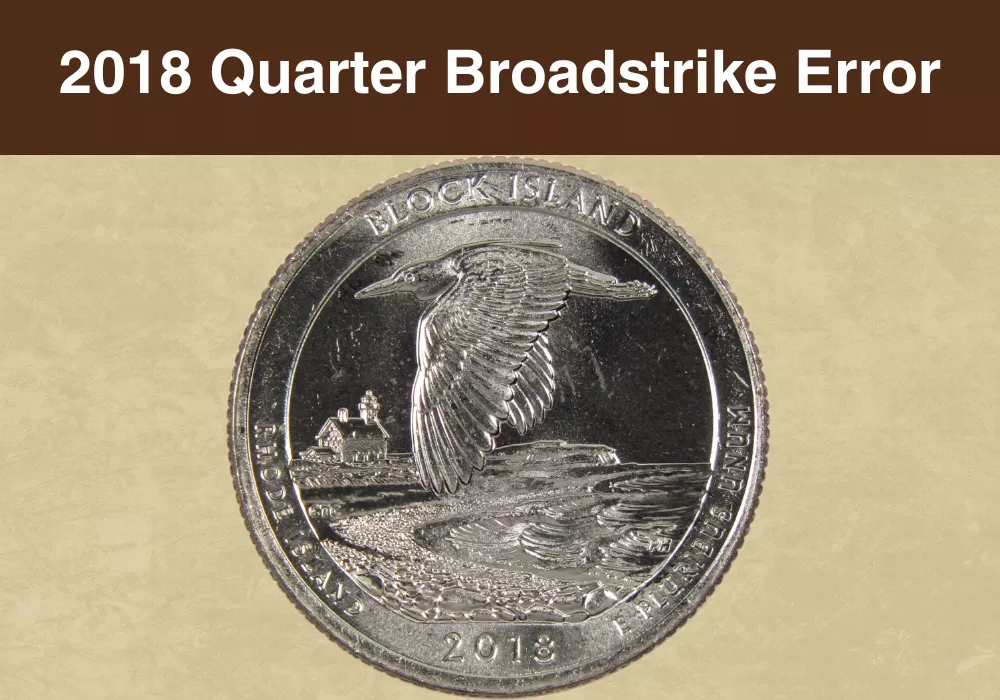
A broadstrike occurs when the retaining collar fails to engage during striking, allowing metal to spread outward freely under full press pressure. The result is a coin wider and thinner than normal with a completely smooth edge where reeding should be.
The entire design remains present and centered — just stretched slightly toward the edges. On modern ATB quarters, broadstrikes are relatively rare because automated quality control catches most collar malfunctions, making any 2018 example a legitimate find worth keeping.
Value: Most broadstruck 2018 quarters sell for $20 to $50 in circulated condition on eBay. Uncirculated examples with full sharp design detail have reached $75 to $100 when certified by PCGS or NGC.
A broadstrike showing additional errors — like a slight off-center shift — commands extra premium. Modern broadstruck quarters are scarcer than pre-2000 examples due to improved mint equipment.
How to Identify: Compare the diameter to a normal quarter’s 24.26mm using calipers — a broadstrike will measure noticeably wider, sometimes reaching 26mm or more. Check the edge: it should be completely smooth with no reeding whatsoever, which is the most obvious visual indicator.
The design should appear complete but pushed outward, with lettering and the portrait slightly closer to the edge than on a normal coin. Weight stays at 5.67g since the same amount of metal is present, just spread thinner across a wider area.
Do not confuse with coins squeezed in a vise, which show distorted design elements rather than a cleanly expanded impression. The fastest confirmation is the smooth edge combined with wider-than-standard diameter measured by calipers.
Use Our 2018 Quarter Value Checker
9. 2018 Block Island Quarter Rotated Die Error (Up to $100)

Every U.S. coin is struck in “medal alignment” — flip it top to bottom and the reverse should appear right-side up. A rotated die error occurs when one die is improperly seated at the wrong angle in the coining press, causing the obverse and reverse designs to be misaligned relative to each other.
Rotations range from a barely perceptible few degrees to a dramatic full 180-degree “coin turn.” Full rotations on modern quarters are genuinely rare due to automated die installation procedures at all three active U.S. Mint facilities.
Value: A 2018 Block Island quarter with a rotated die error sold for $100 on eBay. Minor rotations under 45 degrees typically sell for $10 to $30.
Rotations between 90 and 180 degrees reach $50 to $100 or more. The greater the rotation angle, the higher the price — a clearly measurable 90-degree rotation is the sweet spot for value relative to what actually circulates.
How to Identify: Hold the coin with Washington’s portrait facing you normally, then flip it top to bottom. On a correctly struck quarter, the reverse design should appear right-side up — if it appears at any other angle, you have a rotated die error.
Minor rotations under 15 degrees are hard to detect without a reference coin for direct side-by-side comparison. Lay both coins on a flat surface with identical obverse positioning and compare the reverse alignment carefully.
Weight is 5.67g, diameter 24.26mm, reeded edge — all completely normal on a rotated die error since only the die orientation was wrong, not the striking process. The fastest confirmation is the top-to-bottom flip test against a known normal coin from the same year and mint.
Use Our 2018 Quarter Value Checker
10. 2018 Voyageurs Quarter Off-Center Strike Error (Up to $200)

An off-center strike happens when the planchet isn’t properly seated in the collar before the dies close, leaving a blank crescent-shaped area where metal wasn’t present. A 2018 Voyageurs quarter with a significant off-center shift sold for $200 — the premium reflected visible date retention on a dramatically misaligned strike.
Modern minting machinery catches most misfeeds before coins reach circulation. Any genuine off-center 2018 ATB quarter is scarcer than its pre-2000 counterparts, and the date must remain visible for the coin to command full error pricing.
Value: Mildly off-center 2018 quarters with a 5–10% shift sell for $20 to $50 on eBay. Once the shift reaches 20% or more with the date still visible, prices climb to $75 to $200.
The date is everything — coins missing it due to the off-center shift drop to $5 to $10 because year attribution becomes impossible. The $200 Voyageurs sale represents the documented high point for this error on 2018 ATB quarters.
How to Identify: Look for a blank crescent-shaped area on one side where no design was struck. The struck portion should show normal detail and full depth — not mushy or weak, which would suggest a weak strike instead.
Coin Identifier and Value App
Not sure what your coins are worth? Get Instant Value • Grade • Error Detection with coin identifier and value app (FREE Usage Daily)
Weigh the coin — it should still hit 5.67g since the full planchet is present even though the design isn’t centered. The struck side has reeding while the blank crescent shows a smooth or distorted rim.
Under 10x magnification, genuine off-center strikes show clean metal flow lines where metal pushed outward. The fastest confirmation is full weight combined with a clean blank crescent on one side.
Use Our 2018 Quarter Value Checker
11. 2018 Apostle Islands Quarter Improperly Annealed Error (Up to $250)

Before striking, coin blanks are heated in an annealing furnace to soften the metal for proper die impression. When the heating or cooling process goes wrong — too hot, too cold, or uneven — the planchet develops abnormal coloring and surface texture.
A 2018 Apostle Islands quarter with this error shows reddish-brown and blackish color variations across the surface, with copper core visible in spots where clad bonding was compromised by irregular heat treatment. The color anomaly is structural, not surface contamination.
Value: A 2018 Apostle Islands ATB quarter graded MS-65 with an improperly annealed error sold for $250 on eBay. Raw circulated examples with obvious color anomalies typically sell for $50 to $100.
PCGS or NGC certification at MS-65 or above commands the strongest premiums because it proves the color is a mint error rather than environmental damage. The visual drama of the discoloration drives buyer interest at this level.
How to Identify: Look for unusual color variations — reddish, brownish, or dark patches that don’t match the normal silver-gray appearance of a clad quarter. The discoloration should appear as part of the coin’s structure, not as surface staining.
A genuinely improperly annealed coin often shows a slightly different surface texture — sometimes smoother or more matte than normal. Weight should remain at or very near 5.67g, since significant deviation suggests a different error type entirely.
Environmental damage from chemicals or burial creates pitting and porosity under magnification, while improper annealing produces smooth surfaces with abnormal coloring. The fastest confirmation is abnormal coloring combined with a smooth, pit-free surface under 10x magnification.
Use Our 2018 Quarter Value Checker
12. 2018 Cumberland Quarter Missing Clad Layer Error (Up to $1,200)

Standard quarters are three-layer sandwiches: a pure copper core bonded between two outer layers of 75% copper / 25% nickel alloy. A missing clad layer means one outer layer failed to bond properly during strip preparation at the mill, and when it peels away, the exposed copper core gives one side a distinctly reddish-brown appearance.
A 2018 Cumberland Island quarter missing its reverse clad layer is the most expensive documented error in the entire 2018 ATB series. Cumberland Island’s low mintage among 2018 designs — 138 million from Philadelphia — adds a scarcity factor.
Value: The Cumberland Island missing clad layer sold for $1,200 on eBay, the highest confirmed price for any 2018 ATB error. Full missing clad layers where an entire side shows copper are much rarer than partial peels.
Partial missing clad layers, where a strip or section of nickel surface is absent, sell for $100 to $300 depending on exposed area size. PCGS or NGC certification is essential at four-figure prices.
How to Identify: Weight is the definitive diagnostic — a standard quarter weighs 5.67g, while one missing a clad layer will weigh noticeably less, typically 4.9g to 5.3g. If the coin shows reddish color but still weighs 5.67g, the discoloration is environmental damage rather than a genuine error.
Check the edge for clearly exposed copper on the side where the clad is absent rather than the normal sandwich appearance. Under 10x magnification, genuine missing clad shows smooth copper without pitting or porosity.
Chemical stripping and acid-etching are used to fake this error — they leave tool marks and porous texture that a genuine error doesn’t show. The fastest confirmation is weighing the coin, since anything significantly under 5.67g with visible copper exposure points to a genuine missing clad layer.
Use Our 2018 Quarter Value Checker
Conclusion
The 2018 ATB quarter error market runs from $15 die gouges to a $1,200 missing clad layer on Cumberland Island. Most errors land in the $20 to $100 range — enough to pull from circulation but not retirement money. Cumberland Island errors deserve the closest attention thanks to the design’s lower mintage. A 10x loupe and a digital scale accurate to 0.01g cover identification for every error on this list.