Rare 2018 Dime Errors Worth Money (Full List With Pictures)
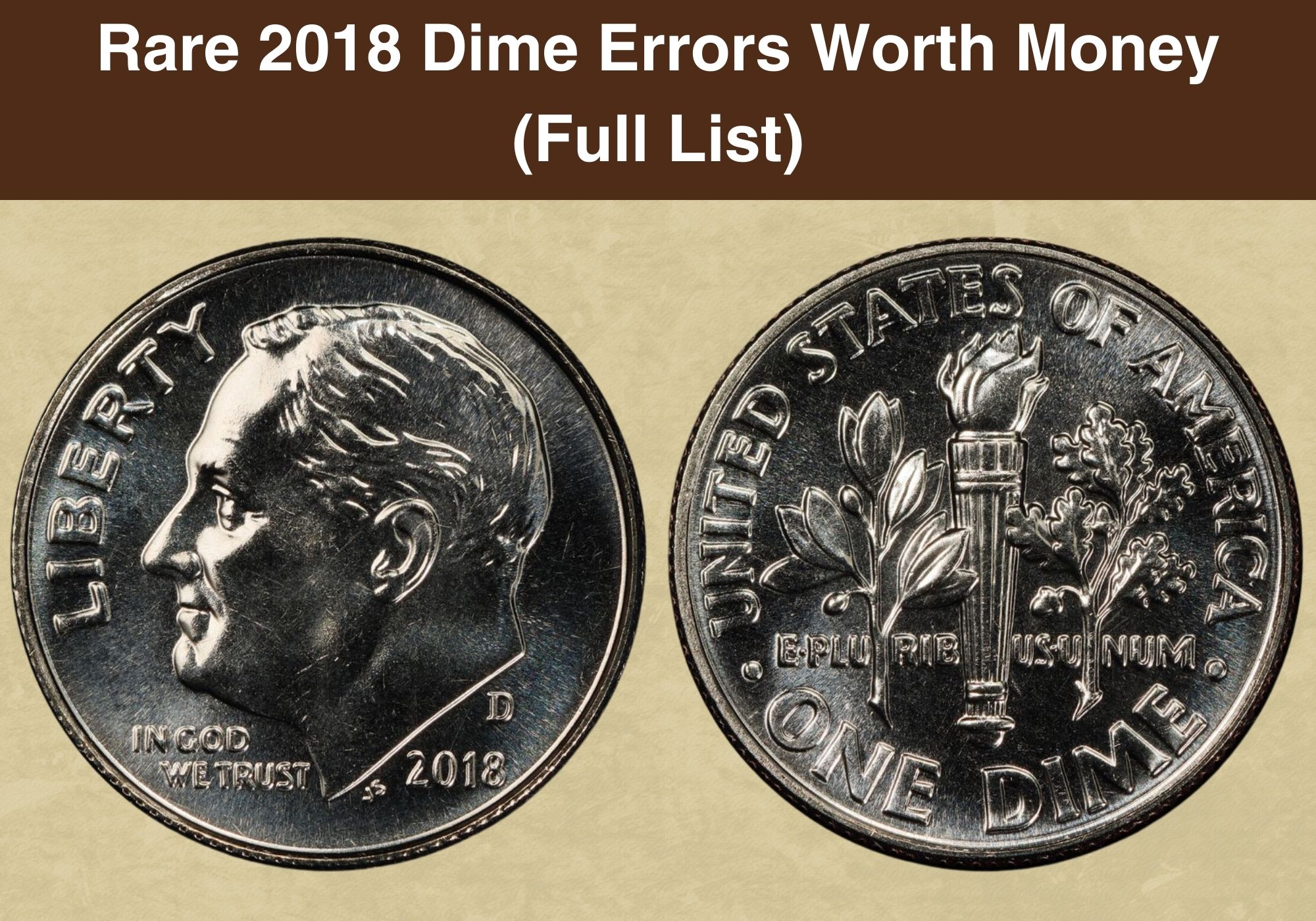
A 2018 Roosevelt dime struck on a steel planchet — the only known example — sold at auction for $1,000. The complete 2018 dime error list covers nine distinct mint mistakes, with values running from $15 off-center strikes and die cuds to a four-figure off-metal coin that shouldn’t exist. The Mint struck over 2.6 billion dimes that year across Philadelphia and Denver, and the production included a “Lightning Bolt” die crack variety that earned its own collector nickname. Here’s every documented error, sorted by value, with auction records and how to identify each one.
1. 2018 Dime Off-Center Strike Error (Up to $15)

Off-center strikes happen when the planchet isn’t seated properly in the striking chamber. The die comes down, but the blank has shifted — only part catches the full impression.
On this 2018 Roosevelt dime, the offset was minor — Roosevelt’s profile shifted slightly to the right, leaving extra space on the left side of the obverse. LIBERTY ended up struck closer to the rim than normal. A small off-center like this adds minimal premium because the visual impact is subtle. Dramatic off-center strikes of 30%+ with visible dates on 2018 dimes would command significantly more, but none have surfaced at major auction yet.
Value: A 2018 Roosevelt dime with a minor off-center strike error sold for $15. Small off-center shifts under 5% on circulated dimes trade for $5–$15. The premium increases with the percentage of displacement — 10–20% off-center pushes $30–$75, and 30%+ with a readable date would likely push past $100. No dramatic 2018 dime off-center has appeared at Heritage or GreatCollections.
How to Identify: Look for an uneven rim width — one side noticeably wider than the other, with a sliver of blank planchet visible on the wide side. The design will be shifted toward the narrow-rim edge, and part of the lettering may be cut off.
Compare against a normally struck 2018 dime side by side. Even small off-centers become obvious when you have a reference coin.
Don’t confuse with a Misaligned Die (MAD), which shows the complete design with uneven rim but nothing missing. An off-center always has some blank planchet showing. Post-mint damage creates uneven distortion with scratches. Fastest confirmation: clean blank crescent with design shifted and date readable.
2. 2018 Dime Die Cud Error (Up to $15)
A die cud forms when a piece of the die’s surface breaks away. Metal fills the void during each strike, leaving a raised lump on the finished coin.
On this 2018 Roosevelt dime, the cud appeared as a small raised bump — modest enough to sell for just $15. Cuds come in all sizes. A tiny nub near the rim barely registers with collectors, while a large cud eating into LIBERTY or Roosevelt’s face would bring substantially more. The $15 price suggests this was a small cud on a circulated coin, sitting in a location that didn’t disrupt any prominent design element.
Value: A 2018 Roosevelt dime with a die cud error sold for $15. Small cuds on circulated dimes trade for $5–$15. Larger cuds that encroach on prominent lettering or design elements push $30–$100+. The more the cud disrupts the visible design, the higher the premium. No large 2018 dime cud has appeared at a major auction house.
How to Identify: Run your finger along the rim and across the design. A cud feels like a raised bump that doesn’t belong. Genuine cuds have a flat, smooth top because they formed under striking pressure.
Post-mint damage looks rough and irregular. Check the design elements near the cud — letters or portrait features adjacent to the break may appear weakened because the broken die couldn’t apply full pressure.
Examine the opposite side behind the cud for a slight depression. Fastest confirmation: smooth flat-topped bump with weakened design adjacent.
3. 2018 Dime Feeder Finger Error (Up to $30)

Feeder fingers are mechanical arms inside the press that position each blank planchet onto the collar before striking. When a finger doesn’t retract fast enough, the die strikes both the planchet and the lingering finger.
The result is a set of parallel lines pressed into the coin’s surface. On 2018 Roosevelt dimes, the finger marks typically cross Roosevelt’s face — parallel grooves running across the portrait that look like deliberate scratch marks but are perfectly uniform in spacing and depth. Feeder finger errors are under-recognized by casual collectors, which keeps prices accessible relative to their actual scarcity.
Value: A 2018 Roosevelt dime with a feeder finger error sold for approximately $30. Feeder finger errors on Roosevelt dimes generally range from $10–$50 depending on the visibility and extent of the line pattern. Bold, well-defined lines on uncirculated coins push toward the top of the range. Faint marks requiring magnification sell for the low end.
How to Identify: Look for a set of parallel, evenly spaced lines running across the coin’s surface. These are distinct from random scratches, which go in multiple directions with varying depth.
The lines usually appear on one side only, most often the obverse across Roosevelt’s face. Check that they’re uniform in depth and spacing — random handling scratches won’t match that consistency.
Post-mint scratches cut through raised and recessed areas unevenly. Feeder finger marks sit at consistent depth because they formed under full striking pressure. Fastest confirmation: parallel, evenly spaced lines on one side with uniform depth.
4. 2018 Dime Smooth Edge Error (Up to $50)
Roosevelt dimes have a reeded edge — 118 vertical grooves around the circumference formed by the collar during striking. A smooth edge error means those reeds are partially or completely missing.
This can happen two ways. If the collar fails entirely during striking, the planchet expands outward and the coin comes out as a broadstrike — wider than normal with a smooth edge. If the collar malfunctions without fully failing, the coin may retain its correct diameter but lose its reeding. The distinction matters. A broadstrike with expanded diameter is the more common version; a correct-diameter smooth-edge dime is rarer and harder to authenticate because post-mint filing can remove reeds.
Value: A circulated 2018 Roosevelt dime with smooth edges sold for $50. Smooth-edge dimes on modern dates generally trade for $25–$75. Professional grading service authentication is important here — CoinValueChecker specifically recommends having smooth-edge coins assessed by a professional to confirm the error is genuine and not artificially created by filing or grinding the reeds off after minting.
How to Identify: Check the edge. A normal dime has 118 reeds — vertical grooves visible to the naked eye and felt by running your fingernail along the edge. A smooth-edge error shows a completely flat, featureless edge.
Measure the diameter with calipers. If it’s over 17.91mm, the coin is a broadstrike with a smooth edge — the collar was absent. If the diameter is exactly 17.91mm but the edge is smooth, the collar malfunctioned without releasing the coin.

Coin Identifier and Value App
Not sure what your coins are worth? Get Instant Value • Grade • Error Detection with coin identifier and value app (FREE Usage Daily)
Examine the smooth area under magnification for tool marks. Post-mint filing leaves directional scratches visible at 10x. A genuine mint error produces a clean, unmarked smooth surface. Fastest confirmation: smooth edge with no tool marks at correct diameter, ideally confirmed by PCGS or NGC.
5. 2018 Dime Doubled Die Error (Up to $100)

A doubled die occurs when the hub impresses its design onto the working die at slightly different positions during manufacturing. Every coin from that die carries the same overlapping design.
On 2018 dimes, the doubling has been documented on both the obverse and reverse. The obverse shows doubling on LIBERTY, IN GOD WE TRUST, and the date “2018.” The reverse shows it on E PLURIBUS UNUM, ONE DIME, and UNITED STATES OF AMERICA. The value range for 2018 DDO/DDR varieties is wide — $5 for barely detectable doubling up to $100 for strong, eye-visible examples — because the intensity varies dramatically between die states.
Value: Examples of 2018 dimes with doubled die errors have sold for $5 to $100 depending on the intensity of the doubling. Strong doubling visible at 5x magnification on uncirculated coins commands the $75–$100 range. Minor doubling requiring 20x to detect brings $5–$20. No specific 2018 DDO or DDR has sold as a headline lot at Heritage or GreatCollections.
How to Identify: Use at least 10x magnification. On the obverse, check LIBERTY letter by letter, the date digits, and IN GOD WE TRUST. On the reverse, examine ONE DIME and E PLURIBUS UNUM for secondary outlines.
True hub doubling shows rounded, separated secondary images with depth. Machine doubling — flat, shelf-like shadows pushed to one side — is extremely common on 2018 dimes and worth nothing.
The Collectors Universe forum documents a 2018-P variety with split serifs on the “T” in UNITED on the reverse. Check that specific diagnostic point. Fastest confirmation: rounded secondary images with depth at known diagnostic points, not flat uniform shadows.
6. 2018 Dime Strike-Through Error (Up to $105)

A strike-through error happens when a foreign object gets trapped between the die and planchet during striking. The object blocks part of the design, leaving its impression on the finished coin.
On this 2018 Roosevelt dime, the foreign object left a vertical impression running from the top of Roosevelt’s head down to his cheek — a long, narrow dent that crosses the most prominent part of the portrait. A strike-through on the face gets more attention than one hiding near the rim or in the field because the disruption to a recognizable feature is immediately obvious. The MS65 grade indicates the coin was otherwise well-preserved.
Value: A 2018 Roosevelt dime graded MS65 with a strike-through error — a vertical impression from head to cheek — sold for $105. Strike-through errors on circulated dimes bring $10–$40. Larger impressions on uncirculated coins with prominent placement push $50–$105. Retained strike-throughs — where the foreign material is still embedded — command the highest premiums.
How to Identify: Look for an impression or mark on Roosevelt’s portrait that doesn’t match the standard design. The mark on this variety runs vertically from the top of the head to the cheek — a long, narrow dent.
The impression should sit within the coin’s surface — pressed in during striking. The area around the impression may show slightly weakened design where the object blocked the die.
Don’t confuse with post-mint scratches, which show metal displacement at their edges. A struck-through impression is smooth and consistent. Fastest confirmation: smooth foreign impression pressed into the surface with weakened design around it.
7. 2018 Dime Missing Clad Layer Error (Up to $225)

Roosevelt dimes are three-layer coins — a copper core between two outer skins of 75% copper / 25% nickel alloy. When contaminants prevent proper bonding at the strip mill, one or both outer layers can separate.
On this 2018 Roosevelt dime, a partial missing clad layer exposed the copper core on a section of the obverse, turning part of Washington’s portrait a vivid reddish-brown. The coin was graded MS64. Complete missing clad — where the entire layer is gone — commands higher prices than partial missing clad. The CoinKnow guide notes that a fully missing clad layer drops the weight to approximately 1.6 grams, compared to the normal 2.27.
Value: A 2018 Roosevelt dime graded MS64 with a partial obverse missing clad layer sold for $225. Circulated examples with smaller exposed copper areas trade for $30–$100. Certified coins with full missing clad on one side push above $225. Dual missing clad — both sides showing copper — would command significantly more but is exceptionally rare.
How to Identify: Color is the first clue. A section of the obverse will appear copper — brassy orange to dark brown — instead of the standard silver.
Weigh it. A standard dime weighs 2.27 grams. A coin missing one full clad layer drops to approximately 1.6–2.0 grams. If your copper-colored dime weighs 2.27 grams, it’s almost certainly acid-treated — worth face value only.
Check the rim for a thin profile or absent cladding band at the copper section. Examine the opposite side — the design may appear weak where the thinner planchet couldn’t fill the die. Fastest confirmation: copper color plus weight well below 2.27 grams.
8. 2018 Dime “Lightning Bolt” Die Crack Error (Up to $600)

Die cracks form when the steel die fractures from repeated stress. Metal fills the fracture and transfers onto each coin as a thin raised line. Most die cracks are generic and barely worth a premium.
Coin Identifier and Value App
Not sure what your coins are worth? Get Instant Value • Grade • Error Detection with coin identifier and value app (FREE Usage Daily)
This one is different. On certain 2018 Roosevelt dimes, a die crack runs from the rim to the top of Roosevelt’s head in a jagged path that mimics a lightning bolt striking the president’s skull. The visual resemblance to a bolt of electricity hitting Roosevelt earned the variety its nickname. Like the “Scarface” die crack on 2016-D nickels and the “Sneezing Washington” on 2010 Hot Springs quarters, the pop-culture visual transforms an ordinary defect into a named collectible.
Value: A circulated 2018 Roosevelt dime with the “Lightning Bolt” die crack sold for $600. That price is driven almost entirely by the visual novelty — a generic die crack of identical length in a less interesting position would bring $10–$30. The nickname creates a built-in collector audience willing to pay multiples of what the error would otherwise command. Uncirculated examples would likely push well past $600.
How to Identify: Look at the top of Roosevelt’s head on the obverse. The “Lightning Bolt” appears as a raised, jagged line running from the rim downward into the portrait — mimicking a bolt of electricity striking his head.
The line should be raised, not recessed. Run your fingernail across it — a die crack catches upward. The jagged path should look natural and lightning-like, not straight or uniform.
Not every die crack on a 2018 dime is the Lightning Bolt variety. The crack must originate near the rim above Roosevelt’s head and run downward in a jagged, branching path. Compare against confirmed Lightning Bolt examples online. Fastest confirmation: raised jagged line from rim to Roosevelt’s head matching the known Lightning Bolt position and path.
9. 2018 Dime Struck on Steel Planchet Error (Up to $1,000)

An off-metal error occurs when a planchet intended for a different purpose ends up in the wrong press. On this 2018 Roosevelt dime, the coin was struck on a steel planchet — a metal the U.S. Mint hasn’t officially used since the 1943 steel Lincoln cent.
A steel planchet weighs approximately 1.5 grams — far lighter than the standard 2.27-gram clad dime blank. Steel is also significantly harder than the copper-nickel clad the dies were designed to strike, which explains why this coin shows a weak strike across the entire design. The CoinValueChecker listing describes it as the only known 2018 dime struck on steel. How a steel blank ended up in a modern dime press is unclear — it may have been an experimental planchet or contamination from a foreign coin production run.
Value: The only known 2018 dime struck on a steel planchet, graded MS60, sold at auction for $1,000. No comparable 2018 steel-planchet dime exists for market comparison. Off-metal errors on modern dimes generally range from $500–$2,000 depending on the planchet type and grade. The uniqueness of this specific off-metal pairing — steel in a clad dime press — drove the price.
How to Identify: The magnet test is definitive. Steel is ferromagnetic — a magnet will stick to it. Normal copper-nickel clad dimes are not magnetic. If a magnet sticks to your 2018 dime, you have something unusual.
Weigh it. This coin weighs 1.5 grams — roughly two-thirds of the standard 2.27 grams. The weight deficit is immediately obvious on a digital scale accurate to 0.01g.
The design will appear weak across the entire surface because steel is harder than clad and resists the die’s impression. The coin may have an unusual luster — steel reflects light differently than copper-nickel. Check that the coin isn’t a foreign coin or token that happens to match the dime’s diameter. Fastest confirmation: magnet sticks to the coin plus weight of approximately 1.5 grams.
Conclusion
The 2018 dime error spectrum runs from $15 off-center strikes and die cuds to a $1,000 steel-planchet dime that may be the only one of its kind. The “Lightning Bolt” die crack at $600 and the missing clad layer at $225 anchor the middle tier. The magnet test on the steel planchet and the weight test on missing clad layers are the two fastest diagnostics you can run. A digital scale, a 10x loupe, a magnet, and a pair of calipers cover the identification basics for all nine error types here.