Rare 2017 Quarter Errors Worth Money (Full List)

A 2017-D Ellis Island quarter with a die gouge nicknamed the “Floating Bottle” sold at Heritage Auctions in 2018 for $465. The complete 2017 quarter error list covers 10 distinct mint mistakes across the America the Beautiful series, with values ranging from $50 grease fills to a three-figure die gouge that put a phantom bottle floating in New York Harbor. Five national park designs rolled off the presses that year — Effigy Mounds, Frederick Douglass, Ozark Riverways, Ellis Island, and George Rogers Clark — and each produced its own set of errors. Here’s every documented error, sorted by value, with auction records and identification details.
1. 2017 Quarter Struck Through Grease Error (Up to $50)
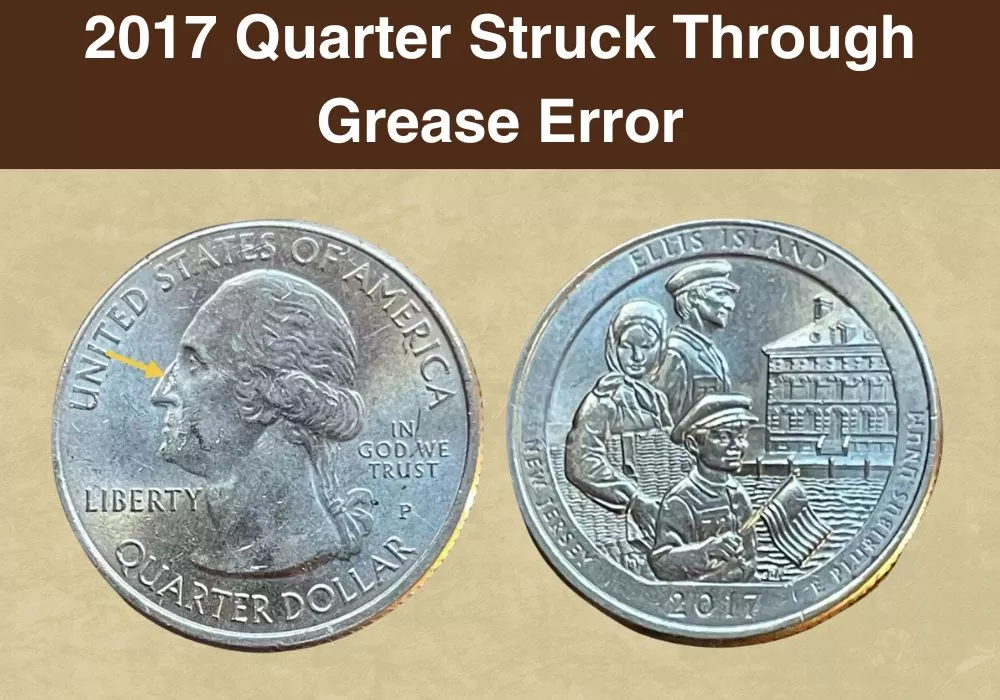
A struck-through error happens when foreign material gets trapped between the die and planchet during striking. Grease — press lubricant pooling in the die’s recessed areas — is the most common culprit on ATB quarters.
The result is a smooth, blank patch where design detail should be. On this 2017-P Frederick Douglass quarter, the grease fill obscured a portion of Washington’s portrait on the obverse. Small grease fills are extremely common across all five 2017 designs. Only large fills that obliterate significant sections of the design attract meaningful buyer interest — a tiny soft spot near the rim barely registers.
Value: In 2021, a 2017-P Frederick Douglass quarter graded MS64 with a grease struck-through error sold for $50. Minor fills on circulated ATB quarters trade for $5–$15. Moderate fills covering a recognizable design element on uncirculated coins push $25–$50. The word “moderate” is doing the heavy lifting in that price range — large fills on high-grade coins can push past $50 but no documented 2017 quarter has cracked $100 on grease alone.
How to Identify: Look for a localized area where the design appears weak, mushy, or entirely absent — a smooth blank zone surrounded by otherwise normal detail. The boundaries should be relatively sharp, not a gradual fade.
Grease fills produce featureless, smooth patches. Don’t confuse with circulation wear, which spreads evenly across all high points. On 2017 quarters, check the detailed reverse park designs — intricate scenes like the Ozark river or Effigy Mounds earthworks have deep die recesses where grease pools.
Make sure the entire coin isn’t weak, which would indicate a different error (die adjustment or improper annealing). Fastest confirmation: sharply defined smooth zone surrounded by normal strike quality on all sides.
Use Our 2017 Quarter Value Checker
2. 2017 Quarter Off-Center Strike Error (Up to $80)
Off-center strikes happen when the planchet isn’t seated properly in the striking chamber. The die comes down, but the blank has shifted — only part of it catches the full impression.
On this 2017-D Ellis Island quarter, the design shifted 10% off-center. A 10% shift is modest — barely visible without comparing to a normally struck coin. The Statue of Liberty reverse on the Ellis Island design makes even minor off-centers identifiable because the statue provides a clear vertical reference line for alignment. Larger off-centers on 2017 quarters with readable dates would command significantly more.
Value: In 2018, Heritage Auctions sold a 2017-D Ellis Island quarter graded MS68 with a 10% off-center strike for $80. The MS68 grade inflated the price — a lower-grade example at the same off-center percentage would bring less. Minor off-center strikes under 10% on ATB quarters trade for $15–$45. Dramatic 30%+ off-centers with visible dates push past $150, but no 2017 quarter at that level has surfaced at major auction.
How to Identify: Look for a clean crescent of blank, featureless metal on one side. The design will be shifted toward the opposite edge, with part of the lettering or portrait cut off. Both obverse and reverse shift the same direction.
At 10%, the shift is subtle. Compare against a normally struck 2017 quarter — the uneven rim width is the tell. Don’t confuse with a Misaligned Die (MAD), which shows the complete design with uneven rim but nothing missing.
On ATB quarters, check which reverse design is identifiable. Collectors want design-specific attribution. Fastest confirmation: clean blank crescent with design shifted and date readable.
Use Our 2017 Quarter Value Checker
3. 2017 Quarter Struck Through Cloth Error (Up to $95)
A cloth strike-through occurs when a piece of fabric gets trapped between the die and planchet during striking. The cloth compresses under the die’s force and leaves its weave pattern impressed into the metal.
Unlike a grease fill, which creates a featureless blank patch, cloth leaves a recognizable texture — the crosshatch pattern of woven fibers pressed into the coin. On this 2017 George Rogers Clark quarter, the textile impression appeared on the reverse near the historical scene. Cloth strike-throughs are less common than grease fills because fabric in the press represents a more unusual contamination event.
Value: In 2019, a 2017 George Rogers Clark quarter graded MS60 with a cloth struck-through error sold for $95. Cloth strike-throughs on ATB quarters generally range from $50–$150 depending on the clarity of the textile impression and the coin’s grade. Retained examples — where the cloth is still physically embedded — would command more. The identifiable weave pattern is what separates this from a generic strike-through and justifies the premium over grease fills.
How to Identify: Look for a regular crosshatch or grid pattern impressed into the coin’s surface. The weave creates a texture that looks distinctly different from a smooth grease fill or random damage.
Use at least 10x magnification. The lines should form a consistent woven grid — horizontal and vertical threads crossing at regular intervals. This regularity distinguishes cloth strike-throughs from random scratches.
The impression should sit within the design, not on top of it — the cloth was struck in during minting. Post-mint fabric impressions from storage or handling would sit loosely on the surface. Fastest confirmation: regular woven crosshatch pattern impressed into the metal surface.
Use Our 2017 Quarter Value Checker
4. 2017 Quarter Rim Cud Error (Up to $116)
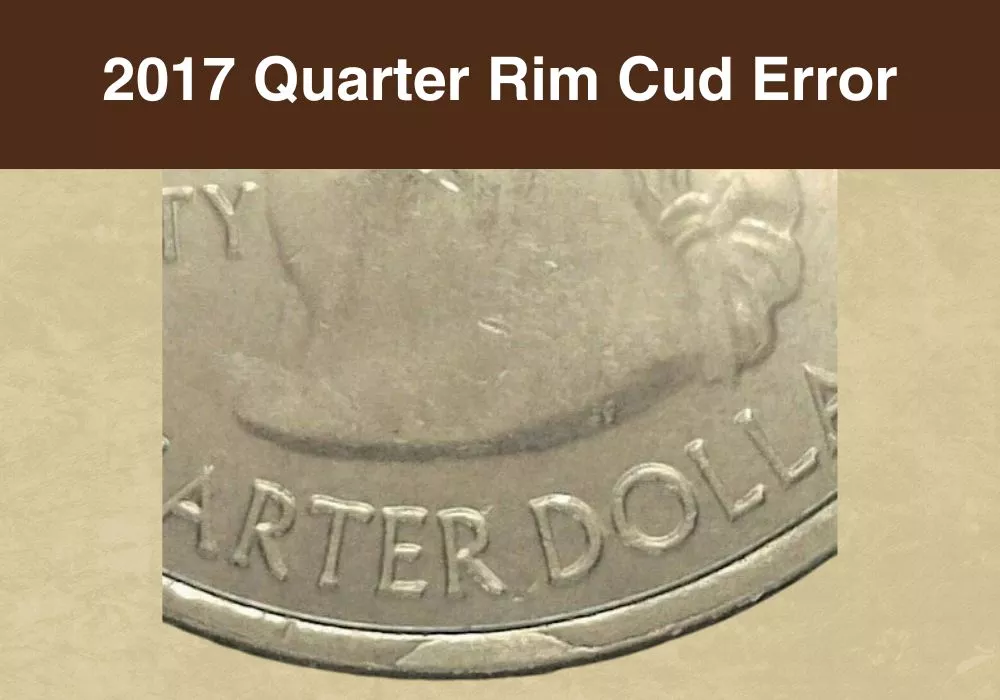
A rim cud forms when a chunk of the die’s edge breaks away completely. Metal flows into the void during striking and creates a raised, blob-like bump along the rim.
On this 2017-P George Rogers Clark quarter, the cud appeared on the reverse near the historical scene. Cuds vary in size — some are barely noticeable nubs, others large enough to eat into nearby lettering. George Rogers Clark quarters produced three of the top ten 2017 quarter errors, suggesting the dies for this particular design experienced more stress or had longer production runs than the other four designs.
Value: In 2021, a 2017-P George Rogers Clark quarter graded MS60 with a rim cud error sold on eBay for $116. Smaller cuds on circulated ATB quarters trade for $20–$50. Larger cuds that encroach on prominent design elements push $60–$116 in uncirculated grades. Size and location together determine where the price lands — a cud overlapping QUARTER DOLLAR outsells one in empty rim space.
How to Identify: Run your finger along the rim. A cud feels like a raised bump that disrupts the smooth edge. Genuine cuds have a flat, smooth top — they formed under striking pressure.
Post-mint damage looks rough and jagged. Check the design elements near the cud — letters or park scene details adjacent to the break may appear weakened because the broken die couldn’t apply full pressure.
Examine the opposite side behind the cud. A slight depression or weakness at the corresponding position helps confirm it. Fastest confirmation: smooth flat-topped bump at the rim with weakened design adjacent.
Use Our 2017 Quarter Value Checker
5. 2017 Quarter Improperly Annealed Error (Up to $130)

Before striking, metal planchets go through annealing — a heat treatment that softens them for proper die impression. When the temperature or duration is wrong, the planchet’s surface chemistry changes, producing unusual coloring.

Coin Identifier and Value App
Not sure what your coins are worth? Get Instant Value • Grade • Error Detection with coin identifier and value app (FREE Usage Daily)
On this 2017-D Frederick Douglass quarter, the annealing failure produced a coin with distinctly abnormal tones — not the standard silver of a normal quarter. The 75/25 copper-nickel clad composition reacts to temperature variations by shifting color. Depending on severity, improperly annealed quarters can range from subtly off-color to dramatically dark, purple, or multicolored. Frederick Douglass quarters from Denver seem to be the primary source for this error in the 2017 series.
Value: In 2018, Heritage Auctions sold a 2017-D Frederick Douglass quarter graded MS66 with an improperly annealed error for $130. Circulated examples with obvious discoloration trade for $20–$60. Dramatic color shifts on uncirculated coins push $75–$130. The more visually different the coin looks from a normal quarter, the higher the price.
How to Identify: Check the overall color. An improperly annealed quarter displays unusual hues — dark gray, charcoal, purple, yellow, or multicolored tones — across the entire coin.
Weigh it: should still be 5.67 grams. The planchet is correct, just improperly heated. Don’t confuse with environmental toning, which creates surface-level color changes from exposure. Annealing errors produce uniform discoloration from the manufacturing process itself.
Look for intact mint luster under the unusual color. A genuine annealing error retains cartwheel luster despite the color shift. Environmental damage typically kills luster and leaves a matte surface. Fastest confirmation: uniform unusual color across the entire coin with intact cartwheel luster at correct weight.
Use Our 2017 Quarter Value Checker
6. 2017 Quarter Missing Clad Layer Error (Up to $200)

Washington quarters are three-layer coins — a copper core between two outer skins of 75% copper / 25% nickel alloy. When contaminants prevent proper bonding at the strip mill, one or both outer layers can separate.
On this 2017-P Effigy Mounds quarter, the missing clad layer exposed the copper core on the obverse, turning Washington’s portrait a vivid reddish-brown. The reverse Effigy Mounds design — showing the aerial view of the ancient earthworks — struck normally, making the contrast between a copper obverse and silver reverse immediately eye-catching. Partial missing clad errors, where only part of the layer separated, are more common than full-face missing clad.
Value: In 2020, a 2017-P Effigy Mounds quarter graded MS65 with a partial obverse missing clad layer sold at an online auction for $200. Circulated examples with smaller areas of exposed copper trade for $30–$100. Certified coins with full missing clad on one side push $100–$200. Dual missing clad — both sides showing copper — would command well above $200 but is exceptionally rare.
How to Identify: Color is the first clue. One side will appear copper — brassy orange to dark brown — instead of the standard silver tone.
Weigh it. A standard quarter weighs 5.67 grams. A coin missing one clad layer will be noticeably lighter — roughly 4.9–5.2 grams. If your copper-colored quarter weighs the full 5.67 grams, it’s likely acid-treated, not a genuine mint error.
Check the rim for a thin profile or absent cladding band. Examine the opposite side — the design may appear weak where the thinner planchet couldn’t fill the die. Fastest confirmation: copper color plus weight well below 5.67 grams.
Use Our 2017 Quarter Value Checker
7. 2017 Quarter Die Chip Error (Up to $312)

Die chips form when small fragments break off the striking die’s surface. Metal fills the void and transfers as a raised blob onto every coin the damaged die strikes.
On this 2017-D George Rogers Clark quarter, multiple die chips appeared simultaneously on the same coin — several raised blobs scattered across the design rather than a single isolated chip. Multiple chips on one coin indicate an advanced-state die that was well past its prime but kept running. The accumulation of defects creates a visually busier coin than a single chip, and that multiplied visual impact drove the price well above the typical $10–$50 range for individual chips.
Value: In 2019, a 2017-D George Rogers Clark quarter graded MS62 with multiple die chip errors sold at an online auction for $312. Single chips on circulated coins trade for $10–$40. Multiple chips on the same coin multiply the premium — especially when they affect prominent design elements. The MS62 grade on this example was modest; the quantity and placement of the chips carried the price.
How to Identify: Use a 5x loupe and scan for raised, irregular metal blobs that don’t belong to the original design. Each chip will be smooth and rounded on top.
Compare to a normal 2017 George Rogers Clark quarter side by side. Any extra raised material that doesn’t match the standard design warrants closer examination. Check both obverse and reverse — chips can appear on either side.
Run your fingernail across each blob. Die chips catch upward. Contact marks catch downward or feel flat. Fastest confirmation: multiple smooth raised blobs with matching luster, all on the same coin.
Use Our 2017 Quarter Value Checker
8. 2017 Quarter Die Crack Error (Up to $400)

Die cracks form when the steel die fractures from repeated stress and heat cycles. Metal fills the fracture and transfers onto each coin as a thin raised line across the surface.
On this 2017-P Frederick Douglass quarter, the crack ran through a major design element prominently enough to command $400 at auction. Frederick Douglass quarters from Philadelphia appear disproportionately in the 2017 error population — this design accounts for two of the top five errors on this list. Whether the Douglass dies were particularly stressed or ran longer shifts is unclear, but the pattern is there.
Value: In 2018, a 2017-P Frederick Douglass quarter graded MS63 with a die crack error sold at an online auction for $400. Small peripheral cracks add $10–$40. Dramatic cracks through major design elements on uncirculated coins reach $100–$400. The $400 price reflects a large, prominent crack on a popular ATB design.
How to Identify: Look for thin, raised lines running across the coin’s surface. Die cracks sit above the metal — run your fingernail perpendicular across a suspected line and it should catch upward.
Use a loupe to trace the full length. Die cracks follow irregular, jagged paths. Check both sides — dual-sided cracks bring higher prices.
If the crack reaches the rim and a chunk has broken away leaving a raised blob, that’s a cud — listed separately above. Don’t confuse with scratches, which are recessed. Fastest confirmation: raised irregular line you can feel with a fingernail.
Use Our 2017 Quarter Value Checker
9. 2017 Quarter Doubled Die Error (Up to $400)

Coin Identifier and Value App
Not sure what your coins are worth? Get Instant Value • Grade • Error Detection with coin identifier and value app (FREE Usage Daily)
A doubled die occurs when the hub impresses its design onto the working die at slightly different positions during manufacturing. Every coin struck by that die inherits the same overlapping design.
On this 2017-P Ozark Riverways quarter, the doubling appeared on both the obverse and reverse — a dual-side DDO+DDR combination. The obverse shows doubling on LIBERTY and IN GOD WE TRUST, while the reverse shows it on the Ozark river scene inscriptions. Dual-side doubling from the same coin is less common than single-side varieties because it requires both the obverse and reverse dies to have been affected by hub misalignment.
Value: Heritage Auctions sold a 2017-P Ozark Riverways quarter graded MS65 with an obverse and reverse doubled die error for $400. Minor doubled dies on circulated ATB quarters trade for $25–$75. Strong doubling visible under low magnification on uncirculated coins pushes $100–$400. The dual-side DDO+DDR combination and the MS65 grade drove this example to the top.
How to Identify: Use at least 10x magnification. On the obverse, check LIBERTY and IN GOD WE TRUST letter by letter. On the reverse, examine the Ozark Riverways inscriptions and the river scene details for secondary outlines.
True hub doubling shows rounded, separated secondary images with depth. Machine doubling — flat, shelf-like shadows — is extremely common on 2017 quarters and worth nothing.
Check both sides. If only one side shows doubling, it’s still a DDO or DDR. If both sides show it, you have a more valuable dual-variety coin. Compare against known 2017 DDO/DDR variety photos. Fastest confirmation: rounded secondary images with depth on both sides at known diagnostic points.
Use Our 2017 Quarter Value Checker
10. 2017 Quarter Die Gouge “Floating Bottle” Error (Up to $465)

A die gouge is a deep, linear scratch cut into the die’s striking surface during maintenance. Unlike die cracks, which follow internal stress lines, gouges run in straighter paths because they were physically scraped by a tool.
On 2017-D Ellis Island quarters, a specific die gouge on the reverse created an image that looks like a bottle floating in the water of New York Harbor, near the base of the Statue of Liberty. The gouge’s position and shape — narrow at the top, wider at the bottom — mimic a glass bottle bobbing in the waves. This is a nickname error, similar to the 2016 “Cat on the Roof” and 2016 nickel “Scarface.” The visual association gives an otherwise ordinary die gouge outsized collector appeal.
Value: In 2018, Heritage Auctions sold a 2017-D Ellis Island quarter graded MS65 with the “Floating Bottle” die gouge for $465 — the highest confirmed price for any 2017 ATB quarter error. Generic die gouges on 2017 quarters without a recognizable shape trade for $15–$75. The nickname drives the entire premium. Other 2017 Ellis Island quarters with die gouges in different positions bring a fraction of this price because they lack the visual punch.
How to Identify: Flip to the reverse of a 2017-D Ellis Island quarter and examine the water area at the base of the Statue of Liberty. The “Floating Bottle” appears as a raised, linear mark in the harbor — narrow at one end, wider at the other, roughly resembling a glass bottle.
The mark should be raised, not recessed. Run your fingernail across it — a die gouge catches upward because metal fills the groove during striking. Post-mint scratches catch downward.
Compare against known “Floating Bottle” examples online. The gouge needs to be in the specific water-area position to qualify for the nickname. Not every die gouge on an Ellis Island quarter is the Floating Bottle — only the ones in the right spot. Fastest confirmation: raised linear mark in the harbor area of a 2017-D Ellis Island reverse, matching the known bottle shape and position.
Use Our 2017 Quarter Value Checker
Conclusion
The 2017 ATB quarter error spectrum runs from $50 grease fills at the low end to a $465 “Floating Bottle” die gouge on the Ellis Island design. Heritage Auctions provides the most reliable documentation, with four lots anchoring the upper half of the price range. The doubled die on Ozark Riverways at $400 and the die crack on Frederick Douglass at $400 share the second tier. A digital scale, a 10x loupe, and side-by-side comparison with a normal coin cover the identification basics for all 10 error types here.