Rare 2012 Quarter Errors Worth Money (Full List)
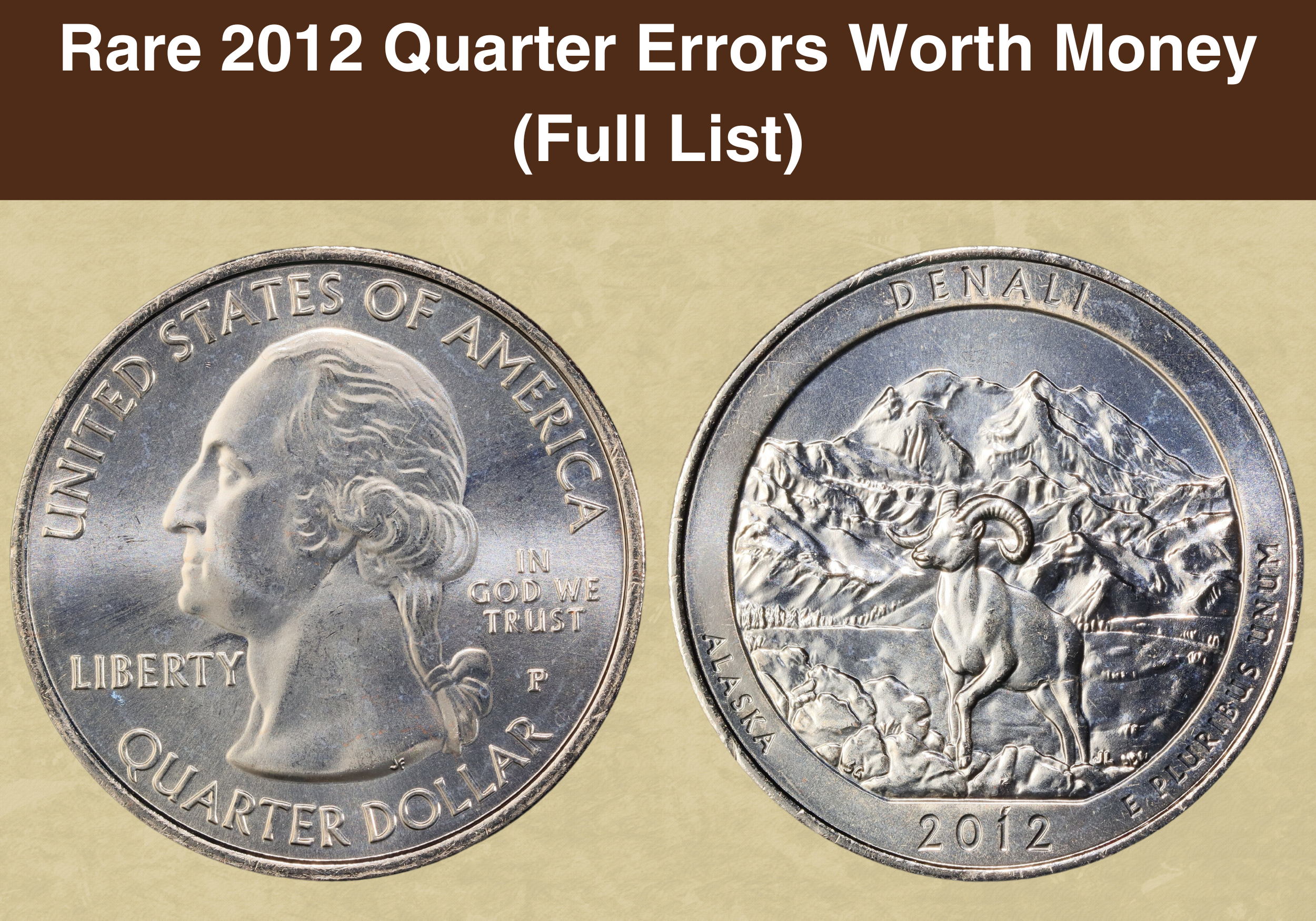
A 2012-P Denali quarter with a strike-through error sold at Heritage Auctions in 2015 for $1,200. The complete 2012 quarter error list covers eight distinct mint mistakes across the America the Beautiful series, with values running from $310 improperly annealed coins to three separate errors that crossed the $1,000 mark. The 2012 ATB quarters had some of the lowest mintages in the entire program — as few as 21.6 million per design from Denver — and that scarcity inflates every error from this date. Here’s every documented error, sorted by value, with auction records and identification details.
1. 2012 Quarter Improperly Annealed Error (Up to $310)
Before striking, metal planchets go through annealing — a heat treatment that softens them for proper die impression. When the temperature or duration is wrong, the planchet’s surface chemistry changes, producing a coin with unusual coloring.
On this 2012-P Denali quarter, the annealing failure produced a coin with dramatically abnormal tones instead of the standard silver. Denali’s mountain and Dall sheep reverse design appears in muted or altered color against an improperly heated planchet, making the visual disruption immediately obvious. The 75/25 copper-nickel clad composition reacts to temperature fluctuations by shifting color — dark gray, charcoal, purple, yellow, or multicolored tones depending on severity.
Value: In 2020, a 2012-P Denali quarter graded MS63 with an improperly annealed error sold on eBay for $310. On common ATB dates, comparable annealing errors bring $30–$100. The 2012 low-mintage premium roughly triples the normal range. Dramatic color shifts on uncirculated coins push $150–$310. Subtle discoloration that’s hard to distinguish from toning trades at the low end.
How to Identify: Check the overall color. An improperly annealed quarter displays unusual hues across the entire coin — not patchy spots, but a uniform shift from the standard silver.
Weigh it: should still be 5.67 grams. The planchet is correct, just improperly heated. Look for intact cartwheel mint luster under the unusual color. A genuine annealing error retains this luster despite the color shift. Environmental damage produces dark coins too, but they look matte and lifeless.
Don’t confuse with artificial toning or chemical damage, which creates uneven coloration and surface residue. Fastest confirmation: uniform unusual color across the entire coin with intact cartwheel luster at correct weight.
Use Our 2012 Quarter Value Checker
2. 2012 Quarter Doubled Die Reverse Error (Up to $350)

A doubled die occurs when the hub impresses its design onto the working die at slightly different positions during manufacturing. Every coin struck by that die carries the same overlapping design.
The 2012-P Denali National Park quarter is the most documented DDR in the entire ATB series. The doubling appears on the reverse inscriptions — DENALI and E PLURIBUS UNUM — and on the mountain and tree details. The Denali design’s fine landscape elements amplify even small hub shifts into visible splitting. Multiple DDR varieties exist for this design, making it a productive date for variety collectors to cherrypick through.
Value: In 2020, a collector paid $350 for a 2012-P Denali quarter graded MS63 with a strong doubled die reverse error. Minor DDR varieties with subtle doubling trade for $20–$100. Strong, well-defined examples in uncirculated condition push past $200. The $350 price reflects a particularly bold example with clearly separated secondary images. Grade and doubling strength together determine where a specific coin falls.
How to Identify: Use at least 10x magnification and focus on the reverse. Check DENALI letter by letter, E PLURIBUS UNUM, and the mountain contour lines for secondary outlines. True DDR doubling shows rounded, separated secondary images with depth.
Machine doubling — flat, shelf-like shadows pushed to one side — is common on 2012 quarters and worth nothing. The 2012-P Hawai’i Volcanoes quarter also shows reported doubling on the obverse, but most of these are die deterioration, not true doubled dies — worth only $4–$10.
Compare against known 2012 Denali DDR variety photos online. The doubling direction and affected elements should match documented diagnostic positions. Fastest confirmation: rounded split secondary images on DENALI lettering, not flat shadows.
Use Our 2012 Quarter Value Checker
3. 2012 Quarter Die Clash Error (Up to $535)
A die clash happens when the obverse and reverse dies strike each other without a planchet between them. The force transfers a mirror image of each die’s design onto the opposing die face.
On this 2012-P Chaco Culture quarter, the clash produced visible ghost images from one side onto the other. The Chaco Culture reverse — showing the ancient Pueblo Bonito ruins with their distinctive curved walls — creates recognizable ghost patterns. The curved architectural lines of the pueblo transfer as faint arc-shaped impressions onto the obverse field, which makes this clash easier to identify than clashes on simpler designs.
Value: In 2021, Heritage Auctions sold a 2012-P Chaco Culture quarter graded MS63 with a die clash error for $535. On common ATB dates, die clashes bring $50–$200. The 2012 low-mintage premium and the Heritage provenance pushed this example to $535. Strong clashes visible to the naked eye on uncirculated coins command the top of the range.
How to Identify: Look for faint design elements that don’t belong on that side of the coin. On a Chaco Culture clash, the curved pueblo wall lines ghosting behind Washington’s portrait on the obverse are the tell.
The ghost images are incuse (sunken), not raised. Use angled lighting — tilt the coin slowly under a desk lamp and watch for outlines emerging in the field. Clash marks often only reveal themselves at specific light angles.
Don’t confuse with strike-throughs, which create blank areas. A clash produces a recognizable reversed mirror image. The curved Chaco ruins give this particular clash a distinctive pattern. Fastest confirmation: recognizable curved pueblo wall lines ghosting on the obverse under angled light.
Use Our 2012 Quarter Value Checker
4. 2012 Quarter Rim Cud Error (Up to $610)
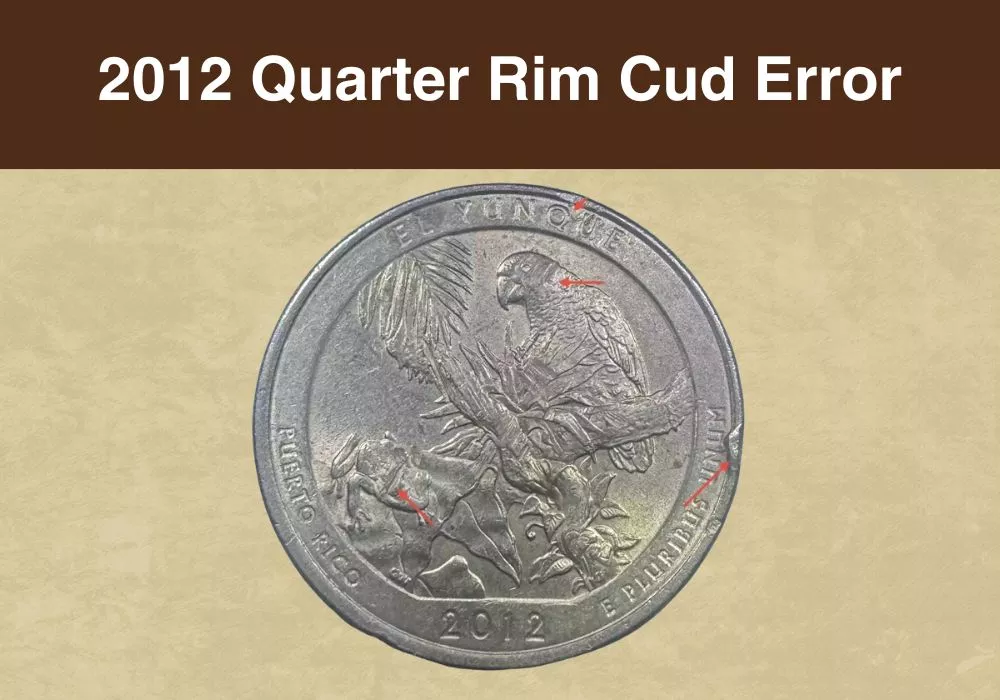
A rim cud forms when a chunk of the die’s edge breaks away completely. Metal flows into the void during striking, creating a raised, blob-like bump along the rim.
On this 2012-D Acadia quarter, the cud was large enough to encroach on the reverse design. The Acadia reverse features Bass Harbor Head Lighthouse against a rocky coastline — a design with clear horizontal lines and architectural details that make rim disruption visually obvious. eBay records confirm $610 for this example, a strong price driven by the cud’s size, the MS64 grade, and the 2012 low mintage.

Coin Identifier and Value App
Not sure what your coins are worth? Get Instant Value • Grade • Error Detection with coin identifier and value app (FREE Usage Daily)
Value: In 2022, a 2012-D Acadia quarter graded MS64 with a rim cud error sold on eBay for $610. On common ATB dates, rim cuds bring $50–$200. The 2012 low mintage inflates the premium. Small cuds on circulated 2012 quarters trade for $75–$200. Large cuds obscuring nearby design elements on uncirculated coins push $300–$610.
How to Identify: Run your finger along the rim. A cud feels like a raised bump that disrupts the smooth edge. Genuine cuds have a flat, smooth top — they formed under striking pressure.
Post-mint damage looks rough and irregular. Check design elements near the cud — letters or lighthouse details adjacent to the break may appear weakened because the broken die couldn’t apply full pressure.
Examine the opposite side behind the cud for a slight depression or weakness at the corresponding position. Fastest confirmation: smooth flat-topped bump at the rim with weakened design adjacent.
Use Our 2012 Quarter Value Checker
5. 2012 Quarter Off-Center Strike Error (Up to $720)
Off-center strikes happen when the planchet isn’t seated properly in the striking chamber. The die comes down, but the blank has shifted — only part catches the full impression.
On this 2012-D El Yunque quarter, the design shifted 30% off-center. That’s dramatic — a third of the coin is blank metal. The El Yunque reverse shows a Puerto Rican parrot against a tropical rainforest backdrop, and at 30% off-center a significant portion of the parrot and forest canopy disappears into the blank crescent. GreatCollections sold this one for $720, reflecting both the displacement percentage and the 2012 low-mintage premium.
Value: In 2021, GreatCollections auctioned a 2012-D El Yunque quarter graded MS63 with a 30% off-center strike for $720. On common ATB dates, 30% off-centers bring $100–$300. The 2012 low-mintage premium roughly doubles the normal range. Minor off-center strikes under 10% trade for $30–$100 on this date. A readable date is critical for value.
How to Identify: Look for a clean crescent of blank, featureless metal on one side. The design shifts toward the opposite edge, with part of the lettering or portrait cut off. Both obverse and reverse shift the same direction.
At 30%, the crescent is obvious and covers a large area. Don’t confuse with a Misaligned Die (MAD), which shows the complete design with uneven rim but nothing missing. An off-center always has blank planchet showing.
Check which reverse design is identifiable — on ATB quarters, the design identity adds attribution value. Fastest confirmation: clean blank crescent with design shifted and date readable.
Use Our 2012 Quarter Value Checker
6. 2012 Quarter Die Chip Error (Up to $1,010)

Die chips form when small fragments break off the striking die’s surface. Metal fills the void and transfers as a raised blob onto every coin the damaged die strikes.
On this 2012-D El Yunque quarter, the die chip was large and prominently placed — significant enough to drive the price past $1,000 at Heritage Auctions. El Yunque quarters from Denver had a mintage of just 25 million, which is a fraction of typical ATB production. A $1,010 die chip is unusual — on common dates, even large chips rarely crack $100. The combination of low mintage, MS65 grade, and an aggressively placed chip on the reverse pushed this coin into four figures.
Value: Heritage Auctions sold a 2012-D El Yunque quarter graded MS65 with a reverse die chip error for $1,010. That’s one of the highest prices ever paid for a die chip on any modern quarter. On common ATB dates, large die chips bring $30–$150. On 2012 quarters, the low-mintage premium inflates the range to $100–$1,010. Size, placement, and grade together determine where a specific coin falls.
How to Identify: Use a 5x loupe and scan for raised, irregular metal blobs on the reverse that don’t belong to the El Yunque design. Die chips look like smooth, rounded bumps sitting on top of the parrot, forest, or inscriptions.
Compare to a normal 2012-D El Yunque quarter. Any extra raised material that doesn’t match the standard design warrants closer examination.
Run your fingernail across the suspected chip. Die chips catch upward — they’re raised. Contact marks catch downward. The blob should have the same luster as the surrounding coin. Fastest confirmation: smooth raised blob with matching luster on the reverse, confirmed by comparison to a normal example.
Use Our 2012 Quarter Value Checker
7. 2012 Quarter Overdate Error (Up to $1,120)
An overdate error occurs when a digit in the date is punched over a different digit on the working die. On this 2012-P Hawai’i Volcanoes quarter, the number “1” was re-punched over the “0” in the date, turning “2012” into what appears to read “2112.”
Overdates on modern coins are extraordinarily rare. The Mint engraves dates on master dies using automated equipment — the entire system is designed to prevent exactly this. When one slips through, it represents a failure of multiple quality control layers. The “2112” overdate on a Hawai’i Volcanoes quarter is the only documented example in the 2012 ATB series, and overdate errors haven’t been seen on any other ATB quarter year.
Value: In 2020, GreatCollections auctioned a 2012-P Hawai’i Volcanoes quarter graded MS64 with the overdate error (2112/2012) for $1,120. No comparable overdate exists on any other modern ATB quarter. The error’s uniqueness — the only confirmed overdate in the series — drives the premium independent of any mintage considerations. If a higher-grade example surfaces, it would likely exceed this price.
How to Identify: Focus on the date “2012” on the obverse. Use at least 10x magnification and examine the second digit from the left — the “0.” On the overdate variety, you’ll see traces of the digit “1” punched over or adjacent to the “0,” creating the appearance of “2112.”
Coin Identifier and Value App
Not sure what your coins are worth? Get Instant Value • Grade • Error Detection with coin identifier and value app (FREE Usage Daily)
The overdate impression should show raised metal consistent with a die-struck impression. It should appear the same on every coin struck by that die — this is a die variety, not random damage.
Don’t confuse with post-mint scratches near the date, which create recessed marks. The overdate produces a raised secondary digit. Compare against documented photos of the confirmed 2112/2012 variety. Fastest confirmation: visible raised “1” overlapping the “0” in the date, matching the known overdate diagnostic position.
Use Our 2012 Quarter Value Checker
8. 2012 Quarter Strike-Through Error (Up to $1,200)

A strike-through error happens when a foreign object gets trapped between the die and planchet during striking. The object blocks part of the design, leaving its impression on the finished coin.
On this 2012-P Denali quarter, a foreign object was struck into the coin’s surface during minting — Heritage Auctions sold it for $1,200 in 2015, the highest price for any 2012 ATB quarter error. The MS65 grade means the coin was otherwise well-preserved despite the struck-in defect. Denali quarters from Philadelphia had a mintage of just 24.8 million, so the error pool is inherently smaller than on higher-volume dates — fewer coins minted means fewer error survivors.
Value: In 2015, Heritage Auctions sold a 2012-P Denali quarter graded MS65 with a strike-through error for $1,200 — the highest confirmed price for any 2012 ATB quarter error. Strike-through errors on common ATB dates bring $50–$400. The combination of MS65 grade, Heritage provenance, and 2012’s low mintage pushed this example to four figures. Retained strike-throughs — where the foreign material is still embedded — would command even more.
How to Identify: Look for an impression or mark that doesn’t match the standard Denali design. The struck-through area may appear as a thin line (hair or fiber), an irregular patch (debris), or a textured area (cloth weave).
The impression should sit within the coin’s surface — pressed in during striking — not on top of it. The area around the impression may show slightly weakened design where the foreign object blocked the die.
Don’t confuse with post-mint scratches, which cut into the surface with visible metal displacement. A struck-through impression is smooth, consistent, and shows matching design weakness around it. Fastest confirmation: foreign impression pressed into the surface with weakened design in the surrounding area.
Use Our 2012 Quarter Value Checker
Conclusion
The 2012 ATB quarter error spectrum runs from $310 improperly annealed coins to a $1,200 strike-through that tops every other ATB quarter year on record. Three errors crossed $1,000 — the die chip at $1,010, the overdate at $1,120, and the strike-through at $1,200 — making 2012 the undisputed high-value year in the America the Beautiful series. The overdate (2112/2012) on the Hawai’i Volcanoes design is the rarest error type on this list and the only confirmed overdate in the entire ATB program. A digital scale, a 10x loupe, and side-by-side comparison with a normal coin cover the basics for all eight error types here.