Rare 2011 Quarter Errors Worth Money (Full List)
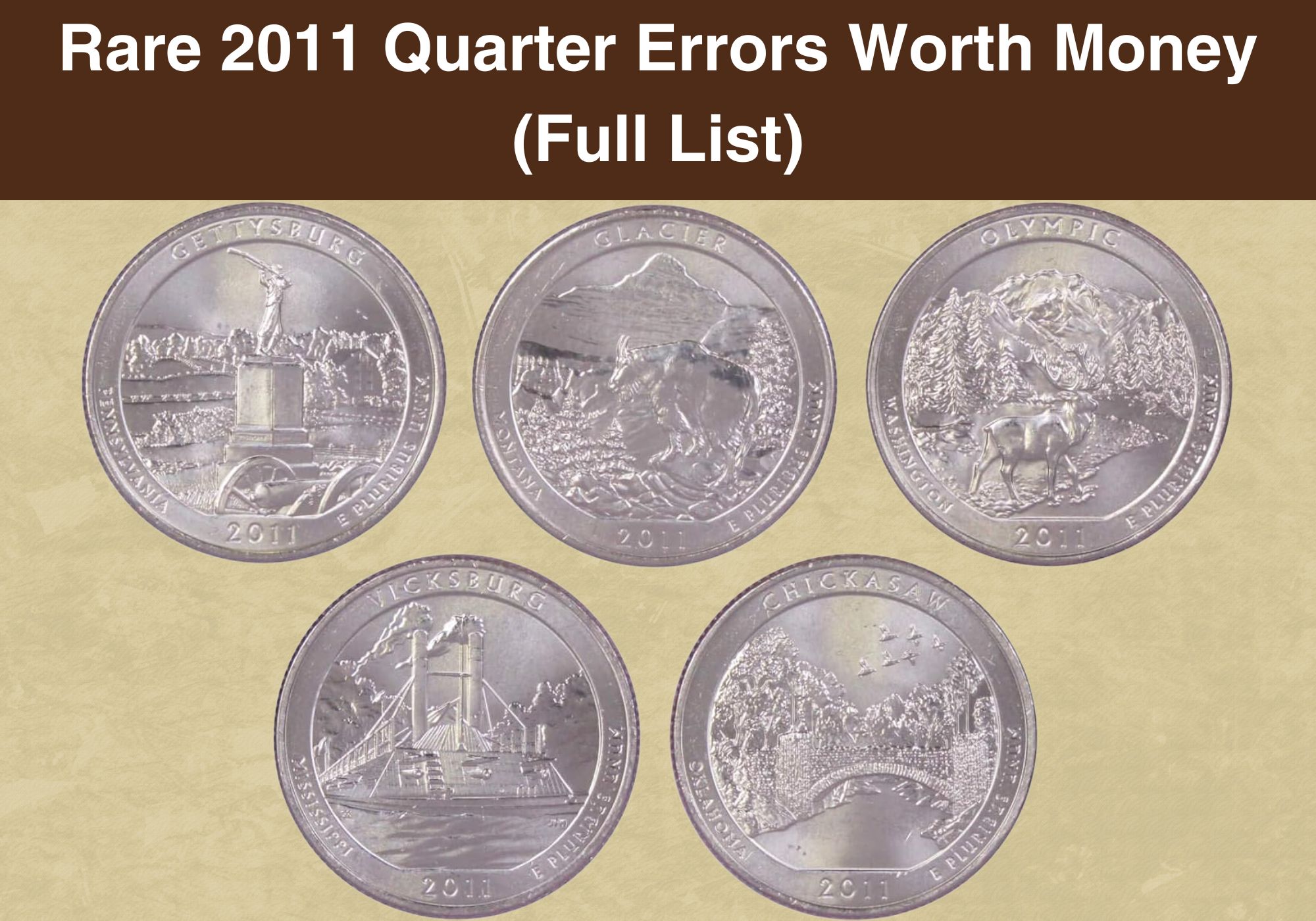
A 2011-D Glacier quarter with a large clipped planchet error sold on eBay in 2015 for $1,410. The complete 2011 quarter error list covers nine distinct mint mistakes across the America the Beautiful series, with values running from $215 re-punched mint marks to three separate errors that crossed the $1,000 threshold — including the highest single price for any ATB quarter error on record. Five national park designs hit circulation that year: Gettysburg, Glacier, Olympic, Vicksburg, and Chickasaw. Here’s every documented error, sorted by value, with auction records and how to identify each one.
1. 2011 Quarter Re-Punched Mint Mark Error (Up to $215)
A re-punched mint mark occurs when the mintmark punch strikes the die more than once at slightly different positions. The result is a doubled or offset “P” or “D” visible on the finished coin.
On this 2011-P Vicksburg quarter, the “P” shows a secondary impression offset from the primary — a ghost of the first punch visible alongside the final position. By 2011, mintmark application was largely automated, making RPMs less frequent than on earlier quarters where hand-punching created routine misalignments. Vicksburg quarters account for three of the nine errors on this list, suggesting those dies saw heavier use or less careful maintenance than the other four designs.
Value: In 2013, a collector paid $215 for a 2011-P Vicksburg quarter graded MS64 with a re-punched mint mark error. RPMs on modern quarters without dramatic separation trade for $25–$75. Well-separated examples with clear doubling on certified coins push $100–$215. Proper variety attribution — matching the RPM to a cataloged listing — unlocks the full premium over raw, unattributed examples.
How to Identify: Focus on the mint mark on the obverse, below Washington’s ponytail. Use at least 10x magnification and look for any doubling, shadowing, or offset around the “P” or “D.”
A genuine RPM shows a secondary impression with the same raised profile as the primary mintmark. The most valuable examples show clear separation where you can distinguish two overlapping letter outlines.
Don’t confuse with machine doubling on the mintmark, which creates a flat shelf-like shadow on one side. A true RPM shows rounded, three-dimensional secondary impressions. Fastest confirmation: raised secondary mintmark impression with rounded depth matching the primary letter.
Use Our 2011 Quarter Value Checker
2. 2011 Quarter Doubled Die Reverse Error (Up to $350)

A doubled die occurs when the hub impresses its design onto the working die at slightly different positions during manufacturing. Every coin struck by that die carries the same overlapping design.
On this 2011-P Glacier quarter, the doubling appeared on the reverse — the mountain goat and rocky peaks of the Glacier National Park design show secondary outlines on the inscriptions and terrain details. The Glacier design’s fine mountain ridgelines amplify even small hub shifts into visible splitting. This is a die variety, not a press event — every coin from the affected die carries the same doubling at the same positions, which is what separates it from machine doubling.
Value: In 2015, GreatCollections auctioned a 2011-P Glacier quarter graded MS63 with a doubled die reverse error for $350. Minor DDR varieties on circulated 2011 ATB quarters trade for $30–$100. Strong doubling visible under low magnification on uncirculated coins pushes $150–$350. The GreatCollections provenance and clear doubling drove the top price.
How to Identify: Use at least 10x magnification. Focus on the reverse inscriptions and the mountain terrain — check GLACIER and E PLURIBUS UNUM letter by letter for secondary outlines, and examine the ridgeline contours for splitting.
True hub doubling shows rounded, separated secondary images with depth. Machine doubling — flat, shelf-like shadows pushed uniformly to one side — is common on 2011 quarters and worth nothing.
The doubling direction and affected elements should be consistent across every coin from that die. Compare against known 2011 Glacier DDR variety photos. Fastest confirmation: rounded split secondary images on the reverse inscriptions, not flat uniform shadows.
Use Our 2011 Quarter Value Checker
3. 2011 Quarter Die Chip Error (Up to $415)

Die chips form when small fragments break off the striking die’s surface. Metal fills the void and transfers as a raised blob onto every coin the damaged die strikes.
On this 2011-P Olympic quarter, the die chip was prominent and well-placed enough to command $415 at GreatCollections. The Olympic design features a rocky coastline and tide pool — detailed terrain where a die chip creates immediate visual disruption. Size and placement together drive the value. A chip sitting on the rocky foreground or overlapping the tide pool would be more noticeable than one hiding in the sky or field area.
Value: In 2021, GreatCollections auctioned a 2011-P Olympic quarter graded MS65 with a die chip error for $415. Generic die chips on circulated ATB quarters trade for $10–$50. Large, prominently placed chips on uncirculated coins push $100–$415. The MS65 grade and the chip’s positioning on the Olympic design drove this example to the top of the range.
How to Identify: Use a 5x loupe and scan for raised, irregular metal blobs that don’t belong to the original design. Die chips are smooth and rounded on top because they formed under striking pressure.
Compare to a normal 2011 Olympic quarter side by side. Any extra raised material that doesn’t match the standard rocky coastline or tide pool design warrants closer examination.
Run your fingernail across the suspected chip. Die chips catch upward. Contact marks from other coins catch downward or feel flat. The blob should have matching luster. Fastest confirmation: smooth raised blob with same luster as surrounding coin, confirmed by comparison to a normal example.
Use Our 2011 Quarter Value Checker
4. 2011 Quarter Strike-Through Error (Up to $540)

A strike-through error happens when a foreign object gets trapped between the die and planchet during striking. The object blocks part of the design, leaving its impression on the finished coin.
On this 2011-D Vicksburg quarter, the foreign material left a significant impression during striking. The Vicksburg reverse — showing a Civil War cannon overlooking the Mississippi River — has detailed foreground elements where a struck-through impression creates obvious visual disruption. Heritage Auctions sold this example for $540 in 2014, reflecting both the impression’s size and the MS65 grade. Vicksburg quarters account for a disproportionate share of 2011 errors.
Value: In 2014, Heritage Auctions sold a 2011-D Vicksburg quarter graded MS65 with a strike-through error for $540. Strike-through errors on common ATB dates bring $50–$200. The MS65 grade and Heritage provenance pushed this example to $540. Retained strike-throughs — where the foreign material is still embedded — command the highest premiums in this category.

Coin Identifier and Value App
Not sure what your coins are worth? Get Instant Value • Grade • Error Detection with coin identifier and value app (FREE Usage Daily)
How to Identify: Look for an impression or mark on the coin that doesn’t match the standard Vicksburg cannon design. The mark may appear as a thin line (hair or fiber), an irregular patch (debris), or a textured area (cloth).
The impression should sit within the coin’s surface — pressed in during striking — not on top of it. The area around the impression may show slightly weakened design where the foreign object blocked the die.
Don’t confuse with post-mint scratches, which cut into the surface with visible metal displacement. A struck-through impression is smooth and consistent. Fastest confirmation: foreign impression pressed into the surface with weakened design in the surrounding area.
Use Our 2011 Quarter Value Checker
5. 2011 Quarter Rim Cud Error (Up to $640)
A rim cud forms when a chunk of the die’s edge breaks away completely. Metal flows into the void during striking, creating a raised, blob-like bump along the rim.
On this 2011-D ATB quarter, the cud was large enough to encroach on nearby design elements. Heritage Auctions sold it for $640 in 2016 — a strong price driven by the cud’s size and the MS64 grade. Cuds represent the terminal stage of die fatigue — a crack reaches the rim, widens under repeated striking pressure, and eventually a piece of the die breaks away entirely. The larger the chunk, the more dramatic the raised mass on the finished coin.
Value: In 2016, Heritage Auctions sold a 2011-D ATB quarter graded MS64 with a rim cud error for $640. Small cuds on circulated ATB quarters trade for $30–$100. Large cuds that encroach on prominent design elements push $200–$640. The Heritage provenance and MS64 grade drove this example to the top of the range.
How to Identify: Run your finger along the rim. A cud feels like a raised bump that disrupts the smooth edge. Genuine cuds have a flat, smooth top — they formed under thousands of pounds of striking pressure.
Post-mint damage looks rough and irregular. Check design elements near the cud — letters or park scene details adjacent to the break may appear weakened because the broken die couldn’t apply full pressure in that zone.
Examine the opposite side behind the cud for a slight depression or weakness at the corresponding position. Fastest confirmation: smooth flat-topped bump at the rim with weakened design adjacent.
Use Our 2011 Quarter Value Checker
6. 2011 Quarter Off-Center Strike Error (Up to $980)
Off-center strikes happen when the planchet isn’t seated properly in the striking chamber. The die comes down, but the blank has shifted — only part catches the full impression.
On this 2011-D Gettysburg quarter, the design shifted far enough off-center to leave a dramatic crescent of blank metal on one side. The Gettysburg reverse — showing the 72nd Pennsylvania Infantry Monument — loses a section of the battlefield scene to the blank crescent. eBay records confirm $980 for this MS60 example, nearly hitting four figures on an error that’s usually $100–$300 on common dates. The date visibility and design-specific attribution together drove the price.
Value: In 2018, an eBay collector paid $980 for a 2011-D Gettysburg quarter graded MS60 with an off-center strike error. Minor off-center strikes under 10% on ATB quarters trade for $20–$75. Dramatic off-centers with visible dates push $200–$980. The Gettysburg design attribution and readable date together drove the near-four-figure price.
How to Identify: Look for a clean crescent of blank, featureless metal on one side. The design shifts toward the opposite edge, with part of the lettering or portrait cut off. Both obverse and reverse shift the same direction.
Don’t confuse with a Misaligned Die (MAD), which shows the complete design with uneven rim but nothing missing. An off-center always has blank planchet showing. Check which reverse design is identifiable — collectors want to know which of the five 2011 designs it is. Fastest confirmation: clean blank crescent with design shifted and date readable.
Use Our 2011 Quarter Value Checker
7. 2011 Quarter Die Clash Error (Up to $1,020)
A die clash happens when the obverse and reverse dies strike each other without a planchet between them. The force transfers a mirror image of each die’s design onto the opposing die face.
On this 2011-D Vicksburg quarter, the clash produced visible ghost images — the Civil War cannon and monument from the reverse ghosting through Washington’s obverse field, or Washington’s jawline curving through the reverse battlefield scene. Heritage Auctions sold it for $1,020 in 2016, making this the highest-priced die clash on any ATB quarter. Vicksburg’s detailed military design creates recognizable clash patterns — the cannon barrel and monument silhouette are distinctive shapes when ghosted.
Value: In 2016, Heritage Auctions sold a 2011-D Vicksburg quarter graded MS65 with a die clash error for $1,020 — the most expensive die clash on any ATB quarter. On common dates, die clashes bring $50–$200. The MS65 grade, Heritage provenance, and strong ghost imagery pushed this example past four figures. Visible clashes on uncirculated 2011 quarters from all five designs generally range from $100–$500.
How to Identify: Look for faint design elements that don’t belong on that side of the coin. On a Vicksburg clash, the cannon barrel or monument silhouette ghosting behind Washington on the obverse is the tell.
The ghost images are incuse (sunken), not raised. Use angled lighting — tilt the coin slowly under a desk lamp and watch for outlines emerging in the field. Clash marks often only reveal themselves at specific light angles.
Don’t confuse with strike-throughs, which create blank or weak areas. A clash produces a recognizable reversed mirror image. Fastest confirmation: recognizable reversed ghost of the opposite design under angled light.
Use Our 2011 Quarter Value Checker
8. 2011 Quarter Broad Struck Error (Up to $1,200)
A broad strike occurs when the retaining collar fails or is absent during striking. Without the collar, the planchet spreads outward under the die’s pressure, creating a coin wider than the standard 24.26mm.
On this 2011-D Chickasaw quarter, the missing collar allowed the planchet to expand while retaining full design detail on both sides — the Lincoln Memorial Bridge and natural spring from the Chickasaw design stretched slightly but remained complete. All 119 reeds disappeared from the edge, replaced by a completely smooth rim. Heritage Auctions sold this one for $1,200 in 2020, the second-highest price for any 2011 ATB quarter error.
Coin Identifier and Value App
Not sure what your coins are worth? Get Instant Value • Grade • Error Detection with coin identifier and value app (FREE Usage Daily)
Value: In 2020, Heritage Auctions sold a 2011-D Chickasaw quarter graded MS64 with a broad struck error for $1,200. On common ATB dates, broadstrikes bring $100–$400. The Heritage provenance and MS64 grade pushed this example well past typical range. Less dramatic broadstrikes with slight expansion on circulated 2011 quarters trade for $200–$500.
How to Identify: Size is the giveaway. Hold a suspected broadstrike next to a normal quarter — the broadstrike will be visibly wider. Confirm with calipers: anything over 24.26mm is a flag.
Check the edge. A normal quarter has 119 reeds. A broad struck quarter has a completely smooth edge with zero reeding — this is the fastest visual confirmation. The design on both sides should be complete. If parts are missing, it’s an off-center error instead.
Weigh it: should still be 5.67 grams. Coins flattened by machinery show uneven spreading and damaged detail. A genuine broadstrike expands symmetrically. Fastest confirmation: smooth edge with zero reeding, expanded diameter, complete design.
Use Our 2011 Quarter Value Checker
9. 2011 Quarter Clipped Planchet Error (Up to $1,410)

Clipped planchet errors happen at the blanking press. When the metal strip feeds incorrectly, the punch overlaps a previously cut hole or catches the strip’s edge, producing an incomplete blank with a missing section.
On this 2011-D Glacier quarter, the clip was large — large enough to earn $1,410 on eBay in 2015, the highest price ever paid for an ATB quarter error at the time. The Glacier National Park reverse shows a mountain goat standing on a rocky ledge with snow-capped peaks behind it, and the clip removed a significant section of that landscape. Large clips are exponentially rarer than small nicks and chips because quality control catches most incomplete blanks before they reach the press.
Value: In 2015, an eBay collector paid $1,410 for a 2011-D Glacier quarter graded MS60 with a large clipped planchet error — the highest confirmed price for any single ATB quarter error. Small clips on ATB quarters trade for $30–$150. Large clips removing 15%+ of the planchet push $500–$1,410. The dramatic size of the missing section, combined with readable design attribution to the Glacier design, drove the record price.
How to Identify: Look for a large section of missing metal along the coin’s edge. Curved clips show a smooth arc where the blanking punch overlapped a previous hole. Straight clips show a flat line. Ragged clips show a rough, torn edge.
Check for the Blakesley Effect — a weakening of the rim 180 degrees opposite the clip. This confirms the clip happened before striking, not after. The Blakesley Effect is the single strongest indicator of a genuine pre-strike clip versus post-mint damage.
Weigh it — a large-clipped quarter will come in well under 5.67 grams. Post-mint damage from tools shows scratches, sharp edges, and no opposite-side rim weakness. Fastest confirmation: large missing section plus Blakesley Effect on the opposite rim.
Use Our 2011 Quarter Value Checker
Conclusion
The 2011 ATB quarter error spectrum runs from $215 re-punched mint marks to a $1,410 clipped planchet on the Glacier design that holds the record for any ATB quarter error. Three errors crossed $1,000 — the die clash at $1,020, the broad strike at $1,200, and the clipped planchet at $1,410. Vicksburg produced three of the nine errors, earning it the title of the 2011 error hotspot. Heritage Auctions provides the strongest documentation, with four lots anchoring the upper half of the list.