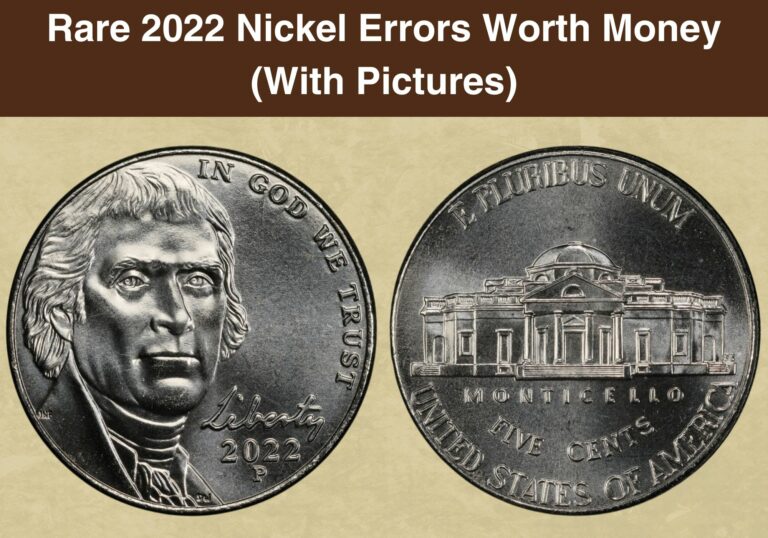
Rare 2009 Nickel Errors Worth Money (Full List With Pictures)

A 2009-P Jefferson nickel with a broad struck error sold at GreatCollections in 2020 for $1,040. The complete 2009 nickel error list covers nine distinct mint mistakes, with values running from $410 doubled dies to four-figure striking errors. The 2009 Jefferson nickel is one of the hardest modern nickels to find — total production dropped 93% from 2008, falling from 626 million to just 86.6 million as the Great Recession crushed coin demand. That scarcity inflates every error from this date. Here’s every documented error, sorted by value, with auction records and identification details.
1. 2009 Nickel Doubled Die Error (Up to $410)
A doubled die occurs when the hub impresses its design onto the working die at slightly different positions during manufacturing. Every coin struck by that die inherits the same overlapping design.
On 2009-D nickels, the doubling appears on MONTICELLO, IN GOD WE TRUST, the date “2009,” and Jefferson’s portrait — particularly around the eye and jawline. The low 2009 mintage means fewer dies were used overall, which limits the population of doubled die varieties for this date. Any confirmed DDO or DDR from 2009 carries a premium that the same variety wouldn’t earn on a higher-mintage year.
Value: In 2021, a 2009-D nickel graded MS60 with a strong obverse and reverse doubled die error sold on eBay for $410. On common-date Jefferson nickels, equivalent doubled dies bring $25–$100. The 2009 low-mintage premium roughly quadruples the normal range. Minor doubling visible only at 20x on circulated coins brings $50–$150. Strong doubling on uncirculated coins pushes past $300.
How to Identify: Use at least 10x magnification. Check IN GOD WE TRUST letter by letter, the date digits, Jefferson’s eye and jawline on the obverse, and MONTICELLO with its window and column details on the reverse.
True hub doubling shows rounded, separated secondary images with depth. Machine doubling — flat, shelf-like shadows pushed to one side — is extremely common on 2009 nickels and worth nothing.
The distinction matters. DDO/DDR notching is rounded and appears at specific diagnostic points. Machine doubling is flat and affects everything uniformly. Cross-reference against known 2009 doubled die variety photos. Fastest confirmation: rounded secondary images with depth at diagnostic points, not flat uniform shadows.
Use Our 2009 Nickel Value Checker
2. 2009 Nickel Improperly Annealed Error (Up to $515)

Before striking, metal planchets go through annealing — a heat treatment that softens them for proper die impression. When the temperature or duration is wrong, the planchet’s surface chemistry changes, producing unusual colors.
On 2009-D nickels, improperly annealed examples show color shifts across the full spectrum — gray, black, purple, yellow, orange, or reddish tones instead of the standard silver. The 75/25 copper-nickel alloy is sensitive to temperature fluctuations during annealing, which is why Jefferson nickels produce more annealing errors than harder-to-affect clad coins. The color change is baked into the metal’s structure, not sitting on the surface — it can’t be replicated by chemical treatment after the fact.
Value: A 2009-D nickel graded MS60 with an improperly annealed error sold on eBay for $515. On common-date nickels, comparable annealing errors bring $30–$150. The 2009 low-mintage premium triples the typical range. Dramatic color shifts — charcoal black or vivid purple — bring the top end. Subtle discoloration barely distinguishable from normal toning trades at the low end.
How to Identify: Check the overall color. An improperly annealed nickel will display unusual hues across the entire coin — not patchy spots, but a uniform shift from the standard silver tone.
The surface texture often differs from a normal nickel. Annealing errors may produce a matte or grainy finish instead of normal mint luster. Under magnification, the surface may look rougher than expected.
Weigh it: should still be 5.00 grams since the planchet is correct, just improperly heated. Don’t confuse with environmental toning, which creates surface-level color changes that develop over time. Annealing errors produce uniform discoloration from the manufacturing process. Fastest confirmation: uniform unusual color across the entire coin with abnormal surface texture, at correct weight.
Use Our 2009 Nickel Value Checker
3. 2009 Nickel Off-Center Strike Error (Up to $600)
Off-center strikes happen when the planchet isn’t seated properly in the striking chamber. The die comes down, but the blank has shifted — only part of it catches the full impression.
This 2009-P example was struck just 10% off-center — a minor shift that would add $20–$50 on a common-date nickel. On a 2009, it sold for $600. That price gap is the low-mintage effect in action. The 39.8 million Philadelphia mintage for 2009 was a fraction of normal production, meaning fewer total coins exist and even fewer error survivors. A 30%+ off-center 2009 nickel with a readable date would likely push well past $1,000.
Value: In 2020, a 2009-P nickel graded MS65 with a 10% off-center strike sold on eBay for $600. That’s roughly twelve times what the same error brings on a 2016 or 2017 nickel. No documented 2009 nickel with a dramatic 30%+ off-center has surfaced at major auction yet. If one does, expect a significant hammer price.
How to Identify: Look for a clean crescent of blank, featureless metal on one side. The design will be shifted toward the opposite edge, with part of the lettering or portrait cut off. Both obverse and reverse shift the same direction.
At 10%, the shift is subtle. Compare against a normally struck 2009 nickel to see the uneven rim width. Don’t confuse with a Misaligned Die (MAD), which shows the complete design with uneven rim but nothing missing. An off-center always has blank planchet showing.
Post-mint damage creates uneven distortion with scratches. Genuine off-center strikes have clean, smooth unstruck areas. Fastest confirmation: clean blank crescent with design shifted and date readable.
Use Our 2009 Nickel Value Checker
4. 2009 Nickel Struck Through Grease Error (Up to $630)

A struck-through error happens when foreign material gets trapped between the die and planchet during striking. Grease — press lubricant pooling in the die’s recessed areas — is the most common culprit.
The result is a smooth, blank patch where design detail should be. On this 2009-P example, the grease fill was large enough to obliterate a significant section of the design, driving the price to $630 at Heritage Auctions. On a common-date nickel, the same error might bring $30–$75. The Monticello reverse with its architectural columns and windows provides plenty of deep die recesses where grease accumulates.
Value: In 2021, Heritage Auctions sold a 2009-P nickel graded MS64 with a grease strike-through error for $630. Minor grease fills on circulated 2009 nickels trade for $50–$200. Large fills covering significant design sections on uncirculated coins push $300–$630. The size of the affected area is the primary value driver — small spots barely register, while half of Jefferson’s face missing gets attention.
How to Identify: Look for a localized area where the design appears weak, mushy, or entirely absent — a smooth blank zone surrounded by otherwise normal detail. The boundaries should be relatively sharp.

Coin Identifier and Value App
Not sure what your coins are worth? Get Instant Value • Grade • Error Detection with coin identifier and value app (FREE Usage Daily)
Grease fills produce featureless, smooth patches. Don’t confuse with circulation wear, which spreads evenly across all high points. A strike-through affects a specific area while the surrounding design stays sharp. On Jefferson nickels, check the hair above the ear and the Monticello columns — deep die recesses where grease pools most often.
Make sure the weakness isn’t from an improperly annealed planchet, which weakens the entire coin uniformly. Fastest confirmation: sharply defined smooth zone surrounded by normal strike quality.
Use Our 2009 Nickel Value Checker
5. 2009 Nickel Lamination Error (Up to $715)
Lamination errors originate in the planchet itself. When impurities or gas pockets contaminate the metal during strip manufacturing, the planchet develops internal weaknesses that cause the surface to crack, peel, or flake after striking.
Jefferson nickels use a solid 75% copper / 25% nickel alloy — not the three-layer clad structure of dimes and quarters. Lamination on nickels occurs when contaminants trapped within the alloy create planes of weakness. The result is visible surface separation — metal peeling away in layers from what should be a solid, homogeneous coin. On this 2009-P example, the delamination exposed enough subsurface metal to create a dramatic visual that drove the price to $715.
Value: A 2009-P nickel graded MS61 with a lamination error sold on eBay for $715. On common-date Jefferson nickels, comparable lamination errors bring $50–$200. Large peels with retained metal flaps on uncirculated 2009 nickels push $300–$715. The more dramatic the separation and the higher the grade, the more the coin brings.
How to Identify: Look for areas where the surface is peeling, splitting, or flaking. The affected area may show a thin metal flap lifting from the coin, or a bare patch where material has separated.
The exposed area underneath should look rough and fibrous — the interior metal was never meant to be a surface. The separation follows the alloy’s internal grain, not a clean geometric line.
Don’t confuse with environmental corrosion, which creates uniform degradation. Also distinguish from post-mint scraping — tool marks show directional scratches, while lamination separations are organic with rough, fibrous layers. Weigh it: the coin will be slightly under 5.00 grams if material has separated. Fastest confirmation: metal peeling or split in a flap with rough fibrous interior visible.
Use Our 2009 Nickel Value Checker
6. 2009 Nickel Double Curved Clipped Planchet Error (Up to $810)
Clipped planchet errors start at the blanking press. When the metal strip feeds incorrectly, the punch overlaps a previously cut hole, producing an incomplete blank. A double curved clip means the punch caught two overlapping holes on the same blank.
Two clips on one coin is significantly rarer than a single clip. Each missing section creates its own Blakesley Effect — a weakening of the rim 180 degrees opposite the clip — so a double clip shows two separate areas of rim weakness. On this 2009-D example, both clips were visible along the edge, creating a coin that was obviously incomplete from two different directions. Heritage Auctions sold it for $810, driven by both the double clip and the 2009 low mintage.
Value: In 2021, Heritage Auctions sold a 2009-D nickel graded MS63 with a double curved clipped planchet error for $810. Single-clip errors on 2009 nickels trade for $100–$400. The double clip roughly doubles the premium over a single clip in comparable grade. On common-date nickels, double clips bring $100–$300.
How to Identify: Look for two separate curved sections of missing metal along the coin’s edge. Each clip will show a smooth arc where the blanking punch overlapped a previous hole.
Check for two Blakesley Effects — weakened rim areas on the opposite side of each clip. This is the strongest evidence that both clips happened pre-strike. The two areas of rim weakness should correspond to positions 180 degrees from each missing section.
Weigh it: a double-clipped nickel will come in noticeably under 5.00 grams. Post-mint damage from tools shows scratches and sharp edges without corresponding rim weakness. Fastest confirmation: two curved missing sections plus two matching Blakesley Effects on opposite sides.
Use Our 2009 Nickel Value Checker
7. 2009 Nickel Die Clash Error (Up to $830)
A die clash happens when the obverse and reverse dies strike each other without a planchet between them. The force transfers a mirror image of each die’s design onto the opposing die face.
On 2009-P nickels, clash marks show as ghost images — Jefferson’s jawline and profile faintly appearing near Monticello on the reverse, or Monticello’s architectural lines ghosting through the obverse field. The complex Monticello design with its columns, windows, and triangular pediment creates recognizable ghost patterns when clashed. Heritage sold this 2009-P example for $830, reflecting both the clarity of the clash and the date’s scarcity.
Value: In 2022, Heritage Auctions sold a 2009-P nickel graded MS63 with a reverse die clash error for $830. On common-date Jefferson nickels, equivalent die clashes bring $50–$200. The 2009 low-mintage premium roughly quadruples the normal range. Strong clashes visible to the naked eye on uncirculated coins command the top of the range.
How to Identify: Look for faint design elements that don’t belong on that side of the coin. Monticello’s columns or pediment ghosting in the obverse field, or Jefferson’s jawline curving through the reverse, are the most common tells.
The ghost images are incuse (sunken), not raised. Use angled lighting — tilt the coin slowly under a desk lamp and watch for outlines emerging in the field. Clash marks often only reveal themselves at specific light angles.
Don’t confuse with strike-throughs, which create blank areas without recognizable design. A clash produces an identifiable reversed mirror image. Fastest confirmation: recognizable reversed ghost of the opposite design, visible under angled light.
Use Our 2009 Nickel Value Checker
8. 2009 Nickel Die Cap Error (Up to $1,010)
A die cap starts when a freshly struck coin sticks to the upper die and doesn’t eject. That stuck coin becomes a new striking surface, and the press keeps running.
Coin Identifier and Value App
Not sure what your coins are worth? Get Instant Value • Grade • Error Detection with coin identifier and value app (FREE Usage Daily)
With each successive strike, the stuck coin curls around the die into a bottle-cap shape. Incoming planchets receive a weak, mirror-image impression from the stuck coin instead of the proper die design. On this 2009-D example, the cap produced a brockage ghost on the reverse of subsequent coins. Die caps are mechanically complex — multiple things failed in sequence, and the press kept running. On a date with only 46.8 million coins from Denver, the error population is inherently small.
Value: In 2020, GreatCollections auctioned a 2009-D nickel graded MS65 with a reverse die cap error for $1,010. Die caps on common-date Jefferson nickels bring $300–$800. The 2009 low-mintage premium and the MS65 grade combined to push this example past $1,000. Early-stage caps with clear brockage impressions command higher prices than late-stage caps where the image has degenerated.
How to Identify: The shape is the giveaway. A die cap coin is not flat — it’s concave, cupped, or bowl-shaped. Place it on a flat surface and it will rock. The rim on one side will be dramatically raised.
One side should show a normal or near-normal design. The other may carry a weak, reversed mirror-image impression from the stuck coin. Check the rim height — significantly taller than a normal nickel confirms cap formation.
Don’t confuse with a simple brockage from a single extra strike, which stays flat. A cap error is always cupped. Weigh it: should still be approximately 5.00 grams. Fastest confirmation: cupped bottle-cap shape plus reversed incuse design on one side.
Use Our 2009 Nickel Value Checker
9. 2009 Nickel Broad Struck Error (Up to $1,040)
A broad strike happens when the retaining collar fails or is absent during striking. Without the collar, the planchet spreads outward under pressure, creating a coin visibly wider than normal.
On this 2009-P example, the missing collar allowed the nickel to expand while retaining full design detail on both sides. Since nickels have a plain edge, the key diagnostic isn’t missing reeding — it’s the expanded diameter and weakened rim. The coin spreads symmetrically outward, making Jefferson’s portrait and Monticello both appear slightly stretched. GreatCollections sold this one for $1,040, making it the highest-priced 2009 nickel error on record.
Value: In 2020, GreatCollections auctioned a 2009-P nickel graded MS62 with a broad struck error for $1,040 — the highest confirmed price for any 2009 nickel error. On common-date Jefferson nickels, comparable broadstrikes bring $100–$400. The 2009 low-mintage premium roughly triples the normal range. Less dramatic broadstrikes with slight expansion on circulated 2009 nickels trade for $200–$500.
How to Identify: Measure the diameter. A standard nickel is 21.21mm. A broad struck nickel will be noticeably wider — sometimes 22–24mm. Use calipers for precision.
Check the rim. Normal nickels have a distinct raised collar edge. Broad strikes show a weak, flattened rim or no rim definition at all — the field flows smoothly to the edge. The design on both sides should be complete. If parts are missing, it’s an off-center error instead.
Weigh it: should still be 5.00 grams since the same planchet was used. Watch for coins flattened by machinery or vises — those show uneven spreading, scratches, and damaged detail. A genuine broadstrike expands symmetrically. Fastest confirmation: diameter over 21.21mm, weakened rim, complete design, correct weight.
Use Our 2009 Nickel Value Checker
Conclusion
The 2009 nickel error spectrum runs from $410 doubled dies to a $1,040 broad struck that tops the year’s auction records. The 93% mintage drop from 2008 inflates every error by three to five times what the same defect brings on a common date — a 10% off-center that would fetch $50 on a 2016 nickel sold for $600 here. Heritage Auctions and GreatCollections provide the strongest documentation, with three Heritage lots and two GreatCollections sales anchoring the upper end. A digital scale, a 10x loupe, and calipers cover the identification basics for all nine error types here.