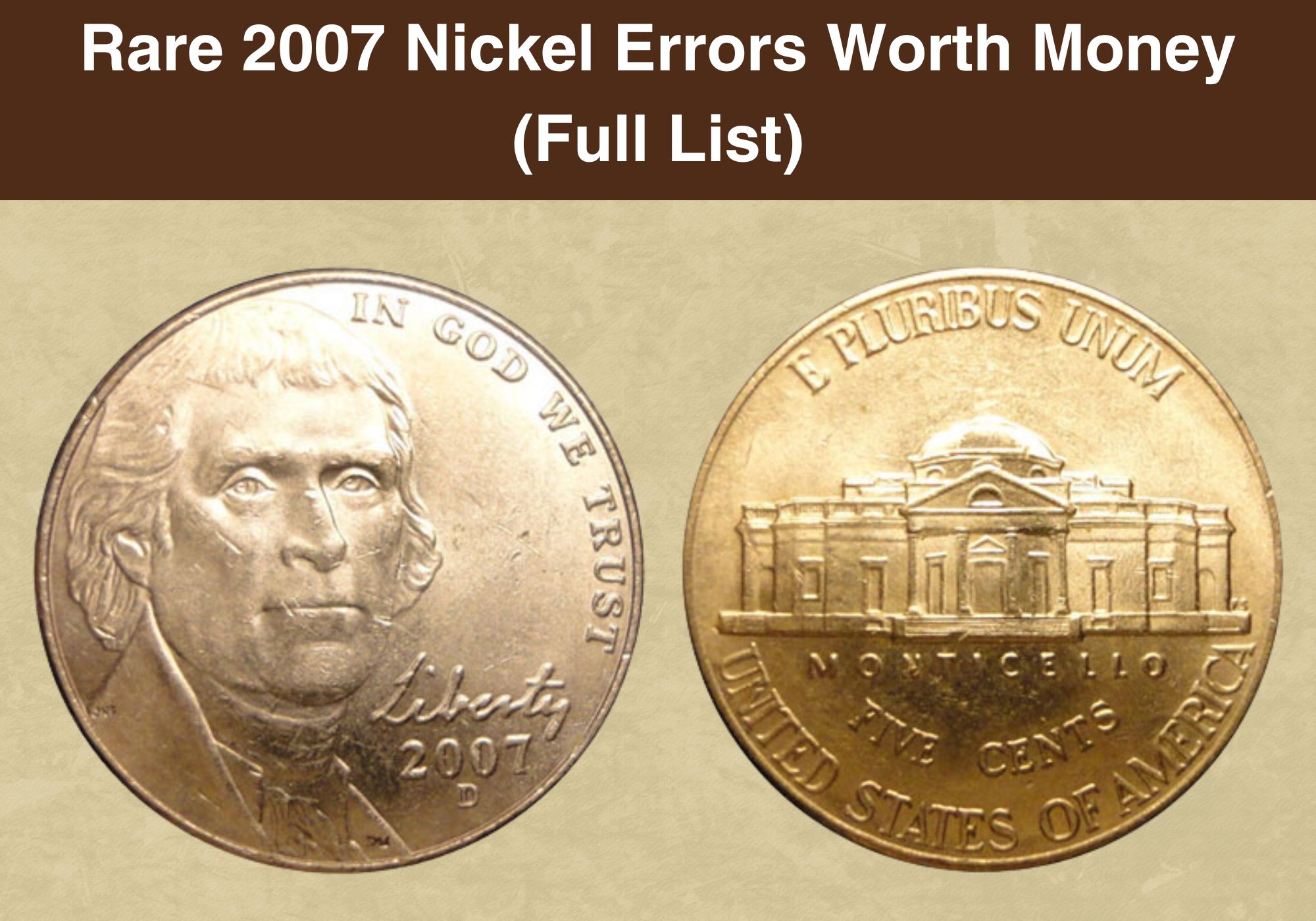
Rare 2007 Nickel Errors Worth Money (Full List With Pictures)
A 2007-D cent struck on a nickel planchet — a double denomination error — sold for $1,340 on eBay in 2023, proving that a five-cent coin can return 26,800 times its face value if the Mint makes the right kind of mistake. This 2007 nickel errors list covers every documented minting error from that year’s Jefferson nickel production, with confirmed sales ranging from $715 to $1,340. Here’s what to look for and what each error is actually worth.
1. 2007 Nickel Clipped Planchet Error (Up to $715)

A clipped planchet error occurs when the blanking press overlaps a previously punched hole in the metal strip, cutting into already-vacant space. The result is a planchet — and ultimately a nickel — with a piece missing from its edge.
The clip happens before striking, so the remaining metal still receives the full die impression. Three types exist: straight clips (from the strip’s edge), curved clips (from overlapping punches), and ragged clips (from strip defects). On a nickel’s 21.21mm diameter, even a modest clip is visible without magnification. Straight clips are less common than curved ones on Jefferson nickels, which is why the 2007 straight clip specimen drew premium pricing at Heritage.
Value: A 2007 Jefferson nickel with a straight clipped planchet sold for $715 at Heritage Auctions in 2007. Smaller clips under 10% of the coin’s area trade for $50 to $200. Larger clips removing 15% or more reach $300 to $700 depending on grade and clip type. Straight clips generally bring more than curved clips at equivalent sizes because they’re scarcer on this denomination.
How to Identify: Look for a concave or straight-edged bite along the coin’s rim. The missing section should follow a smooth geometric contour — either a clean arc or a straight line.
Weigh the coin on a precision scale. A clipped nickel will weigh less than the standard 5.00 grams because metal is physically absent. A 15% clip drops weight to roughly 4.25 grams.
Check for the Blakesley Effect — a weak area on the rim directly opposite the clip. The upsetting mill can’t form a full rim at the point opposite the missing metal. This diagnostic is specific to genuine clips and doesn’t appear on filed coins.
Examine the clip’s edge under magnification. Genuine clips show a smooth, sheared cross-section. Filing produces flat surfaces with visible tool marks and striations.
Fastest check: missing section plus Blakesley Effect (weak rim opposite the clip).
Use Our 2007 Nickel Value Checker
2. 2007 Nickel Partial Tilted Collar Error (Up to $805)
A partial tilted collar error occurs when the planchet isn’t fully seated in the collar die before striking, and the collar itself is tilted at an angle. The result is a coin with reeding on part of the edge and smooth metal on the rest, plus a visible “step” when viewed from the side.
Normally, the collar surrounds the planchet evenly and forms the edge during striking. When the collar is tilted or the planchet sits crooked inside it, one side of the coin gets pressed deeper into the collar while the other side rides above it. The stepped profile is the signature feature — the coin literally has two different thickness levels on opposite edges. This error is distinct from a broadstrike (where the collar is absent entirely) and from a partial collar (where the collar is correctly oriented but not fully engaged).
Value: A 2007-P Jefferson nickel graded MS65 with a partial tilted collar sold for $805 at GreatCollections in 2021. General market range for this error on modern nickels runs $100 to $600 depending on the tilt severity and grade. More dramatic tilts with visible stepped edges command the highest premiums. Minor tilts that require close inspection to detect bring far less.
How to Identify: Hold the coin on its edge and rotate it slowly. A partial tilted collar shows a stepped profile — one side of the coin is visibly thicker or higher than the other. The transition between the two levels should be gradual, not abrupt.
Check the edge reeding. Part of the edge will show normal reeding; the rest will be smooth or partially reeded. This inconsistency is the primary diagnostic.
Measure the coin’s thickness at multiple points using calipers. Normal nickels are uniformly 1.95mm thick. A tilted collar coin will show measurable variation — thicker on one side, thinner on the other.
The design should be fully struck on both faces. If design elements are missing, you may have an off-center strike or a different error type entirely.
Fastest check: stepped edge profile with reeding on one side and smooth edge on the other.
Use Our 2007 Nickel Value Checker
3. 2007 Nickel Missing Clad Layer Error (Up to $900)
Jefferson nickels use a 75% copper / 25% nickel outer layer bonded to a pure copper core. A missing clad error happens when this outer layer fails to adhere on one or both sides, exposing the reddish-copper core underneath.
The color difference is immediate and dramatic. Instead of the familiar silver-gray nickel tone, the affected face shows a copper-penny color that’s visible across the room. The bonding failure occurs during planchet manufacturing — contaminants or rolling defects weaken the adhesion between the nickel-copper alloy and the core. These errors also produce a measurable weight difference, since the missing alloy layer accounts for a noticeable fraction of the coin’s total mass.
Value: A 2007-P Jefferson nickel graded MS63 with a missing clad layer has been documented by CoinValueChecker in the $800 to $900 range. Full-face exposure on one side brings the strongest premiums. Partial cladding loss — small patches rather than full-face — trades for $50 to $200. Both sides missing cladding commands significantly more than single-side examples. PCGS and NGC both authenticate these errors.
How to Identify: The color is the giveaway. One side appears normal silver-gray; the other shows the copper core’s reddish-brown surface.
Weigh the coin on a precision scale. Standard weight is 5.00 grams. A missing clad layer drops the weight noticeably — to approximately 4.2–4.5 grams depending on how much alloy is absent.
Under magnification, the exposed copper surface should be smooth with sharp, fully formed design details. If the surface looks rough, pitted, or chemically etched, someone removed the cladding after minting — that’s damage, not an error.
Check the edge cross-section. On genuine examples, the nickel-copper alloy layer is visibly absent on one side of the sandwich, leaving the copper core exposed.
Fastest check: weigh it — significantly under 5.00 grams with a copper-colored face settles the question.
Use Our 2007 Nickel Value Checker

Coin Identifier and Value App
Not sure what your coins are worth? Get Instant Value • Grade • Error Detection with coin identifier and value app (FREE Usage Daily)
4. 2007 Nickel Weak Edge Lettering Error (Up to $965)
Jefferson nickels have a plain (smooth) edge — they don’t carry edge lettering. But they do have reeding characteristics that can be affected by die adjustment issues. This “weak edge” error occurs when the dies don’t make full contact with the planchet during striking, leaving the rim and edge details underdeveloped.
Die adjustment strikes happen when mint workers reset the gap between the dies and the first few coins come through under insufficient pressure. The edge loses its definition first because it’s the last area to receive metal flow during the strike. On a properly struck nickel, the rim is sharp and well-defined. On a weak edge specimen, the rim is soft, rounded, or partially missing — and the design details near the periphery may also be faint.
Value: A 2007-P Jefferson nickel graded MS64 with weak edge lettering sold for $965 at Heritage Auctions in 2020. General market range for die adjustment strikes on modern nickels runs $100 to $600. Coins with dramatically weak rims and peripheral detail loss command the highest prices. Subtle weakness that could be confused with wear brings far less — and is harder to get authenticated.
How to Identify: Examine the rim first. A genuine weak edge error shows a soft, underdeveloped rim that’s consistent all the way around — not just on one side. The weakness should be uniform, not selective.
Check the design details near the coin’s periphery. Letters in “UNITED STATES OF AMERICA” or “E PLURIBUS UNUM” near the rim may appear faint or incomplete while central design elements remain relatively sharp.
Weigh the coin. It should still be the standard 5.00 grams — this is a striking issue, not a planchet issue. Normal weight rules out a thin planchet or missing clad layer.
The critical distinction from wear: weak edge errors show original mint luster on the surface. Wear removes luster; insufficient striking pressure never creates the detail but leaves the surface undisturbed.
Fastest check: uniformly soft rim with mint luster on the high points.
Use Our 2007 Nickel Value Checker
5. 2007 Nickel Improperly Annealed Error (Up to $1,035)

Annealing is the heat treatment that softens planchets before striking. When the temperature runs too hot, too cold, or the planchet spends too long in the furnace, the metal’s surface chemistry changes — and the coin comes out the wrong color.
Instead of the standard silver-gray nickel appearance, improperly annealed 2007 nickels show up in black, dark gray, purple, orange, or other colors that have no business being on a Jefferson nickel. The color covers the entire coin uniformly because the defect happened at the planchet stage, before any design was struck. All design details remain sharp — only the color is off. Don’t confuse this with environmental toning, which produces uneven, patchy discoloration from years of exposure.
Value: A 2007-D Jefferson nickel graded MS64 with improperly annealed obverse and reverse sold for $1,035 at Heritage Auctions. Vivid, dramatic colors in MS63–MS65 typically move for $300 to $800. Coins with subtle or uneven discoloration — which overlap with environmental toning — trade for $50 to $150. Color intensity and grade both drive pricing here.
How to Identify: The color must be uniform across the entire coin — both sides, including the rim and edge. This is what separates annealing errors from toning, which creates uneven streaks, spots, or halos.
Hold the coin under bright light at multiple angles. The color should look like part of the metal, not a surface coating or residue. If you can wipe, scrape, or dissolve the color, it’s contamination.
Common genuine colors include deep charcoal-black, purple-blue, bright orange, and yellow-gold. All design details should remain crisp underneath the unusual color.
Weigh the coin — standard 5.00 grams. Abnormal weight points to a different planchet problem entirely. Annealing errors affect color only, not mass.
Fastest check: uniform, unnatural color on both faces with sharp, undamaged design details.
Use Our 2007 Nickel Value Checker
6. 2007 Nickel Die Cap Error (Up to $1,200)

A die cap forms when a freshly struck nickel sticks to the upper hammer die instead of ejecting. That stuck coin becomes a new “die face,” striking every incoming planchet with its own distorted image.
With each subsequent strike, the stuck coin’s edges curl progressively around the die, eventually forming a cap or thimble shape. The 2007-D specimen that sold for $1,200 was a reverse die cap — meaning the coin stuck to the reverse die and its edges curled upward around the reverse side. Early-stage caps retain readable design elements. Late-stage caps resemble small metal bowls with garbled impressions. Mint workers usually catch this quickly, which is why die caps on any denomination are genuinely scarce.
Value: A 2007-D Jefferson nickel graded MS63 with a reverse die cap sold for $1,200 at Heritage Auctions in 2020. Die caps on modern nickels rarely appear at major auction houses — most change hands through specialty error dealers. Early-stage caps with recognizable design elements sell for $400 to $1,000. Late-stage caps with dramatic cupping can exceed $1,200. Each specimen is essentially unique.
How to Identify: Die caps are visually unmistakable. The coin has a cupped or domed shape with edges curving upward around the perimeter. One side shows a normal strike; the other displays a mirrored, incuse impression.
Weigh the coin — it should approximate the standard 5.00 grams. Significant weight deviation could indicate multiple strikes or bonded material from the capping process.
Look for progressive edge deformation. Early-stage caps show slight rim curling. Late-stage caps look like small metal bowls with substantially wrapped edges.
The plain edge should be absent or severely distorted. Normal edge characteristics can’t survive the cap formation process. The concave interior should display mint luster, not the rough texture of post-mint damage.
Genuine die caps show uniform curvature with design impressions consistent with the striking process. Random bends from pocket damage produce asymmetric dents, not the symmetrical dome of a cap.
Coin Identifier and Value App
Not sure what your coins are worth? Get Instant Value • Grade • Error Detection with coin identifier and value app (FREE Usage Daily)
Fastest check: cupped shape, incuse reverse, and uniform edge curvature with mint luster on the interior.
Use Our 2007 Nickel Value Checker
7. 2007 Nickel Double Denomination Error (Up to $1,340)

A double denomination error occurs when dies for one denomination strike a planchet intended for a different denomination. The 2007-D specimen that set the price record was a Lincoln cent die pair striking a nickel planchet — producing a coin with Lincoln’s portrait and the Memorial reverse on a blank that’s the wrong size, weight, and color for a penny.
The result is visually bizarre. You’re holding a coin that looks like a penny but feels like a nickel — larger, heavier, and silver-colored instead of copper. The Lincoln cent design appears slightly undersized on the oversized nickel blank because cent dies are smaller than nickel dies. The unstruck border around the design is wider than normal, and the edge is plain rather than showing any reeding. This error requires two simultaneous failures: wrong planchet fed into the press and wrong dies installed on the machine.
Value: A 2007-D cent struck on a nickel planchet graded MS65 sold for $1,340 on eBay in 2023. That’s the highest confirmed sale for any 2007 nickel-related error. Double denomination errors on modern coins are extremely scarce because automated quality controls are designed to prevent exactly this kind of cross-contamination. Comparable examples from nearby years trade between $500 and $1,500 at Heritage and GreatCollections.
How to Identify: Start with the design. If the coin shows Lincoln’s portrait and the Memorial reverse but is silver-colored and nickel-sized, you likely have a double denomination.
Weigh the coin. A nickel planchet weighs 5.00 grams; a cent planchet weighs 2.50 grams. If the coin shows cent designs but weighs 5.00 grams, it was struck on a nickel blank. This single measurement is nearly conclusive.
Measure the diameter. A nickel planchet is 21.21mm; a cent planchet is 19.05mm. The cent design will appear surrounded by extra blank space on the larger nickel planchet.
Check the edge. Nickels have a plain edge; cents also have a plain edge — so the edge alone won’t distinguish. But the color, weight, and diameter together are definitive.
Professional grading is mandatory for this error. The market treats unslabbed double denomination claims with extreme skepticism.
Fastest check: weigh it — Lincoln design on a 5.00-gram, 21.21mm, silver-colored planchet confirms it.
Use Our 2007 Nickel Value Checker
Conclusion
The 2007 Jefferson nickel error market runs from $715 clipped planchets to $1,340 double denomination coins. Between those ends, partial tilted collars, missing clad layers, weak edges, improperly annealed planchets, and die caps all trade between $800 and $1,200 in confirmed auction records. A precision scale (0.01g), a pair of calipers, and a 10x loupe cover every diagnostic you need for this denomination.