Rare 2003 Quarter Errors Worth Money (Full List With Pictures)
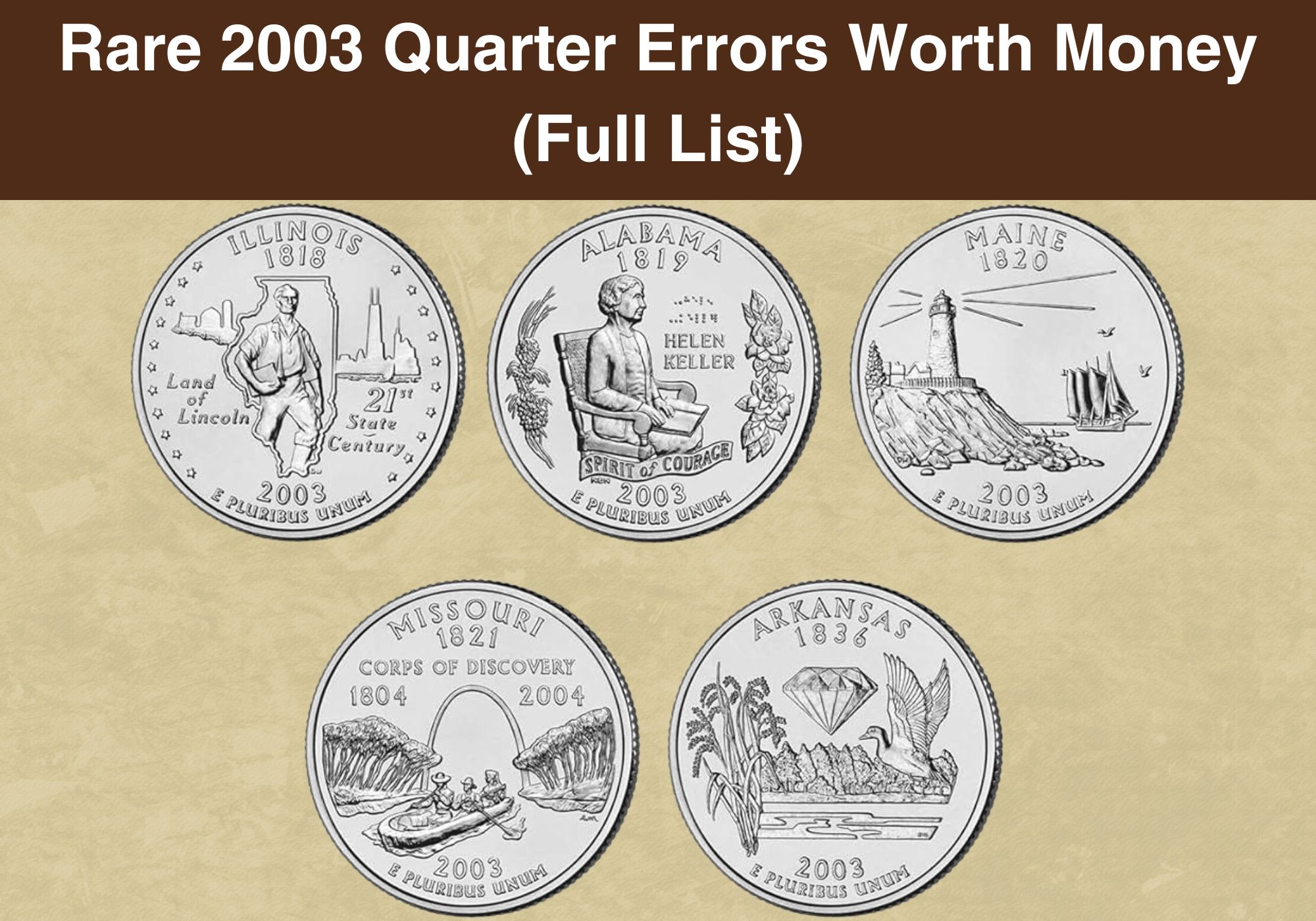
A 2003 state quarter struck on the wrong planchet has sold for over $3,000 at major auction houses. The complete 2003 quarter errors list spans eight distinct mint mistakes across all five state designs — Illinois, Alabama, Maine, Missouri, and Arkansas — with values running from $5 for minor die cracks to four figures for wrong-metal strikes. Most circulated examples are worth face value, but the right error turns a quarter into real money. Here is every error type to look for, sorted from least to most valuable.
1. 2003 Quarter Lamination Error (Up to $150)

Lamination errors happen during planchet production when impurities, gas pockets, or foreign material get trapped between the metal layers. The bonding between the copper core and the outer nickel cladding fails at the contamination point, creating a weak spot that cracks or peels under the pressure of striking.
The result looks like a flap of metal lifting away from the coin’s surface, or a rough patch where material has already separated and fallen off. Some lamination flaws are tiny chips barely visible to the naked eye. Others remove entire sections of the design, exposing the copper core underneath in dramatic fashion.
Value: Small lamination chips on circulated 2003 quarters add $5–$25 over face value. Larger peeling laminations with significant missing metal reach $30–$100 in uncirculated condition. The most dramatic examples — multiple bubbles or large flaps still attached to the coin — have traded for up to $150 when the visual impact is strong and the coin grades MS65 or above.
How to Identify: Look for irregular patches on the coin’s surface where metal appears to be peeling, bubbling, or already missing. The area beneath a separated layer will look dull, rough, and unfinished compared to the normally struck surface around it.
The edges of a genuine lamination have a torn, organic appearance — ragged and uneven, like skin peeling after a sunburn. Post-mint corrosion, by contrast, shows chemical discoloration and pitting that looks splotchy and random rather than following the metal’s internal structure.
Tilt the coin under direct light. A genuine lamination flaw creates a shadow where the metal lifts away from the surface. If the rough area sits flat and level with the surrounding metal rather than lifting or receding, it is more likely environmental damage. The fastest check: a raised flap of metal with clean, shiny metal visible underneath is almost always a genuine lamination.
Use Our 2003 Quarter Value Checker
2. 2003 Quarter Die Crack and Cud Error (Up to $200)

Die cracks form when the hardened steel die develops stress fractures from striking millions of planchets at high pressure. Metal from the planchet flows into these cracks during each strike, leaving raised lines on the finished coin that trace the fracture pattern in the die.
When a crack reaches the die’s rim and an entire section breaks away, the result is a cud — a raised, featureless blob of metal at the coin’s edge where part of the design should be. Cuds are the final stage of die deterioration before the die gets pulled from service.
The five 2003 state quarter reverses offer distinct designs for die cracks to cross. A crack running through Lincoln’s face on the Illinois quarter or across Helen Keller’s portrait on Alabama creates a more collectible coin than one confined to open field area.
Value: Minor die cracks on 2003 quarters add $5–$25 depending on length and location. Dramatic cracks crossing major design elements bring $50–$100. Full rim cuds — where a raised blob covers part of the state name or design — have sold for $100–$200 on uncirculated examples. Location on a recognizable design element drives the premium more than crack length alone.
How to Identify: Run your fingertip lightly across the coin’s surface. A genuine die crack feels raised, like a thin ridge of metal sitting above the normal surface. Scratches, by contrast, are incised — they cut into the metal rather than sitting on top of it.
Die cracks typically run in relatively straight lines from one design element to another or from the rim inward. They may branch or fork, but they follow a linear path rather than wandering randomly.
For cuds, look along the entire rim for a raised, formless blob that merges with the edge. The blob should be the same color and luster as the rest of the coin. If it looks chemically different or has a rough, pitted texture, it is likely corrosion or adhesive residue rather than a genuine die break. The fastest check: raised line equals die crack; raised blob at the rim equals cud. Neither should be incised.
Use Our 2003 Quarter Value Checker
3. 2003 Quarter Clipped Planchet Error (Up to $300)

Clipped planchets happen during blank production when the blanking punch overlaps a previously punched hole in the metal strip. The new blank comes out with a section of its edge missing — a bite-shaped absence that ranges from a small nick to a substantial missing chunk.
The clip can be straight, curved, or irregular depending on where the punch overlapped the prior hole. On 2003 state quarters, clips that cut into the state design on the reverse draw more collector attention than those hitting blank field or the standard Washington obverse.
Curved clips are the most common type. Straight clips — created when the blank is cut from the edge of the metal strip itself — are less frequent and generally command a slight premium over same-sized curved clips.
Value: Small clips removing 5–10% of the coin trade for $25–$75 depending on condition. Mid-sized clips at 15–20% reach $100–$200 in uncirculated grades. Large clips that remove 25% or more of the planchet and cut into major design elements have sold for up to $300 when the date and state remain identifiable. Double clips — two separate bites from the same coin — carry a premium over single clips of comparable total size.
How to Identify: Examine the coin’s edge for any flat, curved, or irregular section where metal is missing. The exposed area should show a clean, sheared surface — the raw interior of the planchet without file marks or tool scratches.
Weigh the coin on a digital scale. A standard quarter is 5.67 grams, and a clipped coin will weigh less depending on how much metal is missing.
The strongest authentication is the Blakesley effect. On a genuine clip, the rim directly opposite the missing section will be weak or incomplete. During the upsetting process that forms the rim, the missing metal cannot provide proper resistance, leaving the opposite side underformed. Post-mint damage from pliers or cutters does not produce this opposite-side weakness. The fastest check: weak rim opposite the clip confirms a genuine mint error.
Use Our 2003 Quarter Value Checker
4. 2003 Quarter Doubled Die Obverse Error (Up to $400)

A doubled die forms during die production when the hub impresses its design onto a working die with slightly misaligned multiple impressions. The result is a die that permanently carries doubled design elements — and every coin struck by that die shows identical doubling.
On 2003 quarters, the doubling appears most prominently on the obverse in “LIBERTY,” “IN GOD WE TRUST,” and the fine details of Washington’s portrait around the eye and ear area. The doubling is a true die variety, not a striking anomaly, which means it is catalogable and repeatable.
This matters because machine doubling — a far more common and far less valuable artifact — also creates doubled-looking details. The mechanical distinction is straightforward: hub doubling produces rounded, three-dimensional secondary impressions, while machine doubling produces flat, shelf-like displacement.
Value: Strong DDO examples on 2003 quarters in high mint-state grades have sold for $150–$400 at auction. Circulated coins with clearly visible doubling bring $20–$80. Minor doubled dies with subtle doubling under magnification trade for $10–$30. The intensity and visibility of the doubling is the primary price driver — a coin that shows doubling to the naked eye commands multiples of one that requires a loupe.

Coin Identifier and Value App
Not sure what your coins are worth? Get Instant Value • Grade • Error Detection with coin identifier and value app (FREE Usage Daily)
How to Identify: Use a 10x loupe and start with “LIBERTY” on the obverse. On a genuine DDO, each letter shows a distinct second impression offset from the primary image, like a raised shadow with rounded edges and clear separation.
Check “IN GOD WE TRUST” and the date “2003” next. Consistent doubling direction across multiple design elements confirms a die variety. If the doubling appears only on one word or only in one area, it is more likely machine doubling or die deterioration.
Move to Washington’s portrait, focusing on the eye, ear, and hair detail. Strong doubled dies show crisp secondary lines that are distinctly raised above the surface.
The critical test: machine doubling looks flat and shelf-like under magnification, while true hub doubling looks rounded and three-dimensional. Rotate the coin under your loupe — genuine DDO doubling maintains consistent depth and direction regardless of viewing angle. Machine doubling tends to disappear or flatten when you shift perspective. The fastest check: rounded, raised doubling consistent across multiple design elements.
Use Our 2003 Quarter Value Checker
5. 2003 Quarter Off-Center Strike Error (Up to $500)
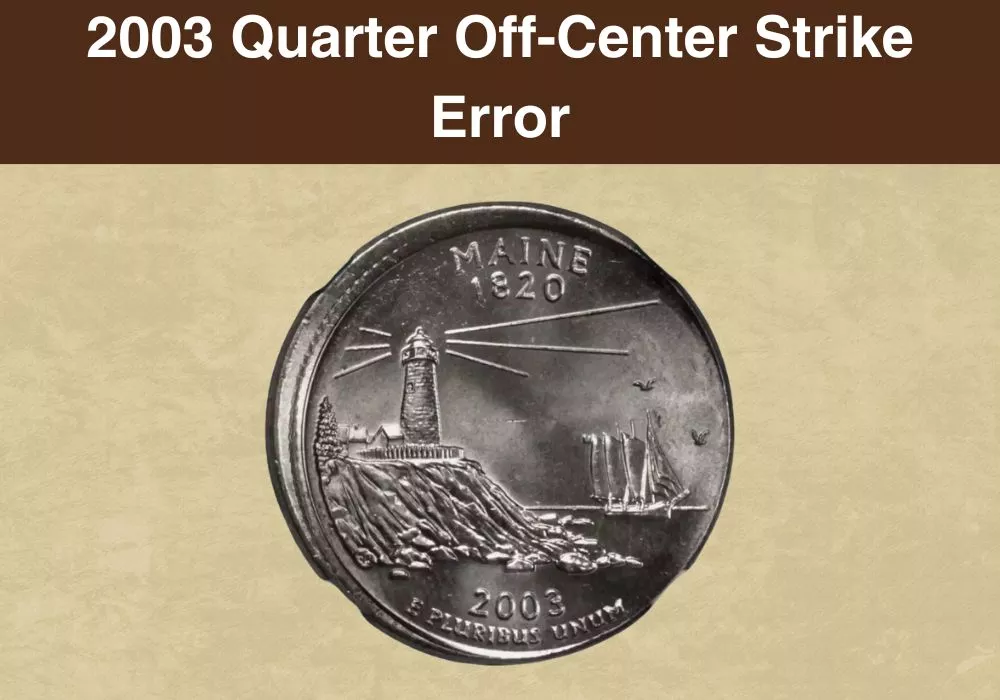
An off-center strike occurs when the planchet is not properly seated between the dies at the moment of impact. The feeding mechanism misfires, the blank shifts, and the die stamps only part of the planchet — leaving a crescent of blank metal on the opposite side.
The percentage of offset determines both the visual drama and the value. A 10% shift creates a modest blank sliver along one edge. A 50% shift means half the coin carries no design at all.
Collectors grade these by offset percentage, but the single biggest value factor is whether the date remains visible. A 40% off-center quarter with a readable “2003” is worth far more than a 60% off-center piece where the date is gone, because without the date the coin cannot be definitively attributed to a specific year.
Value: Off-center 2003 quarters at 10–20% shift bring $25–$75 in uncirculated condition. A 30–40% offset with the full date visible reaches $150–$300. Dramatic strikes at 50% or more off-center with the date and state name still readable have sold for $400–$500 at major auctions. The state reverse design matters less than the offset percentage and date visibility.
How to Identify: Hold the coin flat and look for a blank crescent along one edge. The struck portion should show sharp, fully formed design details — the design is simply in the wrong position, not weakly struck.
Confirm the date is readable. Measure or estimate the offset percentage by comparing the blank crescent to the coin’s total area.
Weigh the coin at 5.67 grams to verify a full planchet. An off-center strike uses a complete blank — only the strike was misaligned. The reeded edge will be absent on the blank side because the collar could not engage the portion of the planchet that was out of position.
Do not confuse this with a die adjustment strike. Die adjustment coins show uniform weakness with a centered design, while off-center strikes show strong details displaced to one side. The fastest check: a crescent of blank metal with sharp, fully struck design on the remaining portion.
Use Our 2003 Quarter Value Checker
6. 2003 Quarter Missing Clad Layer Error (Up to $745)

A standard quarter planchet is a copper core sandwiched between two layers of nickel alloy cladding. When the bonding between layers fails before the blank reaches the press, one or both outer layers can separate completely, leaving the copper core exposed.
The result is a coin that looks dramatically wrong — one side appears copper-brown or reddish instead of the normal silver-white finish. The design strikes normally into the copper surface, so all details remain sharp, but the color mismatch is impossible to miss.
Single-sided missing clad (one face copper, one normal) is more common than double-sided (both faces copper). The double-sided version, where the entire coin appears to be made of copper, is significantly rarer and commands a higher premium.
Value: A 2003 quarter with a missing clad layer graded MS63 sold for $745 at Heritage Auctions in 2021. Circulated examples with a single missing side trade for $100–$300 depending on how clean the copper surface appears. Double-sided missing clad quarters in uncirculated condition have reached $400–$700. The copper side must show uniform, uninterrupted color across the entire face to command top prices.
How to Identify: The most obvious sign is color. One side of the coin will appear copper-brown instead of silver-white. Hold it next to a normal quarter and the difference is unmistakable.
Weigh the coin on a digital scale. A standard quarter weighs 5.67 grams. A coin missing one clad layer typically weighs 4.5–5.0 grams because nickel alloy is denser than the copper core it normally covers.
Check that the design details are fully struck and sharp on the copper side. If the details are mushy or incomplete, you may be looking at environmental damage or a coin that was chemically stripped rather than a genuine missing clad layer.
Do not confuse this with a coin someone has plated, painted, or deliberately altered. Artificial copper color often shows scratching or uneven coating, while a genuine error displays consistent, natural copper tone across the entire face. The fastest check: copper color on one side plus reduced weight equals missing clad layer.
Use Our 2003 Quarter Value Checker
7. 2003 Quarter Re-Punched Mintmark Error (Up to $820)
A re-punched mintmark occurs during die preparation when the mintmark punch is applied more than once, with the second impression landing slightly offset from the first. The result is a mintmark that shows visible doubling, shadowing, or a secondary outline near the primary letter.
On 2003 quarters, the “D” mintmark for Denver is located on the obverse to the right of Washington’s ponytail. When the punch struck the die twice at slightly different positions, both impressions transferred to every coin struck by that die.
The 2003-D Illinois quarter has a documented RPM variety that drew collector attention at auction. Because RPMs are die varieties — repeatable across every coin from the affected die — they can be cataloged and tracked, which gives them more stable market value than one-off striking errors.
Value: A 2003-D Illinois quarter with a re-punched “D” mintmark graded MS65 sold for $820 at Coin World Auctions in 2018. Minor RPMs with subtle offset visible only under magnification trade for $15–$50 in circulated condition. Strong RPMs where the secondary impression is clearly separated from the primary mintmark reach $100–$400 in uncirculated grades. The separation distance between the two impressions directly affects the premium.
How to Identify: Focus a 10x loupe on the “D” mintmark to the right of Washington’s ponytail. On an RPM, you will see a second outline, shadow, or partial letter offset from the primary mintmark. The secondary impression may appear above, below, or to one side of the main letter.
Coin Identifier and Value App
Not sure what your coins are worth? Get Instant Value • Grade • Error Detection with coin identifier and value app (FREE Usage Daily)
Compare the mintmark to a normal 2003-D quarter. On a standard coin, the “D” has clean, singular edges. On an RPM, the edges appear doubled, thickened, or show a ghost letter nearby.
Do not confuse RPMs with die deterioration doubling, which creates mushy, ill-defined spreading around design elements as the die wears out. True RPMs show a crisp secondary impression with clear letterform — you can see the shape of a second “D” rather than just a vague blur.
Check multiple coins if possible. Because this is a die variety, every coin from the same die pair shows identical doubling in the same position. The fastest check: a crisp second “D” outline offset from the primary mintmark, consistent in direction and distance.
Use Our 2003 Quarter Value Checker
8. 2003 Quarter Wrong Planchet Error (Up to $3,000)

A wrong planchet error occurs when a blank intended for another denomination slips into the quarter press. In the high-speed production environment of the U.S. Mint, planchets for nickels, dimes, and quarters share storage and feeding systems, and occasionally a blank finds its way into the wrong hopper.
When a nickel-sized planchet reaches the quarter dies, it receives the full Washington and state design on a disc that is too small, too light, and the wrong diameter. Outer design elements get cut off because the planchet cannot accommodate the full impression. A dime planchet creates an even more dramatic mismatch — the quarter design compressed onto a coin barely larger than a thumbnail.
After 2002, the Mint implemented waffle cancellation machines to destroy defective coins before they reached circulation. This made post-2002 wrong planchet errors significantly scarcer than earlier examples, which is why 2003 specimens command higher premiums.
Value: A 2003-P Illinois quarter struck on a nickel planchet sold for $1,150 at Heritage Auctions. Confirmed wrong planchet 2003 quarters have traded in the $1,500–$3,000 range at major numismatic auctions depending on grade and which planchet was used. A 2003 Arkansas quarter struck on a dime planchet has been estimated at $2,000–$7,000, though verified sold prices are harder to pin down. Dime planchet strikes command more than nickel planchet strikes because the size mismatch is more extreme.
How to Identify: Weigh the coin first. A standard quarter is 5.67 grams and 24.3mm in diameter. A quarter struck on a nickel planchet weighs approximately 5.0 grams and measures 21.2mm. A quarter struck on a dime planchet weighs roughly 2.27 grams and measures 17.9mm. The weight discrepancy is the single most reliable diagnostic.
Check the edge. A quarter struck on a nickel planchet will have a smooth, unreeded edge because nickel planchets are not designed for reeding. A dime planchet already has reeding, so a quarter on a dime blank may show reeded edges at a smaller diameter than normal.
Examine the design coverage. On wrong planchet strikes, peripheral details — rim lettering, state names, date — may be partially missing or compressed because the undersized blank could not reach the full extent of the die.
Have any suspected wrong planchet error authenticated by PCGS or NGC. Counterfeits exist, and a slab from a major grading service protects the investment. The fastest check: if a coin carrying the quarter design weighs significantly under 5.67 grams and measures under 24.3mm, it is almost certainly struck on the wrong planchet.
Use Our 2003 Quarter Value Checker
Conclusion
The 2003 state quarter errors range from $5 for minor die cracks to $3,000 or more for confirmed wrong planchet strikes. The middle ground — missing clad layers around $745 and re-punched mintmarks near $820 — offers the best balance of availability and return. All five 2003 state designs produced errors, though Illinois shows up most frequently in auction records for the higher-value categories. A digital scale, a 10x loupe, and calipers cover every diagnostic on this list.