Rare 2002 Dime Errors Worth Money (Full List With Pictures)
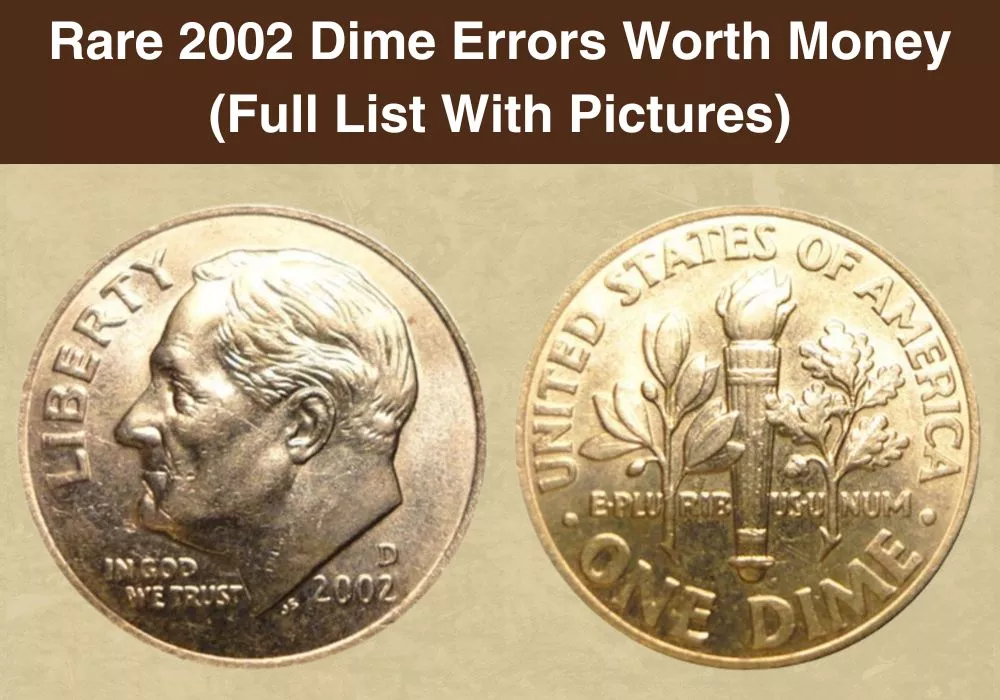
A 2002-P Roosevelt dime with a retained cap error sold at Stack’s Bowers in 2023 for $1,470. The complete 2002 dime error list spans 13 distinct mint mistakes, with values running from $5 die cracks to four-figure striking errors that left coins folded, capped, or struck twice. Philadelphia and Denver each produced over a billion dimes that year, and the vast majority are worth ten cents. But a few came off the presses in ways the Mint never intended — here’s every documented error, sorted by value, with auction records and identification details.
1. 2002 Dime Die Crack Error (Up to $100)

Die cracks form when striking dies fracture from repeated stress and heat cycles. Metal fills the fracture line and transfers onto every coin as a thin raised line across the surface.
Cracks can appear anywhere — through Roosevelt’s portrait, the torch, or cutting across LIBERTY. Small hairline cracks are extremely common on 2002 dimes from both mints. A crack crossing a major design element is a different story. The most dramatic examples run rim-to-rim across the entire coin, and late-stage cracks sometimes develop into full cuds where a chunk of the die breaks away entirely.
Value: No specific 2002 dime die crack has sold as a headline lot at a major auction house, though the error type regularly trades on eBay. Small cracks add $2–$5 above face value. Dramatic rim-to-rim cracks in uncirculated condition reach $50–$100. Cracks on both obverse and reverse from the same die pair push prices further. Location drives value — a crack across Roosevelt’s face outsells one hiding near the rim every time.
How to Identify: Look for thin, raised lines running across the coin’s surface. Die cracks sit above the metal, not into it. Run your fingernail perpendicular across a suspected line — it should catch upward.
Use a loupe to trace the full length. Cracks follow irregular, lightning-bolt-like paths rather than perfectly straight lines. Check both sides — the most valuable examples show cracks on obverse and reverse simultaneously.
If the crack reaches the rim and a chunk of the die has broken away leaving a blob, that’s a cud — related but separately categorized. Don’t confuse die cracks with scratches. Scratches cut into the surface and show metal displacement; cracks are clean raised ridges with consistent width. Fastest confirmation: raised line you can feel with a fingernail.
Use Our 2002 Dime Value Checker
2. 2002 Dime Struck Through Error (Up to $100)
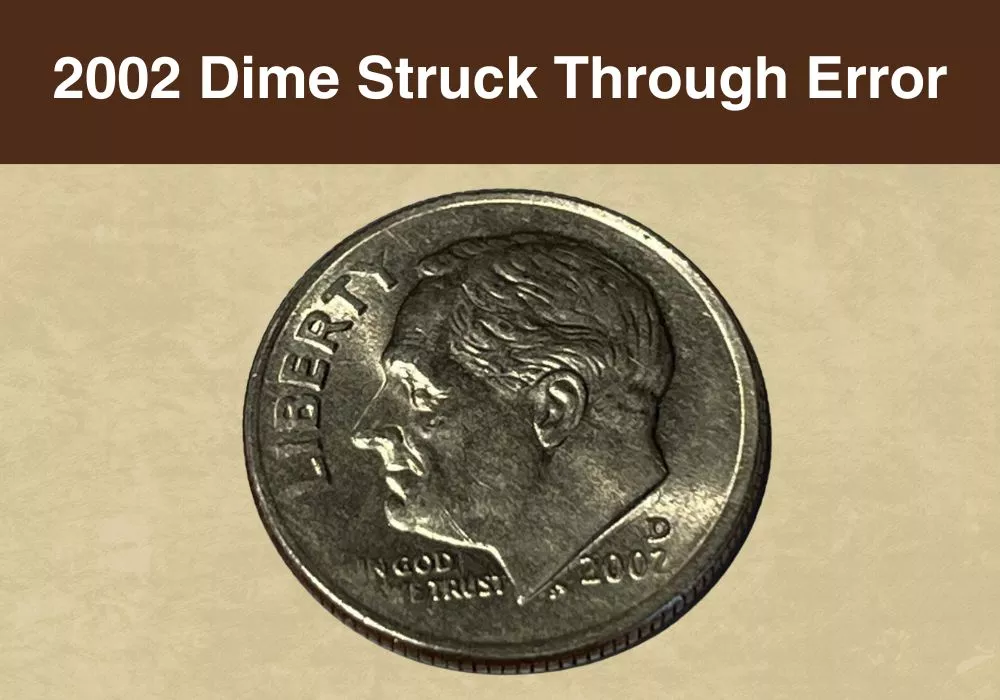
A struck-through happens when a foreign object gets trapped between the die and planchet during striking. The object blocks part of the design from impressing fully onto the coin.
Grease is the most frequent culprit — press lubricant pools in die recesses and fills in design detail. The result is a smooth, blank patch where lettering or design elements should be. Other materials cause strike-throughs too: cloth fibers, metal shavings, wire, hair. When the foreign object stays physically embedded in the finished coin — a “retained” strike-through — the value jumps significantly because the proof is sitting right there on the surface.
Value: No specific 2002 dime struck-through has surfaced as a major auction headline. Grease-filled examples with small affected areas trade for $10–$50 on eBay. Larger affected zones on uncirculated coins push $50–$100. Retained strike-throughs — foreign material still embedded — consistently command the strongest premiums. On other Roosevelt dime dates, retained examples have sold for $500–$1,000+, but no confirmed 2002-specific record at that level.
How to Identify: Look for a localized area where the design appears weak, mushy, or entirely absent — a smooth blank zone surrounded by otherwise normal detail. The boundaries between the struck-through area and normal detail should be relatively sharp.
Grease strike-throughs produce featureless, smooth patches. Solid-object strike-throughs (cloth, wire) may leave visible texture — sometimes you can identify the material. Check whether anything is physically stuck to the surface, which would make it a retained strike-through.
Make sure the weakness isn’t just from circulation wear. Strike-throughs affect a specific localized area while wear spreads evenly across all high points. Fastest confirmation: sharply defined weak zone surrounded by normal strike quality.
Use Our 2002 Dime Value Checker
3. 2002 Dime Clipped Planchet Error (Up to $100)
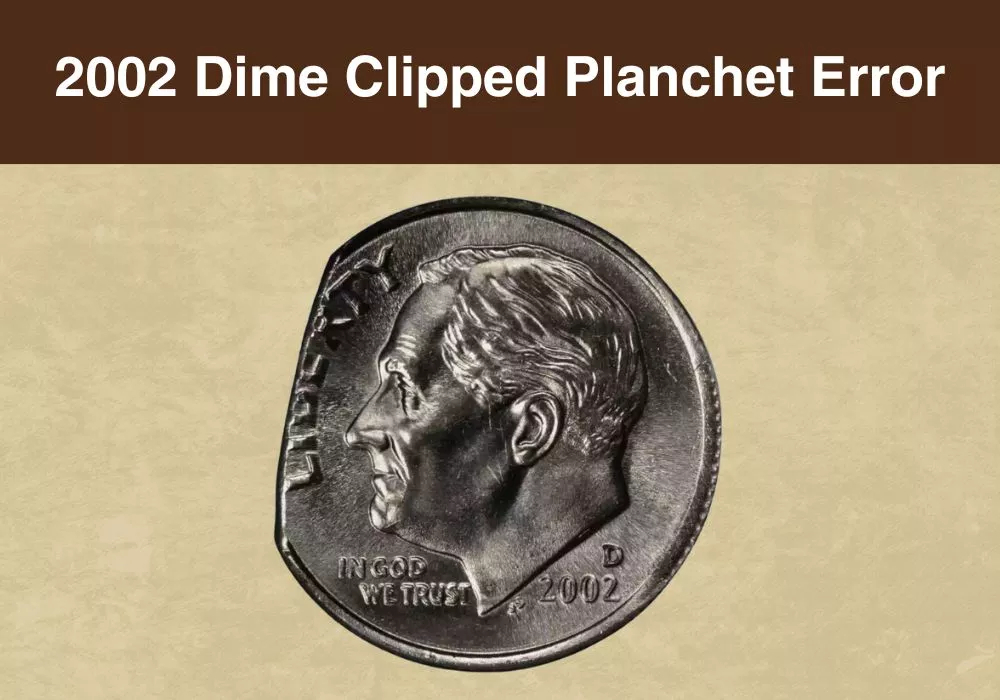
Clipped planchet errors start at the blanking press. When the metal strip feeds incorrectly, the punch overlaps a previously cut hole or catches the strip’s edge, producing an incomplete blank with a missing section.
Three types exist. Curved clips — the most common — have a smooth arc-shaped missing section from overlapping a previous punch hole. Straight clips show a flat, linear missing edge where the punch hit the strip’s border. Ragged clips have a rough, torn edge from damaged strip metal. Ragged clips look the most dramatic and generally bring the highest prices because the irregular edge is unmistakably wrong.
Value: No specific 2002 dime clipped planchet has sold as a major auction lot. General market prices for clipped Roosevelt dimes range from $30–$100 in mint state. Small curved clips removing less than 5% of the planchet bring the low end. Dramatic ragged clips with 20%+ missing metal push toward $100. On comparable Roosevelt dime years, large clipped planchets with certified grades have reached $500–$985 (Stack’s Bowers sold a 2003-D ragged clip for $985).
How to Identify: Look for a section of missing metal along the coin’s edge. Curved clips show a smooth arc; straight clips show a flat line; ragged clips show an irregular, torn edge.
Check for the Blakesley Effect — a weakening of the rim on the opposite side of the coin from the clip. This occurs because the incomplete planchet can’t receive full striking pressure at 180 degrees from the missing section. The Blakesley Effect is the single strongest indicator that the clip happened before striking, not after.
Weigh the coin — clipped planchets come in under 2.27 grams. Post-mint damage from pliers shows scratches, tooling marks, and sharp edges without opposite-side rim weakness. Fastest confirmation: missing edge plus Blakesley Effect on the opposite rim.
Use Our 2002 Dime Value Checker
4. 2002 Dime Die Clash Error (Up to $100)
A die clash happens when the obverse and reverse dies strike each other without a planchet between them. The impact transfers a mirror image of each die’s design onto the other.
When coins are subsequently struck by those damaged dies, they carry ghost images — Roosevelt’s profile faintly visible behind the reverse torch, or torch details showing through the obverse field. Die clashes occur during press malfunctions when the feeder mechanism fails to deliver a planchet. The ghost images are incuse (sunken) impressions, not raised, because they’re the inverse of the opposing die’s relief.
Value: Die clash errors on 2002 Roosevelt dimes generally trade for $30–$50 in circulated condition and $75–$100 in uncirculated grades with clear clash marks. No major auction house has sold a 2002 die clash as a standalone headline lot. Multiple clash impressions from the same die — where the press fired several times without a planchet — create bolder ghost images and bring higher prices. One 2002-P dime graded MS69 with a strong die clash reportedly sold on eBay in 2015 for $1,440, though the MS69 grade likely drove much of that price.
How to Identify: Look for faint design elements that shouldn’t appear on that side of the coin. The most common tell on Roosevelt dimes is Roosevelt’s profile ghosting behind the reverse torch and branches.
The ghost images appear as incuse (sunken) impressions, not raised. They’re mirror-reversed versions of the opposing die’s design. Use angled lighting — clash marks often only show under specific light angles because they’re subtle. Tilt the coin slowly under a desk lamp and watch for faint outlines emerging in the field.
Check the rim areas for small dings or raised spots where the dies’ edges collided. Don’t confuse die clashes with strike-throughs — a clash creates a recognizable mirror image of the opposite design, while a strike-through just creates a blank or weakened area. Fastest confirmation: recognizable mirror-image ghost of the opposite side’s design, visible under angled light.
Use Our 2002 Dime Value Checker
5. 2002 Dime Off-Center Strike Error (Up to $200)
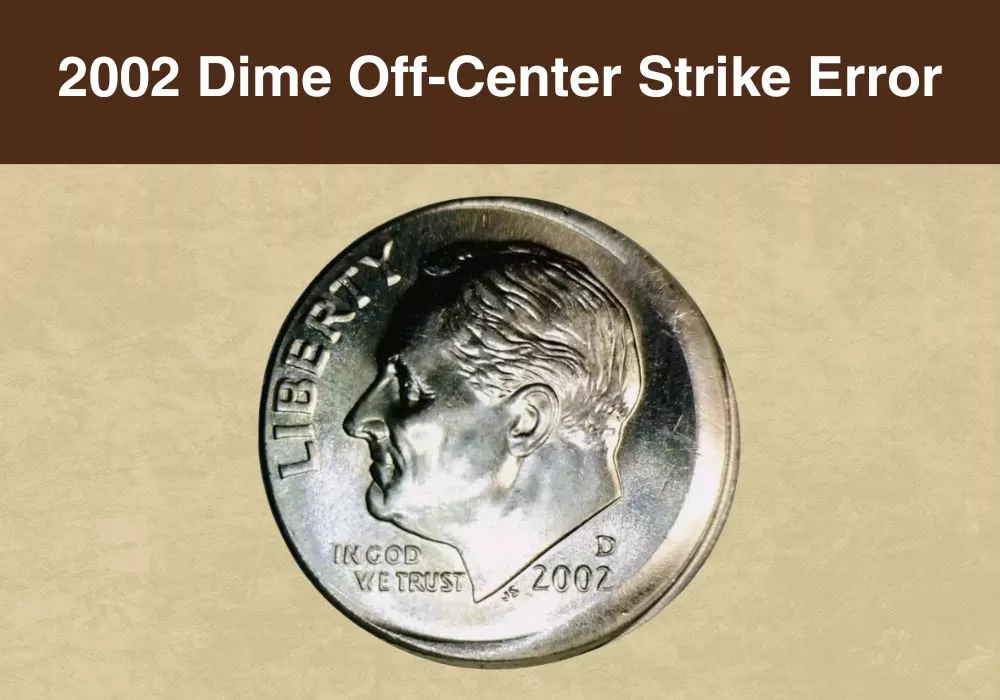
Off-center strikes happen when the planchet isn’t properly seated in the striking chamber. The die comes down, but the blank has shifted — only part of it catches the full impression.
The result is a crescent of smooth, unstruck metal on one side with the design pushed toward the opposite edge. Off-center percentage determines value. A 5% shift barely registers visually; 50% leaves half the coin blank. Whether the date “2002” survived matters more than almost anything else — a 40% off-center with a readable date outperforms a 60% without one at auction.
Value: No specific 2002 dime off-center strike has sold as a major auction headline lot. General market prices for off-center Roosevelt dimes run $10–$20 for minor 5–10% shifts, $50–$200 for dramatic 30–50% displacements with visible dates. On comparable years, Heritage Auctions sold a 2003-P dime MS65 at 15% off-center for $1,325. A 2002 dime with similar displacement and grade would trade in the same territory, but no confirmed record exists at that level for this specific year.
How to Identify: Look for a clean crescent of blank, featureless metal on one side. The design will be shifted toward the opposite edge, with part of the lettering or portrait cut off. Both obverse and reverse shift in the same direction.
Don’t confuse with a Misaligned Die (MAD) error. A MAD shows the complete design with uneven rim width — nothing is missing. An off-center strike always has blank planchet showing and part of the design gone.
Post-mint damage from machinery creates uneven distortion with visible scratches and tooling marks. Genuine off-center strikes have clean, smooth unstruck areas. Fastest confirmation: clean blank crescent with the design clearly shifted and partially missing, and check whether the date is readable.
Use Our 2002 Dime Value Checker

Coin Identifier and Value App
Not sure what your coins are worth? Get Instant Value • Grade • Error Detection with coin identifier and value app (FREE Usage Daily)
6. 2002 Dime Brockage Error (Up to $901)
A brockage forms when a previously struck coin fails to eject from the press and gets struck into the next incoming planchet. The stuck coin acts like a secondary die, pressing its design — in mirror-image — into the fresh blank.
The result is a coin with a normal design on one side and a sunken, reversed impression of the same design on the other. On a 2002 dime brockage, you’d see a normal Roosevelt portrait on the obverse but a sunken, backward Roosevelt impression on the reverse instead of the torch. The incuse mirror image is what separates a brockage from a cap die error, which develops over multiple strikes.
Value: In 2009, GreatCollections auctioned a 2002-D dime graded MS66 with a brockage error for $901. That’s a clean example with a clear, readable mirror-image impression. Brockage errors on Roosevelt dimes generally range from $200–$900 depending on the clarity of the reversed image and the coin’s grade. Early-stage brockages with sharp, detailed reversed designs command higher prices than late-stage examples where the image has deteriorated into an unreadable blob.
How to Identify: Flip the coin over. One side should show a normal struck design. The other side should show an incuse (sunken) mirror-image of a coin design — letters read backward, the portrait is reversed.
The mirror image should look like a negative impression pressed into the surface, not a raised design. It may be slightly distorted depending on the angle at which the stuck coin pressed into the new planchet.
Don’t confuse with a die clash, which produces faint ghost images. A brockage impression is much deeper, more complete, and covers most or all of the affected side. Also distinguish from a cap die error — a brockage is typically from a single extra strike, while cap errors develop over multiple strikes and create a cupped coin shape. Fastest confirmation: one normal side plus one side with a deep, reversed, incuse mirror-image design.
Use Our 2002 Dime Value Checker
7. 2002 Dime Double Rim Error (Up to $960)
A double rim error — also called a partial collar strike — occurs when the planchet isn’t fully seated in the collar during striking. Part of the blank sits inside the collar and gets normal reeding; the part above the collar expands freely.
The result is a visible “step” or shelf along the rim, where the reeded section abruptly transitions to a smooth, expanded area. From the side, the coin looks like it has a miniature staircase running along part of its edge. The three-dimensional quality of the dual rim impression gives these coins an unusual visual depth that’s hard to miss once you know what to look for.
Value: In 2011, Stack’s Bowers auctioned a 2002-P dime graded MS65 with a double rim error for $960. Circulated examples with subtle double rim effects trade for $50–$200. The more pronounced the step, the higher the price. Minor double rims that require magnification to see barely attract interest, while dramatic examples with obvious staircase edges in MS65+ push past $500 without much trouble.
How to Identify: Flip the coin on its side and examine the edge. Look for a distinct step — a visible transition between a normally reeded section and an expanded smooth section on the same coin.
Use calipers to measure. The expanded section will exceed the standard 17.91mm diameter while the collared section stays normal. This dimensional difference on a single coin is the defining feature.
A broadstrike has a uniformly smooth edge all the way around — no reeding anywhere. A double rim coin has both reeded and smooth sections. The shadow rim may appear as a secondary ridge inside or outside the primary rim and may not circle the entire coin. Dryer damage creates uneven distortion with surface scratches, not the clean step of a genuine partial collar error. Fastest confirmation: view edge-on and look for the step between reeded and smooth sections.
Use Our 2002 Dime Value Checker
8. 2002 Dime Misaligned Die Error (Up to $1,045)
A misaligned die error happens when the dies aren’t properly centered during installation. One or both dies sit off their intended axis, so the strike lands slightly out of position.
A tilted die adds another dimension — the die isn’t just off-center, it’s angled. This creates uneven striking pressure: one side of the coin gets a stronger impression while the opposite side comes out weak. On this particular 2002-P dime, the tilt shifted Roosevelt’s profile upward, leaving an oversized rim at the bottom and cutting into the date. The reverse showed uneven pressure with variable strike strength across the design.
Value: In 2017, a 2002-P dime graded MS68 with a partial tilt combined with a misaligned die error sold on eBay for $1,045. The MS68 grade contributed significantly to that price. Standard misaligned die errors on circulated Roosevelt dimes are common and bring $10–$50 for minor shifts. Dramatic misalignments visible to the naked eye on uncirculated coins can reach $100–$300. Combined tilt-plus-misalignment errors are scarcer and trade higher when the visual impact is obvious.
How to Identify: Examine the rim width around the entire circumference. On a properly struck coin, the rim is uniform. A misaligned die coin shows one side noticeably wider while the opposite side narrows or nearly disappears.
The full design will be present — nothing is missing. This is the critical distinction from an off-center strike, which always has blank planchet showing. A misaligned die coin has everything, just shifted.
For tilted dies, check the striking depth on opposite edges. One side will show deeper, sharper detail while the other looks weak and shallow. The uneven pressure across the coin is a telltale sign. Examine the date area — tilted strikes often clip into the date digits on one side. Fastest confirmation: complete design present but with obviously uneven rim width and variable strike pressure across the coin.
Use Our 2002 Dime Value Checker
9. 2002 Dime Die Gouge Error (Up to $1,080)
A die gouge is a deep, linear scratch or groove cut into the die’s striking surface. It usually happens during die maintenance — when workers use tools to clean debris or damage off the die, the tools themselves leave marks.
Those grooves in the die transfer as raised scratches on every coin struck afterward. Unlike die cracks, which follow the die’s internal stress fractures, gouges are straight or gently curved lines that look deliberate and mechanical. On this 2002-D example, the gouge crossed Roosevelt’s face, giving his portrait a scarred appearance that made the coin visually distinctive enough to attract serious auction attention.
Value: In 2013, Stack’s Bowers sold a 2002-D dime graded MS68 with a die gouge error for $1,080. The gouge across Roosevelt’s face and the gem MS68 grade together drove that price. General market prices for die gouges on circulated coins are modest — $10–$50 for most examples. Dramatic gouges crossing prominent design elements on uncirculated coins push into the $100–$300 range. The combination of location, severity, and grade determines where the price lands.
How to Identify: Look for a raised, linear mark on the coin’s surface that appears too straight and deliberate to be a die crack. Die gouges tend to be deeper and wider than cracks, with a more consistent profile.
Unlike die cracks, which meander like lightning bolts following internal stress lines, gouges run in straighter paths because they were physically scraped by a tool. The raised line should be present on every coin struck by that die — if you find two coins with identical gouges, that confirms the die origin.
Don’t confuse with post-mint scratches. Die gouges are raised above the surface (the groove in the die fills with metal during striking). Post-mint scratches are recessed into the surface. Run your fingernail across it — a gouge catches upward. Fastest confirmation: raised, straight-line mark that catches your fingernail upward.
Use Our 2002 Dime Value Checker
10. 2002 Dime Missing Clad Layer Error (Up to $1,180)
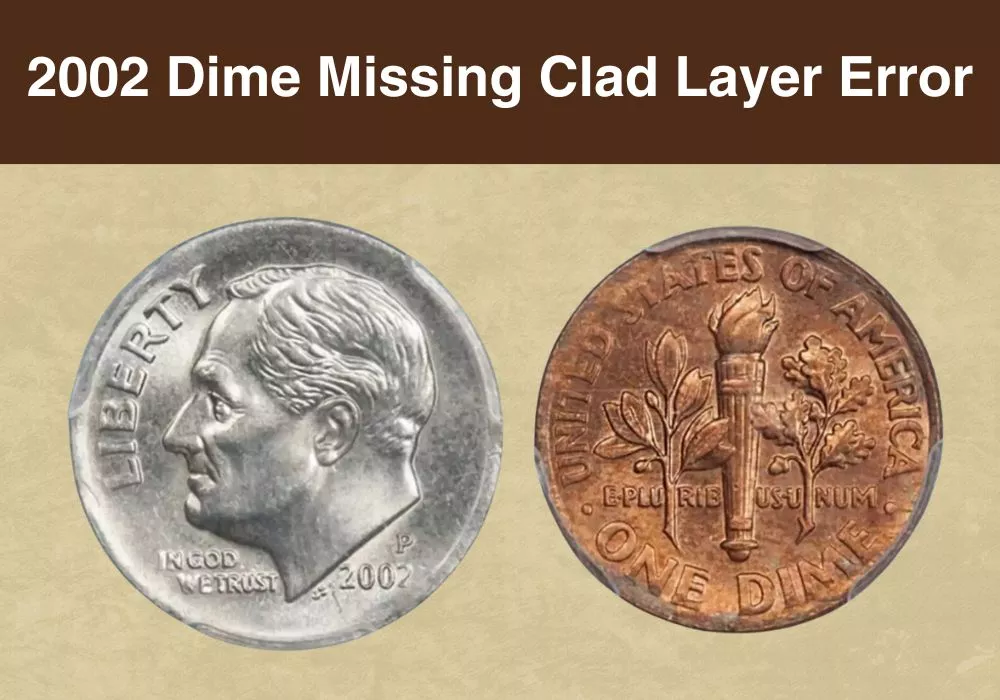
Roosevelt dimes are three-layer coins — a copper core between two outer skins of 75% copper / 25% nickel alloy. When contaminants or oxides prevent proper bonding at the strip mill, one or both outer layers can separate before the blank is punched.
The exposed copper core gives the affected side a vivid reddish-brown color. It jumps out of any pile of change without magnification. Denver-minted 2002 dimes are the primary documented source for this error. On the side opposite the missing layer, the design typically appears weak or mushy because the thinner planchet couldn’t fill the die cavities.
Value: In 2016, Heritage Auctions sold a 2002-D dime graded MS67 with a missing clad layer error for $1,180. The MS67 grade and dramatic visual contrast drove that price. Circulated examples with smaller exposed copper areas trade for $20–$100. Certified coins in MS64–MS67 range from $200–$1,000 depending on the extent of the missing layer. Dual missing clad — both sides showing copper — is exceptionally rare and would command well above $1,000.
How to Identify: Color is the first clue. One or both sides will appear copper — brassy orange to dark brown — instead of the normal silver tone.
Weigh it. This is the make-or-break test. A standard dime weighs 2.27 grams. A coin missing one clad layer comes in around 1.8–2.0 grams. If your copper-colored dime weighs the full 2.27 grams, it’s almost certainly been acid-treated — a post-mint alteration worth face value. Use a digital scale accurate to 0.01g.
Check the rim for an abnormally thin profile or absent cladding band. Examine the opposite side — the design should look weak where the thinner planchet couldn’t fill the die cavities. Acid-stripped fakes retain full detail on both sides at normal weight. Fastest confirmation: copper color plus weight well below 2.27 grams.
Use Our 2002 Dime Value Checker
11. 2002 Dime Folded Planchet Strike Error (Up to $1,290)
A folded planchet error starts before the coin is struck. When the blank planchet is improperly fed into the press, it can fold or crease under the mechanical force of the feeder mechanism.
The folded blank then gets struck by the dies, which compress the folded metal under enormous pressure. The result is a distorted, partially crescent-shaped coin with overlapping metal where the planchet doubled over on itself. One section may show both obverse and reverse design elements compressed into the same area. On this 2002-D example, Roosevelt’s face was partially folded over itself at an angle, while the reverse showed an incomplete strike with the torch blending into the oak branch.
Coin Identifier and Value App
Not sure what your coins are worth? Get Instant Value • Grade • Error Detection with coin identifier and value app (FREE Usage Daily)
Value: In 2018, Heritage Auctions sold a 2002-D dime graded MS67 with a folded planchet strike error for $1,290. The dramatic visual distortion and high grade combined to produce that price. Folded planchet errors on dimes generally range from $300–$1,300. The degree of fold matters — a slight crease at the edge brings the low end, while a coin folded nearly in half with design elements overlapping attracts maximum attention. Clean, high-grade examples always outperform battered ones.
How to Identify: The coin’s shape is the giveaway. A folded planchet will not be flat — it may look partially bent, creased, or crescent-shaped. Part of the coin may overlap itself where the metal folded before striking.
Check for areas where obverse and reverse design elements appear compressed into the same physical space. The fold line may show as a sharp crease or ridge across the surface.
The coin will likely be irregularly shaped when viewed from above, not a clean circle. Hold it flat on a surface — if it rocks or doesn’t sit flat, that’s consistent with the fold. Examine the thickness — folded areas will be noticeably thicker than normal. Don’t confuse with post-mint bending or jewelry damage, which creates smooth curves without any struck-in design overlap. Fastest confirmation: irregular shape with overlapping struck design where the metal folded before impact.
Use Our 2002 Dime Value Checker
12. 2002 Dime Flip-Over Double Strike Error (Up to $1,340)
A flip-over double strike is a two-act error. First, the coin is struck normally. Then, instead of ejecting, it stays in the press, flips over, and gets struck a second time on its opposite side.
The second strike impresses the obverse design partially onto the reverse, or vice versa, creating an overlapping pattern of both sides on the same face. On this 2002-P example, Roosevelt’s silhouette appeared under the torch and olive branch, while part of the E PLURIBUS UNUM inscription showed faintly over the obverse. The overlapping ghost imagery gives these coins a layered, almost holographic quality under magnification.
Value: In 2022, GreatCollections auctioned a 2002-P dime graded MS66 with a flip-over double strike error for $1,340. The clear, readable ghost imagery and gem grade drove the price. Double strike errors on Roosevelt dimes generally range from $500–$1,500 depending on how clearly both impressions read. The second strike’s visibility is everything — a faint ghost barely visible under magnification brings the low end, while a bold secondary impression readable to the naked eye commands the top.
How to Identify: Look for design elements from the opposite side appearing as a secondary impression. Roosevelt’s profile ghosting under the torch and branches on the reverse is the most common tell. The overlapping imagery affects both sides since the coin was struck twice from different orientations.
The secondary impression will be weaker than the primary strike and may appear slightly rotated, since the coin flipped between strikes. Check the alignment — the ghost image won’t line up perfectly with the primary design because the coin didn’t land in exactly the same position after flipping.
This is different from a die clash. A die clash leaves faint, subtle ghost marks from dies striking each other empty. A double strike produces a much bolder secondary impression because the full force of the press struck the coin twice. The doubled rim is another indicator — the coin will show evidence of two separate collar engagements. Fastest confirmation: bold secondary design from the opposite side visible on both faces, with evidence of two separate strikes.
Use Our 2002 Dime Value Checker
13. 2002 Dime Retained Cap Error (Up to $1,470)
A retained cap error starts when a freshly struck coin sticks to the upper die and doesn’t eject. That stuck coin becomes a new “die face” — and it keeps striking incoming planchets.
With each successive strike, the stuck coin deforms further, curling around the die and taking on a cap-like shape. The incoming planchets receive a weak, mirror-image impression from the stuck coin’s design instead of the proper die. The result is a coin with a ghost-like brockage image on one side and often a cupped or bowl-shaped profile. These are among the most mechanically complex errors — multiple things had to go wrong in sequence, and the press had to keep running.
Value: In 2023, Stack’s Bowers auctioned a 2002-P dime graded MS69 with a retained cap error for $1,470 — the highest confirmed price for any 2002 dime error. The near-perfect MS69 grade combined with the error’s rarity produced that result. Cap errors on Roosevelt dimes generally range from $500–$1,500. Early-stage caps with clearer brockage impressions bring more than late-stage caps where the image has degenerated into an unrecognizable blob.
How to Identify: Look for a coin with raised, shelf-like rims and a concave or dish-shaped profile — the cap shape is immediately noticeable. One side may show a sunken, reversed mirror-image of a coin design instead of the expected normal design.
The coin may be cupped or bowl-shaped when viewed from the edge. The brockage side will show backward-reading letters and a reversed portrait.
Check whether the rim is significantly higher than a normal dime — the metal flows upward as the cap forms around the die. The struck side should show the normal die design, while the opposite side carries the incuse ghost impression from the stuck coin above it. Don’t confuse with a simple brockage from a single extra strike — a cap error coin will be cupped, while a standard brockage stays flat. Fastest confirmation: cupped shape plus reversed, incuse design impression on one side.
Use Our 2002 Dime Value Checker
Conclusion
The 2002 dime error spectrum runs from $5 die cracks at the bottom to a $1,470 retained cap that set the year’s auction record at Stack’s Bowers. Between those poles, a solid middle tier of brockages, double rims, die gouges, and missing clad layers fills out the $900–$1,200 range. The mechanical strikes — folded planchets, flip-over double strikes, and cap errors — consistently command the highest prices because they produce the most visually dramatic coins. A digital scale, a 10x loupe, and a pair of calipers cover the basics for checking all 13 error types listed here.