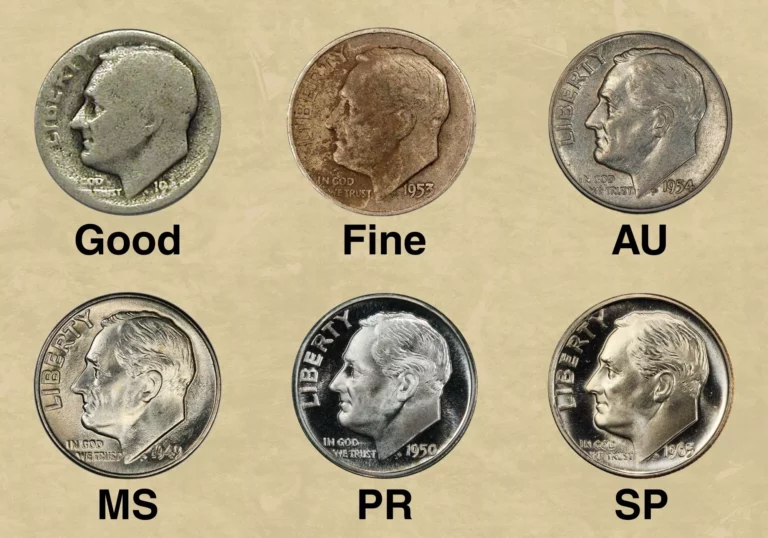
Rare 2001 Dime Errors Worth Money (Full List With Pictures)
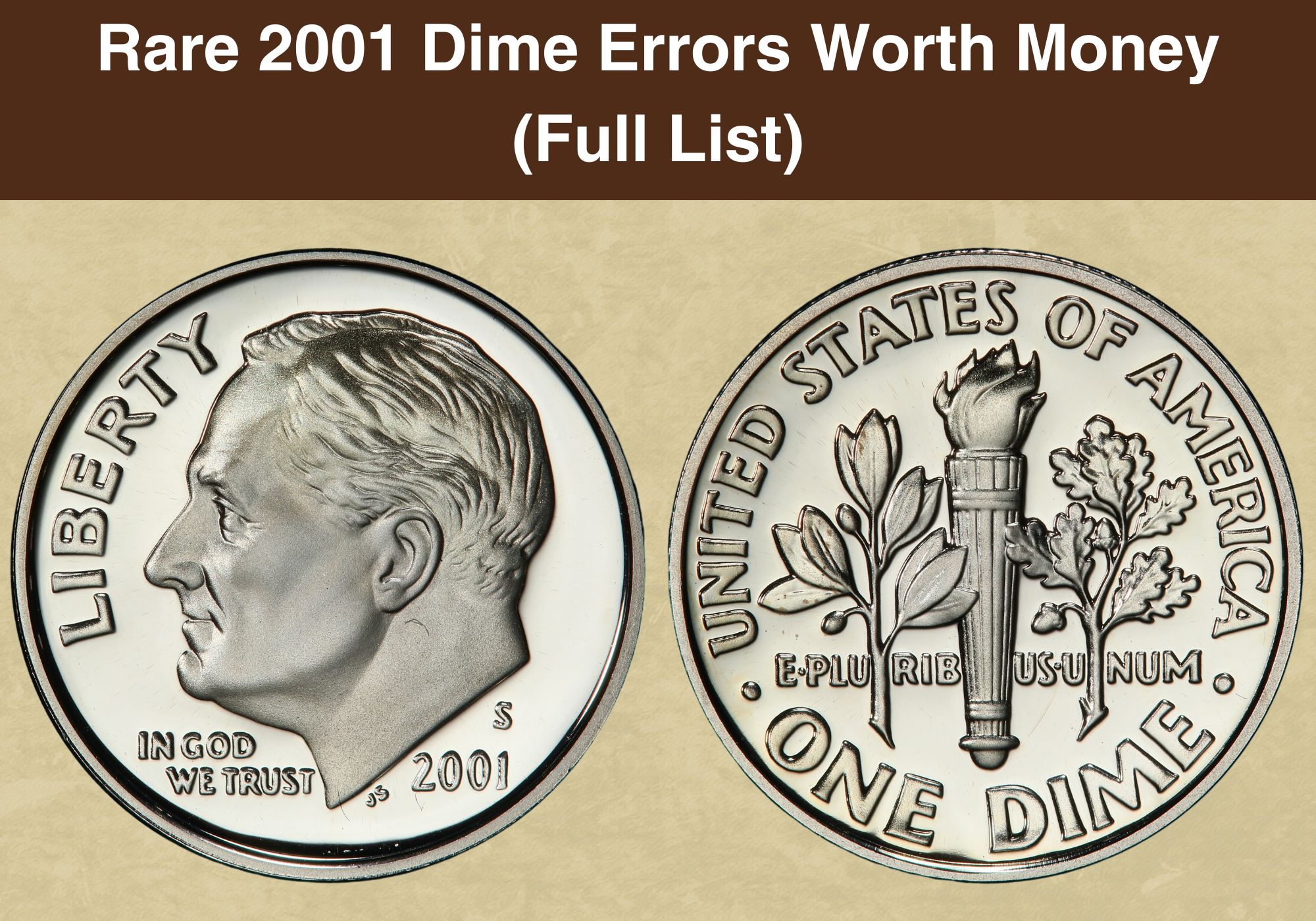
A 2001-P dime struck on a penny planchet sold for $2,850 at Heritage Auctions — not bad for a coin most people spend without a second glance. The complete 2001 Dime error list covers sixteen known error types with confirmed auction records ranging from $380 to $2,850.
Most 2001 dimes are worth face value, but the ones that went wrong at the mint play by different rules. Here are all sixteen, sorted from least to most expensive.
1. 2001 Dime Die Chip Error (Up to $800)

Die chips form when small fragments break off the striking die under repeated high-pressure impacts. The missing piece leaves a void in the die face, and that void transfers as a raised blob of extra metal onto every coin struck afterward.
These blobs range from pinhead-sized dots to lumps several millimeters across. They appear anywhere — Roosevelt’s cheek, inside letters, on the torch flame.
What determines value is location, not size alone. A chip on Roosevelt’s nose draws collector attention; one sitting in the open field between design elements barely registers.
Value: A 2001-D die chip on Roosevelt’s cheek, graded MS66, sold for $380 at Heritage Auctions in 2019. Larger chips affecting prominent facial features have brought $500 to $800 at auction in comparable grades.
Die chips on the reverse torch or olive branches tend to sell lower, around $100 to $250. Ungraded examples with minor chips move on eBay for $20 to $75.
How to Identify: Use a 10x loupe and start with Roosevelt’s face, then move to the torch. Die chips appear as raised, irregular blobs — run a fingernail across the surface and you’ll feel them bump upward.
That upward direction is the critical distinction from post-mint damage, which pushes metal down into the surface. The blob’s shape should look organic and irregular, not geometric.
Check whether the bump sits on top of the normal design detail or has replaced it. Genuine die chips sit on top, adding extra metal rather than displacing it.
Coins from the same die pair will show the chip in an identical position, so finding a match in online variety registries confirms authenticity. The fastest test: tilt the coin under a desk lamp and look for a shadow cast by the raised blob.
Use Our 2001 Dime Value Checker
2. 2001 Dime Broadstruck Error (Up to $825)

A broadstruck error happens when the collar — the metal ring that constrains the planchet and forms the reeded edge — fails to engage during striking. Without that ring, the planchet metal spreads outward under die pressure like a pancake.
The result is a dime visibly larger in diameter than normal. All design details remain intact but appear stretched, as if someone pulled the coin outward from center.
The edge is the giveaway. Instead of normal vertical reeding, you get a smooth, flat rim all the way around.
Value: A 2001-P broadstruck error graded MS64 sold for $825 at GreatCollections, measuring approximately 19mm versus the standard 17.91mm. Coins with more dramatic expansion — 20% or more oversized — push into higher price territory, especially in uncirculated grades above MS65.
Lower-grade circulated broadstrikes sell for $75 to $300 on eBay depending on how much the planchet spread. The diameter increase is the main value driver.
How to Identify: Measure the diameter with a digital caliper or compare side-by-side with a normal dime. A broadstruck 2001 dime typically measures 18.5mm to 20mm, versus the standard 17.91mm.
Check the edge all the way around. There should be zero reeding — just a smooth, blank edge where the collar would normally have formed ridges.
Any partial reeding means you’re looking at a partial collar error instead. Place the coin on edge next to a normal dime — broadstrikes appear thinner because the metal spread laterally.
Weigh the coin: it should still hit 2.268 grams because no metal was added or removed. If the weight is off, you may have a wrong planchet error instead.
Use Our 2001 Dime Value Checker
3. 2001 Dime Split Planchet Error (Up to $940)

Split planchets occur when the metal alloy is improperly mixed during planchet production, creating internal weaknesses invisible from the outside. These weak spots cause the planchet to crack apart, either before or after striking.
The result looks like someone sliced the coin in half horizontally. One side retains a mostly intact design while the other exposes rough copper core with a distinctive granular texture.
The split can happen dead center or at an angle. No two split planchets look the same.
Value: A 2001-D split planchet error graded MS66 sold for $940 on eBay in 2008. The visual contrast — Roosevelt’s portrait on one side, raw copper on the other — made this example particularly collectible.
General market prices for split planchet dimes range from $200 to $500 in lower circulated grades. More severe splitting with larger exposed areas commands the highest premiums from error specialists.
How to Identify: Weigh the coin first. A normal 2001 dime hits 2.268 grams; a split planchet will weigh noticeably less because you’re holding a fraction of the original metal.
Check the exposed side for that characteristic granular copper texture. It should look rough and unfinished — smooth surfaces suggest someone ground the coin down, which is post-mint damage.
Examine the edge: thickness will be visibly less than a normal dime. The design on the intact side should still show a full, normal strike.
If the design appears weak on the intact side too, you might have a struck-through or weak strike error instead. The quickest confirmation: hold the coin edge-on and compare its thickness to a normal dime.
Use Our 2001 Dime Value Checker
4. 2001 Dime Clipped Planchet Error (Up to $970)

Clipped planchets happen during blanking when the metal strip doesn’t advance far enough between punches. The next punch overlaps a previously cut hole, creating an incomplete blank with a crescent-shaped bite taken out of one edge.
That incomplete blank gets fed into the press and receives a full design — minus whatever falls in the clipped area. The clip has a smooth, curved edge matching the radius of the blanking punch.
The mint’s quality control catches most of these. The survivors slipped past multiple inspection points.
Value: A 2001-D clipped planchet error graded MS66 sold for $970 at Stack’s Bowers Auctions in 2015. The prominent crescent clip combined with sharp remaining details drove the price.
Larger clips — 15% or more missing — generally command higher prices than small nicks. Circulated examples with minor clips sell for $25 to $100 on eBay, while moderate clips in AU grades bring $150 to $400.
How to Identify: Look for a smooth, curved indentation along the coin’s edge creating an incomplete circle. The clipped area will have no reeding — normal wear cannot remove reeding in such a clean, curved pattern.
Check for the “Blakesley effect” opposite the clip. The area directly across from the clip often shows a weak strike or missing rim because the metal had less material to flow into during the upset mill process.
The design on the remaining portion should be fully struck right up to the clip boundary. If the design fades gradually toward the edge, you may have a weak strike instead.
Minor clips under 10% add modest premiums; 10-25% is the sweet spot. The fastest check: look for the Blakesley effect on the opposite rim.
Use Our 2001 Dime Value Checker
5. 2001 Dime Rotated Die Error (Up to $980)

Rotated die errors happen when one die in the coin press physically loosens and rotates from its correct position. On a properly struck dime, the obverse and reverse are oriented 180 degrees apart — flip it top-to-bottom and both sides are upright.
When a die rotates, that relationship breaks. Roosevelt faces right on the obverse, but the torch appears tilted at 45, 90, or even 180 degrees when you flip the coin.
The greater the rotation angle, the higher the premium. A 15-degree shift is subtle; a 90-degree rotation is obvious to anyone.
Value: A 2001-D rotated die error graded MS65 sold for $980 at GreatCollections in 2012. The die had rotated enough to produce a visually dramatic misalignment between obverse and reverse designs.
Minor rotations of 10-20 degrees bring $50 to $200 in uncirculated grades. Moderate rotations of 45-90 degrees land in the $300 to $600 range, with only severe rotations consistently breaking $900.
How to Identify: Hold the coin with Roosevelt’s portrait upright. Flip it top-to-bottom, like turning a book page — on a normal dime, the torch should also be upright.
If the torch is tilted, you have a rotated die. Use a protractor or rotation gauge to measure the angle, because value scales directly with the degree of rotation.
Compare multiple coins from the same year and mint mark to confirm. A rotated die affects every coin struck while the die was loose, so finding another example with the same angle validates yours.
Do not confuse rotation with misalignment — a misaligned die shifts the design off-center horizontally, while a rotated die keeps it centered but twists it. The quickest test: flip the coin vertically and check whether the reverse design is tilted.
Use Our 2001 Dime Value Checker
6. 2001 Dime Lamination Error (Up to $1,000)

Modern dimes are three-layer sandwiches: a copper core bonded between two copper-nickel outer layers. Lamination errors happen when impurities or trapped gas between those layers prevents proper adhesion during production.
Mild cases show tiny bubbles or hairline cracks. Severe cases involve entire sections of the outer layer peeling away like sunburned skin, exposing reddish copper underneath.
Unlike a missing clad layer where the layer is completely gone, laminations show partial separation — the layer is still attached but coming apart. The peeling edges look ragged and flaky.
Value: A 2001-P lamination error with prominent obverse peeling, graded MS65, brought $625 at Stack’s Bowers Auctions in 2020. The layer had peeled back near Roosevelt’s neck and shoulder area.
Severe laminations with large bubbles or extensive peeling have fetched $700 to $1,000 in higher grades at major auction houses. Minor lamination cracks in circulated grades sell for $15 to $50.
How to Identify: Look for raised bubbles, blisters, or areas where the silver-colored outer layer is lifting away from the copper core. Peeling edges should appear ragged and flaky, not smooth.
Feel the surface carefully — lamination bubbles may have slight give compared to the solid metal around them. Examine the coin’s edge for visible gaps between layers.
Check for color differences in the affected area. Laminating sections often display unusual toning because air and moisture penetrate between the layers.
The key distinction from missing clad: laminations show partial separation with the layer still attached. Missing clad means the layer is gone entirely.
The fastest tell: ragged edge lifting over copper.
Use Our 2001 Dime Value Checker
7. 2001 Dime Feeder Finger Error (Up to $1,100)

Feeder fingers are automated metal arms that move blank planchets into and out of the striking chamber. When these arms become misaligned or damaged, they scrape against the die face, transferring linear scratch patterns onto the die.
Every subsequent coin struck with that damaged die picks up the scratches as raised linear marks. The marks appear as thin, parallel ridges running across the surface — sometimes straight, sometimes gently curved.
No two feeder finger patterns are identical because the damage depends on exactly how the arm contacted the die. That uniqueness makes them popular with variety collectors.

Coin Identifier and Value App
Not sure what your coins are worth? Get Instant Value • Grade • Error Detection with coin identifier and value app (FREE Usage Daily)
Value: A 2001-S feeder finger error graded MS67 fetched $1,100 at Stack’s Bowers Auctions in 2018. The raised linear marks were prominent, cutting across multiple design elements on both sides.
General market range for feeder finger errors on Roosevelt dimes sits between $100 and $500 for moderate examples. Dramatic patterns that cross Roosevelt’s face or distort major lettering push toward the high end.
How to Identify: Look for thin, raised parallel lines running across the coin’s surface. These lines follow the mechanical path of the feeder arm — straight or gently curved, not random.
The lines must be raised, not incised. Scratches going into the surface are post-mint damage; feeder finger marks sit above it because they originate from die damage.
Check whether the lines cross over design elements without interruption. Genuine marks continue smoothly across both raised and recessed areas of the design.
Find a second coin from the same die pair showing identical marks to confirm. The fastest tell: raised parallel lines crossing unbroken over multiple design elements.
Use Our 2001 Dime Value Checker
8. 2001 Dime Double Rim Error (Up to $1,120)

Double rim errors appear when the planchet shifts slightly within the collar during striking, causing the die to create two distinct, overlapping rim impressions instead of one. The effect is a shadow line running around the coin’s perimeter.
The obverse shows it most clearly, where the dual rim creates visible doubling near Roosevelt’s profile at the edge. On the reverse, the doubling is typically less pronounced but still detectable near the torch.
This error sits between striking errors and die installation issues — the planchet moved just enough for a second rim impression but not enough for a full misalignment.
Value: A 2001-P double rim error graded MS67 sold for $1,120 at GreatCollections in 2019. The dual rim impression was visible on both sides, with the obverse showing stronger doubling around Roosevelt’s profile.
Market range for double rim errors on Roosevelt dimes runs from $75 to $300 for subtle examples. Only coins with clearly visible doubling around the full circumference approach four figures.
How to Identify: Examine the rim under 10x magnification, focusing on the obverse first. You should see two distinct rim lines rather than one — as if the rim was stamped twice in slightly different positions.
Tilt the coin at various angles under bright light. The double rim catches light differently than the surrounding surface, making the second line more visible at certain angles.
Check the reverse rim as well — most double rim errors affect both sides. If you see doubling on only one side, confirm it’s not die wear or a die crack running parallel to the rim.
The spacing between the two rim lines should be consistent around the circumference. The fastest confirmation: look at the rim edge-on for a visible step between the two impressions.
Use Our 2001 Dime Value Checker
9. 2001 Dime Misaligned Die Error (Up to $1,200)

Misaligned die errors — collectors call them MAD errors — happen when one die sits offset horizontally from its correct position. The obverse and reverse designs end up struck in wrong positions relative to each other.
On a properly struck dime, Roosevelt has equal spacing to the rim on all sides. With a misaligned die, the portrait shifts toward one edge, leaving extra space on the opposite side.
The percentage of offset determines value. A 5% shift is barely noticeable, 20% gets attention, and anything above 30% enters premium territory.
Value: A 2001-D misaligned die with approximately 20% offset, graded MS64, sold for $725 at Heritage Auctions in 2021. The torch design was significantly shifted when the obverse was properly oriented.
Greater misalignment of 30% or more has brought $900 to $1,200 in grades above MS65 at major auction houses. Minor misalignments under 10% sell for $25 to $100 on the secondary market.
How to Identify: Measure the distance from the rim to key design elements on each side. On a misaligned die, these measurements will be unequal — Roosevelt sits closer to one edge than the other.
Flip the coin vertically. The reverse should also show uneven spacing, with the offset typically in the opposite direction.
Use a millimeter ruler or caliper for precision. True misalignment starts at roughly 5% offset or greater.
Do not confuse misalignment with rotation — misaligned dies shift the design sideways while rotated dies twist it. If the reverse is shifted but still upright when you flip, it’s misalignment; if tilted at an angle, it’s rotation.
The quickest method: measure rim-to-design spacing on left versus right.
Use Our 2001 Dime Value Checker
10. 2001 Dime Missing Clad Layer Error (Up to $1,280)

A missing clad layer error means one of the two outer copper-nickel layers separated completely from the copper core before or during striking. The exposed side shows a distinctive reddish-brown copper color contrasting sharply with the normal silvery appearance.
The boundary where cladding ends and copper begins has jagged, irregular edges. These coins weigh less than normal because an entire metal layer is gone.
The design still strikes onto the exposed copper, but the look changes — softer, with a warmer tone that cleaning cannot restore to silver.
Value: A 2001-S missing clad layer error graded MS68 sold for $1,280 at Heritage Auctions in 2016. The high grade combined with dramatic full-face copper exposure drove the price to the top of the range.
Coins missing cladding on just a small section sell for $50 to $200. Full-face missing clad layers in uncirculated grades land between $500 and $1,280 depending on the size of the exposed area.
How to Identify: Look for areas where the silvery surface gives way to copper-orange or reddish-brown metal. The color difference is unmistakable.
Weigh the coin on a precision scale. A normal 2001 dime weighs 2.268 grams; a coin missing one clad layer comes in noticeably lighter.
Examine the boundary between remaining cladding and exposed copper — edges should be rough, jagged, and flaky. Smooth, clean boundaries suggest someone deliberately removed the cladding with chemicals, which is damage.
Check the edge cross-section for the normal three-layer sandwich — it should show only two layers where cladding is missing. That cross-section view is the fastest confirmation method.
Use Our 2001 Dime Value Checker
11. 2001 Dime Saddle Strike Error (Up to $1,375)
A saddle strike happens when the planchet shifts between two consecutive die strikes. The first strike lands normally, then the planchet moves slightly before a second impression lands, creating two overlapping designs that “saddle” each other.
Roosevelt’s profile shows a faint ghost duplicate — chin, nose, and forehead appear twice with the second image offset from the first. The reverse torch gets the same treatment.
This is not a doubled die. Doubled dies come from the hub striking the die twice during die production; saddle strikes involve the planchet moving during coin production.
Value: A 2001-P saddle strike graded MS68 brought $1,375 at Heritage Auctions in 2020. The doubling appeared across both sides with strong visibility on Roosevelt’s profile, making it one of the more dramatic examples sold.
Subtle saddle strikes with barely visible secondary images trade for $100 to $300 on the open market. Moderate examples with clear ghosting on major design elements reach $400 to $800 at auction.
How to Identify: Examine Roosevelt’s profile under 10x magnification, focusing on high-relief features: nose, chin, and forehead. Look for a faint duplicate image slightly offset from the primary design.
Saddle strike doubling appears as a complete ghost image — you see Roosevelt’s entire profile echoed. That’s the key visual distinction from doubled die varieties, which show splitting on individual design elements.
Check the lettering around the rim for secondary impressions. On the reverse, the torch flame tip is usually the most obvious confirmation point.
Tilt the coin under light to make the secondary strike more visible. The fastest check: look for a complete ghost of Roosevelt’s nose offset from the main image.
Use Our 2001 Dime Value Checker
12. 2001 Dime Brockage Error (Up to $1,425)

Brockages happen when a freshly struck coin fails to eject from the press and sticks to one of the dies. That stuck coin then acts as a die for the next planchet entering the chamber.
The incoming blank gets stamped normally on one side and by the stuck coin on the other. One side looks normal; the other shows a mirror-image, incused impression pressed into the surface like a wax seal.
These errors require very specific conditions and usually stop after one or two coins. Genuine brockages are rare.
Value: A 2001-P brockage error graded MS67 sold for $1,425 at GreatCollections in 2013. Roosevelt appeared normal on the obverse while the reverse showed the full incused mirror image facing the opposite direction.
Full brockages in MS65 or higher typically trade between $800 and $1,425 at major auction houses. Partial brockages showing only part of the reversed design bring $200 to $600 depending on coverage.
How to Identify: Look for a coin where one side appears normal but the other shows a reversed, sunken design. On a dime brockage, the incused side will be pressed into the metal rather than raised.
Confirm the image is a true mirror — every element reversed left-to-right. Roosevelt should face the opposite direction, and lettering should read backward.
Use magnification to check detail quality on the brockage side. The incused image should be crisp, not mushy — poor detail suggests a weak strike rather than a brockage.
The fastest confirmation: check if the reversed side shows a complete, mirror-image design pressed into the surface rather than raised above it.
Use Our 2001 Dime Value Checker
13. 2001 Dime Partial Collar Error (Up to $1,450)
Partial collar errors happen when the planchet sits only partially inside the collar during striking. Part of the coin gets squeezed by the collar while the rest expands freely outward.
The visible result is a “railroad rim” — one section dramatically raised and thicker while the opposite side shows normal height. Edge-on, the rim has a visible step or shelf.
The reeding tells the story. One portion of the edge has normal vertical ridges; the other is smooth or partially formed where the collar didn’t reach.
Value: A 2001-P partial collar error graded MS69 sold for $1,450 at Heritage Auctions in 2021 — one of the highest-graded partial collar dimes from this year. The exceptional MS69 grade was a significant factor in the price.
Circulated examples sell for $30 to $150 on eBay. Uncirculated partial collars in MS63 to MS66 range from $200 to $700 at auction, with the grade and severity of the collar misalignment both influencing the final number.
How to Identify: Examine the coin edge-on first. Look for a visible step or shelf in the rim where the collar partially engaged — one section sits higher than the rest.
Check reeding around the entire circumference. Genuine partial collars show normal reeding on the collared portion and smooth or distorted reeding on the uncollared portion.
Look at design elements near the rim — inscriptions near the partially collared edge may appear slightly distorted compared to the opposite side.
Measure diameter at multiple points; the uncollared portion will be slightly larger. The fastest test: hold the coin edge-on and look for the step in the rim.
Coin Identifier and Value App
Not sure what your coins are worth? Get Instant Value • Grade • Error Detection with coin identifier and value app (FREE Usage Daily)
Use Our 2001 Dime Value Checker
14. 2001 Dime Struck Through Grease Error (Up to $1,490)

Struck-through errors happen when foreign material gets trapped between die and planchet at the moment of striking. Grease — lubricant from the press machinery — is the most common culprit, building up on the die face and blocking the design from fully transferring.
Where grease sat on the die, the coin shows flat, featureless metal instead of sharp design elements. The affected areas have soft, rounded boundaries because grease doesn’t have hard edges.
The 2001-D struck-through grease holds the record price for this error type on any 2001 dime.
Value: A 2001-D struck-through grease error graded MS69 sold for $1,490 on eBay in 2023, setting the record for this error type on 2001 dimes. The torch flame and olive branch appeared notably faint from heavy grease accumulation on the reverse die.
General market range runs $20 to $200 for minor weakness. Only dramatic examples with large affected areas in high grades break the $500 mark.
How to Identify: Look for areas where design details appear unusually weak, mushy, or completely absent. The boundaries of the affected area tend to be soft and rounded rather than sharp.
Pay attention to the torch flame and olive branches on the reverse — these are the first details to disappear under grease because they require the most die pressure to form fully.
Distinguish from a weak strike by checking rim sharpness. Weak strikes affect the entire coin uniformly, including the rim; struck-throughs leave the rim sharp while selectively weakening specific design areas.
The fastest test: a sharp, fully formed rim combined with selectively missing interior details equals struck-through.
Use Our 2001 Dime Value Checker
15. 2001 Dime Off-Center Strike Error (Up to $2,000)

Off-center strikes happen when the planchet isn’t properly positioned before the dies come down. Part of the blank lands outside the die area, so only a portion receives the design while the rest stays bare.
The visual is unmistakable: a crescent of unstruck metal on one side, a shifted but fully struck partial design on the other. The percentage of off-centering ranges from subtle 5% shifts to dramatic 90% misses.
The value equation is simple — more off-center equals more money, with one non-negotiable requirement. The date must remain visible.
Value: A 2001-P off-center strike at approximately 30%, graded MS64, sold for $850 at Heritage Auctions in 2017. The date and partial Roosevelt profile were clearly visible, which is essential for authentication.
Coins struck 50% or more off-center with full dates can bring $1,200 to $2,000 depending on grade and visual appeal. Minor off-center errors of 5-10% sell for $15 to $75 on the secondary market.
How to Identify: Look for a curved blank area along one edge where no design appears. This bare crescent should show the original planchet surface — smooth, featureless, with no signs of grinding.
The design elements that are present should be fully struck and sharp, just shifted to one side. Estimate the off-center percentage by judging how much design is missing.
Confirm the date is at least partially visible. Without a readable date, authentication becomes nearly impossible and value drops sharply.
Look at where the design cuts off — on genuine off-center strikes, elements end cleanly at the die boundary. The fastest check: visible date plus a smooth unstruck crescent on the opposite edge.
Use Our 2001 Dime Value Checker
16. 2001 Dime Wrong Planchet Error (Up to $2,850)

Wrong planchet errors occur when a blank intended for one denomination accidentally enters the press for a different one. For 2001 dimes, the most likely scenario is a cent planchet getting struck with dime dies.
The result is a dime design on a coin that’s the wrong size, weight, and metal composition. A dime on a cent planchet has a copper appearance, lacks reeding, and measures about 19mm instead of 17.91mm.
This requires planchets from different denominations to get mixed and pass multiple quality checkpoints. That sequence of failures almost never happens.
Value: A 2001-P dime struck on a cent planchet, graded MS63, brought $2,850 at Heritage Auctions in 2018. The zinc composition and incorrect diameter made the error unmistakable and confirmed through professional grading.
Wrong planchet errors on 2001 dimes range from $2,000 to $2,850 depending on planchet type and grade. Authentication through PCGS or NGC is strongly recommended — values at this level justify the grading fee many times over.
How to Identify: Weigh the coin on a precision scale. A normal 2001 dime weighs 2.268 grams; a dime on a post-1982 zinc cent planchet weighs approximately 2.5 grams.
Measure diameter with calipers — a dime on a cent planchet reads about 19mm versus the normal 17.91mm. That mismatch immediately flags the error.
Examine the edge: a dime on a cent planchet shows a plain, smooth edge because cents don’t have reeding. Check color too — copper or brass tint instead of the standard silvery finish is a strong indicator.
The fastest preliminary test: wrong weight combined with wrong edge combined with wrong color. Submit to a professional grading service for definitive authentication.
Use Our 2001 Dime Value Checker
Wrapping Up
The 2001 Dime error list spans from $380 die chips to $2,850 wrong planchet strikes. Most of these errors need nothing more than a 10x loupe, a digital scale, and decent lighting to spot.
The coins are out there in rolls, jars, and pocket change — the question is whether you’re checking before you spend them.